$41 million, where did all that money go? We refer, of course, to the money from various securitization programs guaranteed by Social Security and siphoned into the foreign accounts of Glen (Glenn) Godfrey companies. But even though we hear so much talk of it, what really is this thing called securitization? Basically all it means is selling future cash flows from mortgages or loans, or, differently put, getting money now, for what would normally be paid over maybe 20 years.
In the heady early days of the first Musa administration, securitization was seen as the engine of economic growth, a surefire way to bring vast sums of fresh capital into the county by selling collateral backed mortgage loans on the international market. The idea was that new hard currency would come into the system to fuel an economic boom. But, in the main, that never happened and securitization proceeds were diverted for non-development purposes. Tonight we study the trail of $41 million of the securitization proceeds that went into the Godfrey companies.
Rt. Hon. Said Musa, Prime Minister
[June 17th, 2005] ""The truth of the matter is that we have to go this route, or we're proposing to go this route, because they have the money. You have to follow the money, it's as simply as that. It might sound callous, but that's the truth of the matter. "
Following that sage advice, leads us here, 35 Barrack Road, home to the Godfrey group of companies, including two very special companies: MH Financial and St. James. MH Financials local office is registered here at the headquarters for the Godfrey group of companies. According to the report of special auditor Mark Hulse, "MH Financial Investment Ltd. is an Antigua based IBC which is not registered to do business in Belize."
But it did do business, and lots of it, tens of millions of dollars worth. MH Financial and St. James Building Society, both Godfrey companies, received, in their foreign accounts, $41 million in securitization proceeds guaranteed by the Social Security Board with your money. It's a securitization program that should have seen proceeds go back into the Belizean economy for lending which would spur new projects, but these reports show that in this case, that never happened.
So what did happen? This table on page 90 of the special auditor's report shows that in Tranche C, securitization proceeds came into the country on 22nd March and 17th. April, 2000.
- In the first case, on the 23rd. March, this was funneled out to St James account here at the Hibernia National Bank in New Orleans, US$5.3 million.
- And then on April 18th, another transfer, US$4.3 million, also at Hibernia National Bank.
- That's US$9.6 million sent to St.. James foreign account in New Orleans, but that's just Tranche C.
- 5 months later in September of 2000, receipts of BZ$5 million from Tranche D was sent out on the 7th September
- Again sent out as US$2.5 million to St. James Building Society's account at the Hibernia Bank.
- So that's Tranche D, another US$2.5 million added to Tranche C, a total of US$12.1 million and that wasn't the end of it.
Next was the North American bond issue. The auditors report notes that on 24th. April 2002, Heran Contreras on behalf of St. James wrote to the Social Security Board requesting assistance in transferring the mortgage proceeds in U.S. dollars to the International Bank of Miami for further credit to MH Financial. That letter was copied to the Central Bank, which willingly complied, and transferred, according to this table US$2.9 million, US$1.6 million, US$1.5 million, US$1.6 million, and US$850,000, all between 30th April 2002 and 3rd July 2002. That's another US$8.5 millions for the North American programme, bringing the grand total between Tranches C and D, and the North American to US$6 million, US$41.2 million transferred in U.S. dollars to U.S. accounts for Godfrey companies by an all too compliant Central Bank.
So we followed the money it went here to New Orleans and here to Miami. But where did it all go after that? Yesterday, the Leader of the Opposition said that the government can use its existing laws to find out.
Hon. Dean Barrow,
"It is the government of Belize pressured by the opposition and the
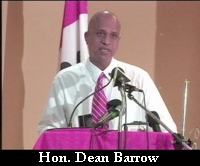
people, as Sedi has said, that will b e obliged to follow the money beyond Hibernia Bank. If the Prime Minister, as he seems to be, is talking about lawyers attempting to sue for the recovery of the money, that is all nonsense. That is exactly what the report has disclosed, that they gave money to people who had no assets. All these companies have now become shell companies so there is never going to be any chance of recovering the money that way.
But just this morning I looked at the money laundering prevention act, the financial intelligence unit act, and the act that brought into force as a part of domestic law the mutual legal assistance treaty between the country and the United States. Under every single one of those legislative instruments, the government can get the authorities in the states to trace the money. The government can get the authorities in the States to freeze the money and the government can get the authorities in this country to institute the sorts of prosecutions that will the entitle the authorities abroad to forfeit the money, to confiscate the money and to repatriate the money to return it to the people of this country and that is what we have to insist that the government of Belize does."
So there is power under the law to follow the money, but is there the will from this man's high office who laid down the mantra.
Glenn Godfrey is scheduled to be Michael Finnegan's guest on Mek Wave and Lik Road tonight at 8 on Channel 7.