
And switching gears from a fire that flattened a foam factory to a giant tourist playground in the middle of the sea that promises to blow up cruise tourism like never before. There are three proposed cruise projects in the Belize District clamoring for the top spot as the Port of choice for the major cruise lines. All of them praise to have berthing facilities - meaning that cruise ships can pull up right alongside the pier and offload their tourists.
But, Port Coral has a distinct advantage and that's because - apart from being on an island - the mega project is just a year away from completion.
And that's because it has been in the making for over a decade - and it got environmental clearance probably as far back as 2007. And that's why developer Mike Feinstein hasn't been wasting time; he figures that if he's the first to build a berthing facility - the cruise lines - which are desperate for one, will jump unto his project.
It's a wild plan - because he still doesn't have a signed deal with any of the major cruise lines - but, when we visited the island today we found out why this project is darn-near UNDENIABLE and may be too big to fail. Courtney Menzies has the story:
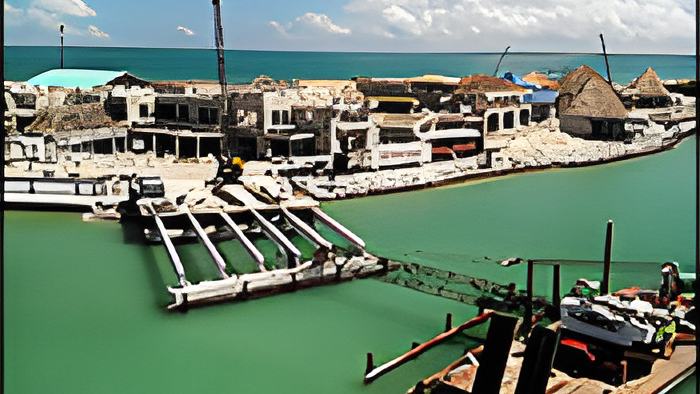
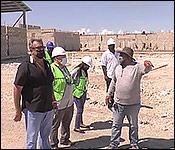
A glance at Stake Bank as is would show you little else other than sand and cement on the 25 acre island.
But Port Coral is shaping up as one of the greatest construction ventures Belize has ever seen, transforming a once desolate mangrove island 7 miles off the mainland - into the ultimate playground for cruise tourists.
And while the numerous restaurant and bar areas, retail rental space, ziplining facilities, and what may be the largest pool in Belize - with a salt water aquarium that has a plane inside built into that pool - is a lot to brag about, and a whole lot going on - indeed the scale is staggering - and, the developers say, not damaging the enviornment:
Caleb Wade, Project Manager, Port Coral
"We have roughly anywhere between 180 to over 310, 320 people working out here every day. Countless pieces of heavy equipment, we have on site over 8 cranes working different projects, quite a number of pieces of heavy equipment, we have the biggest dredge in Belize and we're doing it in an environmentally friendly manner, making sure we don't waste anything at all."
"As we dredge, all the material that we dredge is recovered and used on land in terms of land fill so we don't waste anything at all."
"So far we've dredged over 400-500 thousand cubic yards of material, all that's on the island in terms of landfill, we have a unique dewatering system where we recover heavy material, and we recover sand and light material as well."
And those dredge spoils were used to raise the island ten feet above sea level - making it more resilient to climate change and hurricanes.
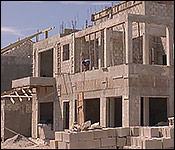
And those enormous cement structures with thick columns are built to withstand a natural disaster, so as to lessen the downtime needed for repairs.
That's a lot of cement - and a lot of equipment to transport to the island.
Caleb Wade, Project Manager, Port Coral
"Cement is more like the backbone of what we're doing here, everything is concrete, no lot of Styrofoam and things, everything is concrete, literally thousands of cement piles, we get a number of loads of cement on a weekly basis and we have our entire batch plant and mixing system out here from medina's that is permanently on the island and that we use every week."
"We have our staging area at mile 5 and from there we load up barges on a daily basis, 6 sometimes 7 days a week, multiple times a day to bring out every single drop of water that use in cement, you'd find it strange we're surrounded by water but we can't use it because of the salinity so every single grain of sand, concrete mix, plaster, structural cement because we use two different kind of cement, structural and we use regular cement for plastering, every single thing is brought in by barge to the island on a daily basis."
Including cement blocks sourced from the prison, made by the inmates. While their operation is slower than what would be needed for a project of this scale, Wade said they've been trying to accommodate the prisoners.
But that's not the only way they've been trying to give back to the community.
Caleb Wade, Project Manager, Port Coral
"Providing employment to all levels of Belizeans especially in the city, in the areas where people struggle to find work and we've partnered with a number of different organizations to do just that and it has turn ed out well for us, we have a great team, a good mix of guys, and as you can see from the speed of what we're building a group of hardworking people who are committed to get it done."
Everything on the island so far was built in a little over a year working through the pandemic.
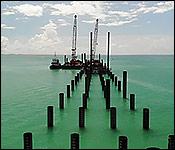
But they've still got a long way to go, and they're aiming to finish the on-land construction mid-2022. What will take more time though is perhaps the most important part of Port Coral - not the three beaches it proposes - but the berthing facilities.
Caleb Wade, Project Manager, Port Coral
"We have two piers under construction, we've started the first one, they're going to be able to handle two ships each at a time where the backbone of those are basically 36 inch in diameter steel piles that are hammered into the ground with 200 ton hammers, hammered down until they reach refusal and then we put concrete material on top of that and that makes it structural, can handle the weight of the ship."
"The draft, we're looking at a little over 11 meters, between 11 and 12 meters is what we're looking at."
Jules Vasquez:
"So we're talking about 35 to 40 feet."
Caleb Wade, Project Manager, Port Coral
"35 to 40 feet, so 37 is the lowest we'll go, shooting for 40."
Jules Vasquez:
"And that can accommodate the largest class of cruise ships tat are currently out there."
Caleb Wade, Project Manager, Port Coral
"Correct, what a lot of people don't realise the ships aren't getting a deeper draft, they're getting wider, they're getting longer, they're getting taller but the draft isn't really increasing at the same ratio."
So these islands are a goldmine for tourism stakeholders, but renting a space won't be cheap. However, Wade added that there will be opportunities for the small tour operators to cash in.
Jules Vasquez:
"Will there be inclusion for the small, local operators to get a piece of this pie."
Caleb Wade, Project Manager, Port Coral
"Most definitely, I can't speak on the details of that as that's not my forte, I'm more in charge of building it but most definitely there will be inclusion."
Stake Bank Island is being built to accommodate 15,000 people at one time - a grand endeavor and a huge undertaking but one that currently does not have an in - writing commercial arrangement with any of the major cruise lines. The plan seems to be - if you build it - they will come. At 82 million US dollars, hopefully it's more than that field of dreams.
Jules Vasquez has been following that project from 2007 - and tomorrow he will offer some historical perspective.