

Belizeans consume more chicken per person than almost any other country in the western hemisphere.
Based on 2021 figures, Belize's poultry industry contributes 123 million dollars annually.
So, in this town, poultry is king - and that's why so many were upset recently when producers increased the price on a 50 pound crate of chicken by 6 cents.
They say that's owing to the cost of labour and infrastructure development.
Jaleeza Roberts went to Spanish Lookout last Friday to see what the development is about:
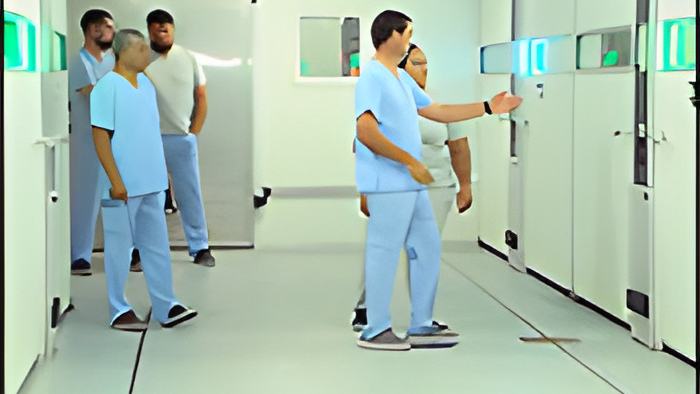
We all know how chicken looks when it reaches our plates, but the process begins long before that, starting at the hatchery level where eggs are incubated in strictly controlled conditions. When visiting the hatchery, it certainly wasn't just a casual walk through. First we had to sanitize: shower, and then don the standard scrubs and footwear. Rare and uncomfortable? Of course for a first timer, but this is what employees must do daily.

Jaleeza Roberts
"Since we're done showering and disinfecting we will now go through the entire factory to see how these go from eggs to chicks to chickens that eventually end up on your table."
General Manager of the Hatchery Edward Dueck explained why the cleansing process is a new health protocol, especially because Belize now hatches breeder chickens instead of importing them:
Edward Dueck, General Manager, Quality Poultry Hatchery
"The reason for us to implement this new change is because we have been bringing in a new breed, bringing in the breed of breeder chicks that we have here now and so we needed to raise the biosecurity levels for that security. Up until now, those birds would've been flown in as live baby chicks day old and so now we're able to implement that hatching here and so for that reason we said it was time to raise the bar."
With newer hatchery systems now in place, they are taking a leap from older infrastructure, and using advanced technology to regulate temperature, humidity, and timing to ensure stronger, more uniform chicks at birth. This early-stage control is critical, because it determines the overall health and growth potential of the birds.

Edward Dueck, General Manager, Quality Poultry Hatchery
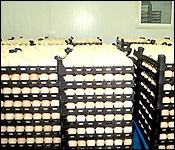
"This is called the traying room, this is where the eggs are received upon arrival they will all come in from the AC controlled trailers, eggs are temperature controlled on the farm during transportation and received into this cold room immediately, so they would have no temperature changed throughout their cycles."
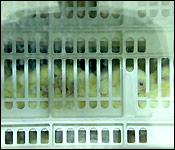
"Next we went into the incubation room which is the eggs are stored in there from 18,19 days and then we just looked into the transfer room where they transfer the eggs from the incubator trolleys to the baskets which Is now we are standing in front of the hatchers and as was witnessed, as is witnessed through this window you see the eggs are in white baskets. The reasons for the baskets is so that the baby chick will, once it hatches it will not be able to jump out but it will stay safe until we pull it out and as you notice it's again, the same program you see on the screen here, we're carefully monitoring the temperature humidity CO2, air flow and eggshell temperature and we're having an electronic gadget in here that will actually monitor activity in the hatcher and communicate the to the computer."
The machinery used is temperature controlled and moves every hour to mimic the motion of a mother hen shifting her eggs around.
And within a 9 hour period on the 21st day, all chicks are hatched with some popping out earlier
Edward Dueck, General Manager, Quality Poultry Hatchery
"We need to reach 21 days full so there's some chicks starting to incubate already and you will see in here, and as you can tell because you have light on they come and migrate towards the front."
And this is when the journey of the chicks begins. Listening closely you hear their peeps as they make their way into the world:
Edward Dueck, General Manager, Quality Poultry Hatchery
"Tomorrow, 6 in the morning, these will be ready to be removed and sorted through. Male, female selected, the first chick you see a little moist feathering right there in the corner."
"Right now there's probably a thousand chicks coming out of these 64,000 eggs that are right here in these three machines, they are starting to incubate."
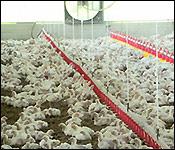
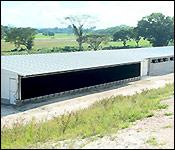
From incubation, chicks are transported to farms, where the industry is undergoing one of its most visible transformations. Traditional open-sided poultry houses, once standard across Belize, are being replaced by fully enclosed, climate-controlled barns. According to Kendall Reimer of Reimer's Feed Mill, these tunnel-ventilated structures maintain stable internal temperatures even during extreme heat, reducing stress on the birds and improving survival rates.

Kendall Reimer, Director, Reimer's Feed Mill
"Things that we're looking at from the equipment side, we're ensuring that we have the right temperature, we have the right environment for the chick, the humidity is not too high, so that the chicks can really be happy, have a happy life, that they're not stressing themselves out with the heat. Like you see right now, temperatures are outside of like 100 Fahrenheit, but inside the barn we're talking about 70, 80 degrees, about a 20 degrees difference right now in the barn. A barn that has already three vehicle checks, those we would see like a 12 degrees difference from outside to inside of the barn."
And in the controlled environment, the birds go from chicks to full sized chickens, suitable for slaughter
Kendall Reimer, Director, Reimer's Feed Mill
"So typically we're aiming for a five pound chicken. However, there's what we call the extra large as well. And so the extra large, they're going to eight pounds, roughly around eight pounds. And those would go up to 49 days. 35 to 49 days is more or less the range. So you'll get a five pound to eight pound to an eight pound chicken."
But these state of the art barns come at a pretty penny - this one cost half a million dollars - but for far greater yield.
Kendall Reimer, Director, Reimer's Feed Mill
"There is a request for more projects like these, but farmers are debating is it worth the investment or not. And we're really, really eagerly looking at what the results will be at the end of the day. A barn project like this, we're talking anywhere, this project here is right around $500,000. is what we're looking at an investment here. It's equal to about $50 per bird. Yes, it is an expensive thing, an expensive project, but we believe it will be worth it, given the environment that the birds will be given. And also, the other thing is what we can do is we can put basically from an open traditional barn to an tunnel climate control barn we can put approximately double the amount of birds per square foot or per square meter in so we can put a lot of more chicken into this barn comparing to an open open sided barn."
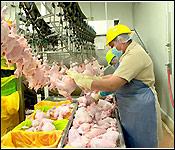
Once birds reach the appropriate weight, they are transported to processing facilities such as Quality Poultry Products, where operations run at industrial scale. General Manager Raymond Barkman explained that chickens are first chilled to strict temperature standards before moving along processing lines. There, each bird is inspected, with any that do not meet quality requirements removed from the system.
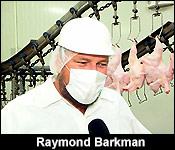
Raymond Barkman, General Manager, Quality Poultry Products
"So what you're just witnessing is the processing plant where we bag, we cut, where the chicken cuts, the leg, the breast, where everything is bagged pretty standard I guess."
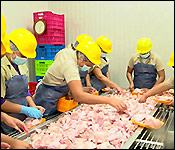
"So when the chicken comes out, it's actually ready at 32. And so, and then it goes through a selection process. If you notice, there was six unloading tables, and then there's also quality control. Any chicken that doesn't look perfect gets taken off the chain and into another department. Then what we do is about half of the chicken gets cut up in parts from the leg, breast, wing. And so that's another department where we saw them cutting it up. There it gets divided separate it and then put in trays or bags to bring it to the retail market."
Reporter
"What's the best selling product that you guys have?"
Raymond Barkman, General Manager, Quality Poultry Products
"The best selling product is still as a whole, the whole chicken, but there is the chicken cuts would be the next big seller. And of course, we can't forget the neck and back."
Reporter
"Really? Talk to us about that, the neck and back factor."
Raymond Barkman, General Manager, Quality Poultry Products
"Well, the neck and back is so good for the soup. I mean, look, I love it as well. So if you want the nice soup, everybody loves neck and back in Belize, right? And that is a big seller."
Maintaining these operations requires a large and specialized workforce. Quality Poultry Products employs over 600 persons nationwide, supported by in-house technicians. In this plant that we visited, there were over 225 employees.
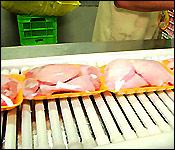
But just like the incubator and the farms where the chickens grow, the company also had to upgrade its packaging to meet consumer expectations:
Raymond Barkman, General Manager, Quality Poultry Products
"Well, see this new packaging machine, we were getting reports that the trays are bloody, that they're sticky or they want to stick to each other. This machine completely seals it off, completely. There's no, the packaging stays clean. It's just like you don't have to dirty up your car anymore. If you buy our package, it stays clean. You don't have to worry about wiping off blood or anything later or anything like that."
And they recently celebrated 50 years of business in Belize but Barkman believes that the poultry industry isn't going anywhere - and on average each Belizean eats about 110 pounds of chicken per year - which is among the highest in the world.
Raymond Barkman, General Manager, Quality Poultry Products
"We all love chicken in Belize. Chicken, I believe, I mean as you know, since 50 years they started from almost nothing to this, as you can see. And I don't see that stopping anytime soon. I believe chicken is worldwide, the chicken markets are growing. Chicken is increasing. Everybody likes more chicken than before. So the future, I believe, looks really good for chicken."
As Belize continues to rely heavily on poultry as a primary source of affordable protein, this drive to modernization hopes to ensure that chicken is going to continue to be what's dinner, and tea on Belizean tables. Jaleeza Roberts, 7 News.
Tomorrow we'll look at the specific factors that led to the recent price increase.