
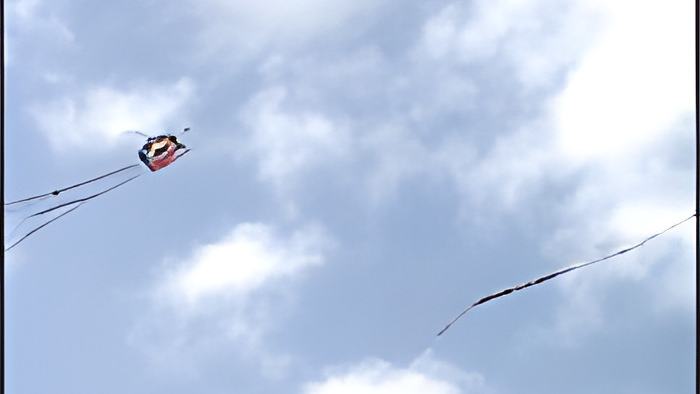
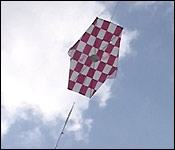
March is kite flying season but the skies are no longer colored with hand made paper kites; you are more likely to find plastic aflutter.
And that's because the art of kite making is getting lost to the era of plasticity and consumerism. Fact is children are no longer taking up kite making and flying as a favored past-time.
So today we went to find the "Kite Master" who still has not lost his touch and passion for making kites or teaching about it. Jomarie Lanza has this story.
As the days grow warmer and the winds pick up during this time of the year, it is also the best weather for flying kites. Years ago it was a popular pastime for the neighborhood kids, foraging for materials to build a kite, and then getting it aloft, up into the blue.
But there aren't many parents or children that still build kites, and many have resorted to just purchasing a kite for their little one from the store.
But there was a time though that kite building was an art of its own. And today we consulted with a kite master, Keith Franklin, who's been building kites for the past 40 years.
Keith Franklin, Kite Maker

"When I was about like 10 years old my dad taught me and my brothers how to make kites. It was a passion from then, back then in primary school we used to have arts and craft and every time kite time would come around this time of the year we started making kites and enjoyed it up until now."
"You know we never bought kites, we always build kites, or tried to build kites before. Back then we used to use coconut straw. We used to use newspaper for those who could not deal with kite paper, sometimes the material was too soft so we would use something stiffer, we would use newspaper. For glue we used to use flour paste, put a little bit of flour with water and put kerosene oil in it so if you have any insects around they don't come and bite it while it is being dried. Yeah or plastic bags we would cut plastic bags and we would use the plastic bag with the coconut straw and do your thing."
"I grew up in the kings park area and we used to go fly kites by barracks where Ramada is now and sometimes we would go by memorial park and here of late a couple of years now between 2020 to now we would go behind Marion Jones where it is open and you could fly your kite."
And even though the interest in kite building is not what it once was years ago, Franklin says that the neighborhood kids still gather at his doorstep whenever they are itching for a kite of their own.
Reporter
"Do you have any little kids who come and ask you to make kites?"
Keith Franklin, Kite Maker
"Well in my neighborhood yes, all the time around this time of the year they would come and sometimes we would go fly the kites that we made, kids come around and then after we fly we just give it to them."
"Since 2021 I think when the pandemic came I think that was the last big kite contest that was to go, I think it was city council that was doing that one and it did not happen and I was a little bit disappointed because I made a kite 21 feet tall so, and it flied, yes it flied. We went to test fly it and it flied so I know I would have probably won for the biggest kite you know so yeah."
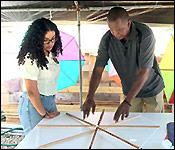
And aside from the feat of putting a 21 foot kite aloft, this passion extends to teaching the art of kite make. He was generous enough to show us how it's done. He guided us from the frame stage, to covering your kite, carefully explaining the do's and don't of the process. And once the kite was finished we hit a critical juncture, the first step in making sure that your Kite can fly.
Keith Franklin, Kite Maker
"The most important part of the kite for it to fly is what you call the loop. There is a thing you call the loop where you put on the string on."
"There are 2 different kinds of loops that we use that I know about, there is a pulling loop and you have mountain loop. Now the reason for the pulling loop is that it will be a little bit smaller but when you Fly your kite the kite will go farther and you will feel more pressure in the pulling of the kite. The mountain loop now your kite will mountain high so you can stand there and your kite will be almost parallel right over your head. That is the mountain loop. It is easier for most people that build bigger kites because if you put on a pulling loop on a very large kite you will need at least 5 or 6 man o fly it but when you put on the mountain loop sometimes you one can hold it because it won't pull, it will just mount over your head so we will make a mountain loop on this one."
"Then the next thing we have to build a loop for the tail because you know a kite can't fly without its tail because it will do what we call a power dive. You will see how it. And with this size of kite you have to have the correct length of tail. You can'T put a tail that is too short or too heavy or maybe even too long because depending on the breeze your kite might not fly."
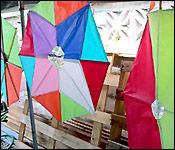
"So these types of kite this round one we call it mooney because it round like the moon so we call it mooney, this one here we call it singer because it has the thing where when the kite fly it buzzes hard, zzzzzzzzz so we call it singer it sings. This one here I really don't know how anyone came up with the name for this one but we call this one coolie kite. I don't know the reason why but from I was a small boy this is what we call "coolie kite." And you can put frills on all of them and string them the same way to fly them."
It's an art steeped in tradition, but also there's something about these sky sailing kites that seems to give us all a lift.