
So far this week we've taken you to a football camp in Lake I and a spiritual camp in Hattieville. Well tonight we will visit another camp and trust us - this one is like no other and it is at a place like no other in Belize. We visited a science camp at the Belize Zoo yesterday and Keith Swift has the story.
Keith Swift Reporting,
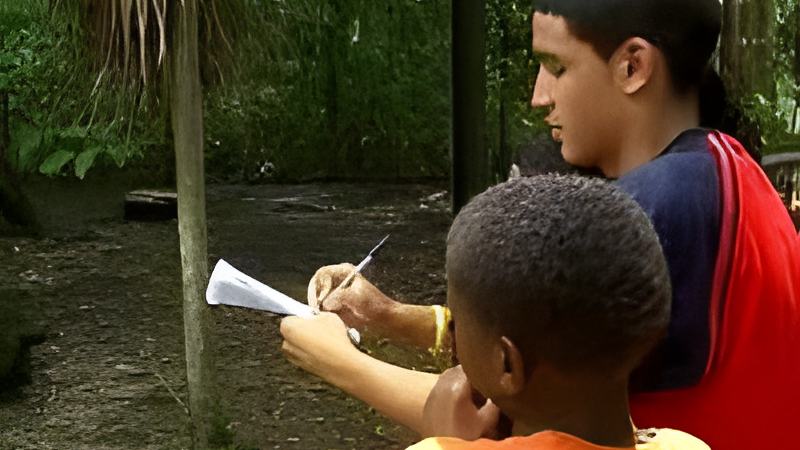
Today we met teenagers at the Belize Zoo staring at spider monkeys, in human to animal bonding with this white tailed deer, and hunting down this elusive spotted jaguar perched in this tree. These teenagers weren't at the zoo as tourists - they played junior scientist for the day.
Celso Poot, Belize Zoo
"Over the course of the last two and a half days, we've had lectures on how scientists think, how they develop questions, we looked at what is a hypothesis, and we looked at the variables that can affect the research. So today they are testing their questions, they are testing their hypothesis."
The groups each chose an animal and then made a hypothesis about its behavior. Shanell Fernandez and her group chose the spider monkey, which they had to sit and watch for 2 hours.
Shannell Fernandez, Participant
"Our hypothesis is that the spider monkeys will move at a faster rate when people are around. So what we are doing is basically just observing. We're tabulating the number of people, the frequency of the people, that come and then we observe the reactions. So far we have noticed that the higher the frequency, the more the monkeys move from one tree to the next."
17-year-old Robert Johnston's group had their eyes on the white tailed deer.
Robert Johnston,
"Our hypothesis is that we are testing that the deer will lift up its tail anytime it gets frightened."
Keith Swift,
And what have you been observing?
Robert Johnston,
"We observed that whenever they bring food, or whenever some tourists come around trying to touch it, it lifts up its tail and it runs about. So our hypothesis is accepted."
It actually wasn't. 11-year-old Chawn Poot and 17-year-old Rosamari Robinson had the enviable task of tracking these two jaguars.
Chawn Poot, Participant
"We say that the black jaguar will move around more than the spotted jaguar which is true because this morning when we came the black jaguar was more active than the spotted jaguar which is in the tree behind us."
Rosamari Robinson.
"Yes John is right, the black jaguar moves around the exit more than the spotted jaguar. As you can see, the spotted jaguar is still sleeping from we came here and the black jaguar moves around the exhibit more."
The experience is surely unlike most other summer camps and at a price tag of 75 dollars for one week it costs more than most. But these participants say it's worth it.
Robert Johnston,
"I love nature and I want to be a scientist and I like science so I want to learn how to keep Belize and the wildlife going strong."
Keith Swift,
Why did you want to be a part of this camp?
Chawn Poot,
"To learn more about conservation and try to help our society."
Rosamari Robinson,
"To learn more about animals because I plan to study biology in the future."
The highlight of the camp was today when they trekked to the Cockscomb Basin Wildlife Sanctuary. This is the fourteenth year of the camp.