
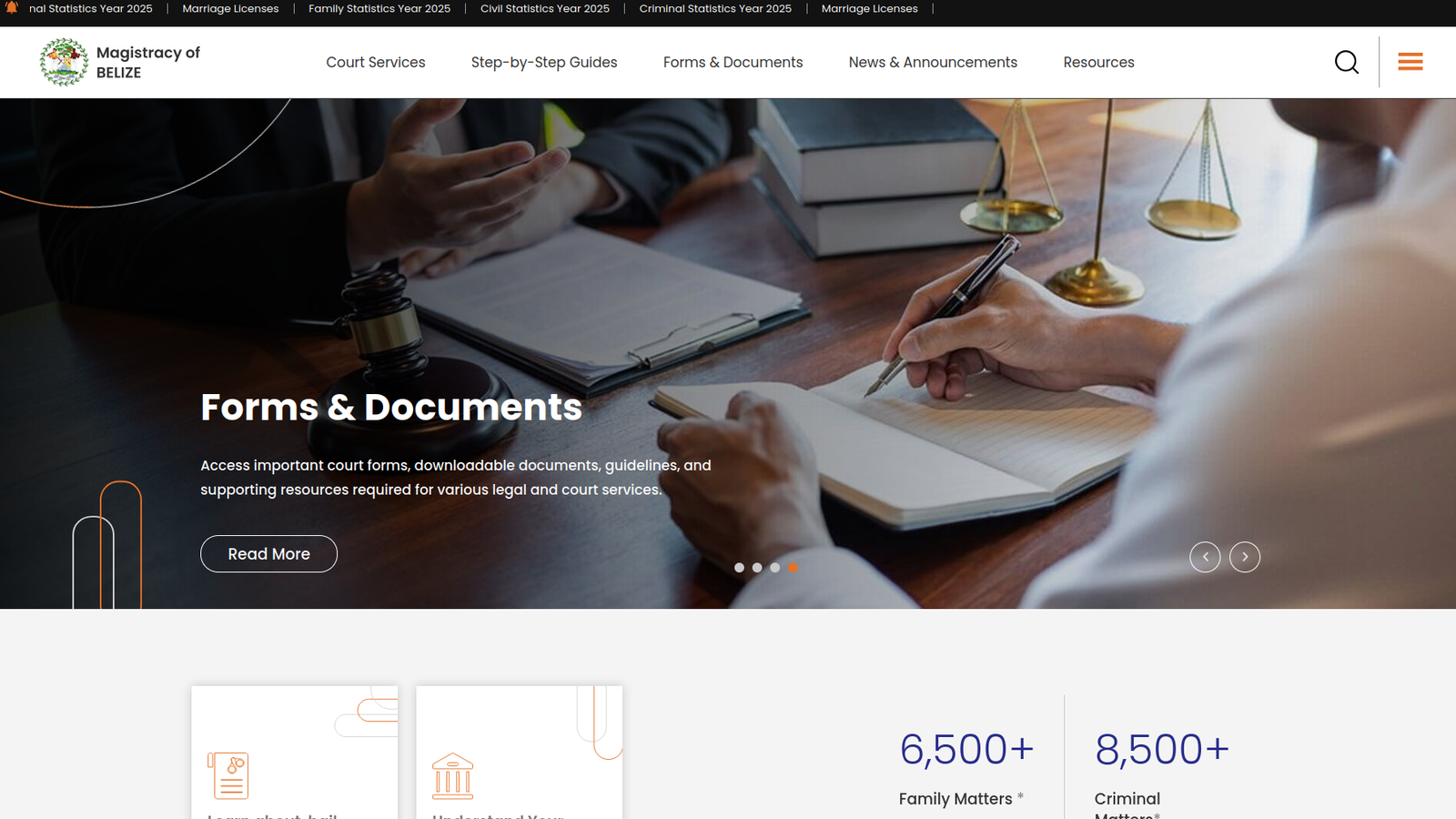
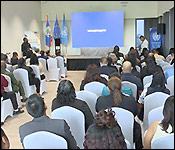
Today, the Magistrate Courts of Belize took a step closer to digitization as they launched their new website. The launch included a full explanation of what it offers and how it can help speed up the process of daily tasks at the magistrate courts throughout the country. Notably, the landmark occasion saw the absence of Belize's Chief Justice Madam Justice Louise Esther Blenman, but saw the attendance of the DPP, Justices of the High Court, the Solicitor General, as well as other legal dignitaries. Jaleeza Roberts attended the ceremony and found out how the courts got closer with the click of a button:
For many Belizeans, dealing with the Magistrate Court has never been as simple as showing up for a hearing. It can mean spending hours on a bus, returning to court for endless adjournments, waiting in long lines, making repeated phone calls that go unanswered, or relying on friends to explain what a summons, bail application or court form actually means.
And for people already navigating an intimidating system, one wrong piece of information can make an already difficult process even harder.
But the Magistrate Court is now trying to change that. A new website is putting court information, forms and practical guidance at the fingertips of Belizeans-an initiative Chief Magistrate Deborah Rogers says is about more than technology; it is about making justice accessible:
Deborah Rogers, Chief Magistrate

"This website is meant to be a tool to assist the public on how to operate when they come to the magistrate court, to have information so that they know exactly what to ask for and get the exact services that they need."
Jaleeza Roberts:
"What specific problems or complaints from the public convinced you that this website was necessary?"
Deborah Rogers:
"One of our biggest criticisms in the magistrates is that we didn't explain things enough to people. And unfortunately, our magistrates and our clerks of court have a high degree of workload. Our dockets are 50 to 100 people a day. The magistrate court is a high-traffic institution. So to meet that need and to give access to that information, we thought that a website would have been the best and most accessible platform. Yes, our staff is still going to be there to be able to assist those who don't have access to internet services or who don't have a computer or printer at home. But for now, we believe that this is a significant step in meeting that demand."
Legal systems can be difficult for regular folks to navigate, and that difficulty can become even greater when information is presented in legal jargon. The European Union, which supported the development of the platform, says the goal is to bring the justice sector closer to the people:
Elizabeth Lanzi Mazzocchini, Programme Officer, European Union

"So what the website does is that it makes it easier for the people living in Belize to be able to get clear guidance, clear information, download the forms on their own and kind of get information, which is in plain, simple language, not legal jargon, because we know that can be really tough in Spanish and English. So it's a great thought."
Reporter:
"How do you feel about the final product?"
Elizabeth Lanzi Mazzocchini:
"I took a look yesterday night when I was preparing to talk today. I think it's really great. I think it's a great start. I found it user friendly, easy to navigate. I like the fact that it's in two languages. Of course, we know there's more languages spoken in Belize, but perhaps that will come gradually. So all in all, ten out of ten."
And Belize is increasingly moving toward digital government services, but the Chief Magistrate says the justice system cannot afford to leave behind the very people it is supposed to serve. Some Belizeans still have limited internet access, others do not own computers or printers. And some still communicate with the court the way they always have, on paper:
Deborah Rogers:
"While more government ministries are moving towards a fully digital platform, we believe in the magistracy that we can never fully go digital. That means that we would disenfranchise the greater majority of people that we serve. So in order to do that, we're taking on a more blended approach. So yes, more services will be available through the platform, but we'll still maintain our paper-based services for those who don't. We still get handwritten correspondence from litigants quite often at the magistrate court. So that is an indication of the demographic that we're serving and the people who need our services."
More times than not, the justice system, especially the Magistrates court intimidates people, but Rogers says they want to change the perception of the courts to the public:
Deborah Rogers:
"We want to break that stigma in how the public operates with the magistrate court, in how we interact. We want to dispel the misconception that the court should be feared. Please approach us, ask us the questions that you have, because we have a duty to respond. We have a duty to assist you all. Many of the perceptions that the general public holds of the magistracy come from our colonial heritage. But in modernizing our court, we also have to appreciate that it needs to be user-friendly. And for the longest time, the magistrate court simply was not user-friendly to the ordinary litigant. So that's what we're trying to change."
A new era for the courts. But will making the system more user-friendly actually improve the delivery of justice? For that, we'll have to wait and see.
Jaleeza Roberts, 7 News.
But the question now arises if the fancy new website will be able to eliminate the backlog completely. In 2025, Belize's Magistrate's Court recorded 15,317 criminal cases submitted and 4,877 disposed of, for a 32% clearance rate, meaning about 68% were not disposed of during the reporting period. The civil caseload showed an even lower clearance rate, with 4,941 cases submitted and just 891 disposed of, or 18%, leaving more than 80% not disposed of during the reporting period.