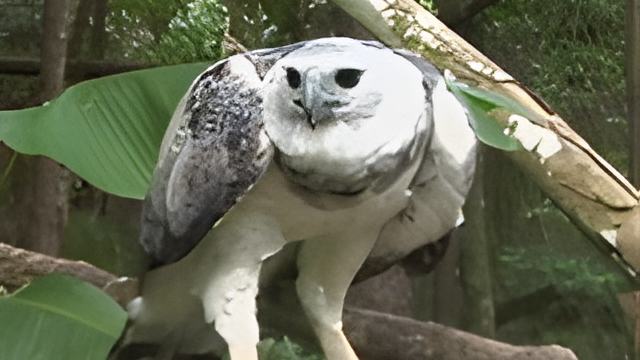
Harpy eagles are one the most awesome birds of prey in the Americas; adult females grow to over three feet tall, weighing as much as 20 pounds, with powerful six and half foot wing-spans that carry them as fast as 40 miles per hour. Add to that talons that compare in size to a grizzly bear's, and you've got one of the most stunning birds on the planet.
Harpy's were once indigenous to Belize and most of Central America. But due to hunting and habitat destruction, Harpy's are now endangered and very rarely spotted in Belize. But thanks to a program spearheaded by the Peregrine Fund, there is an effort to repopulate. Eight Harpy's, that were bred in captivity have been introduced to a familiar habitat in the Rio Bravo Forest Reserve in the Orange Walk District. Alfonso Noble was there today when the eighth bird was released and he has the story.
Angel Muela,
"What they normally do is they come out of the kennel and open their wings and act tough but as soon as she can, she will fly away."
Angel Muela is from the Peregine Fund and is the one responsible for the release of the 8th harpy eagle in the jungles of Belize. At 9 this morning, the 7-year-old female bird of prey was brought into the Rio Bravo Forest and was simply let out of the cage where it had been for the past 24 hours. Within seconds, she was off.
Angel Muela,
"There was another female that we brought from Panama. She has been successfully bred in Panama and was ready to be trans-located to her next home. She was trapped about a month and a half ago and she was brought to Belize as soon as the permits were ready and released. She is now brooding and getting her feathers in placer and hopefully we will see her hunting very soon."
Sharon Matola,
"He was hatched in captivity in 1998 n Panama and the Peregine Fund has determined that the Belize program has exhibited itself to be successful. The people of Belize, the government of Belize, and the forests of Belize are all looking very happily oriented to providing a future home for these birds. So they are moving them up here where they once lived but they haven't been documented for years."
And because the eagle has not been documented in the country for years, the Peregine Fund along with the Belize Zoo and Program for Belize have been working on re-populate the Rio Bravo Area with this raptor.
Sharon Matola,
"This program is a world model, not just for the region but other biologists are looking at it as how to setup a major raptor for the restoration program."
This latest bird to be released had been bred in captivity in Panama and had been roaming wild in that country but the conditions there are not as good as they are in Belize, so it was thought best to bring the bird here as her permanent home.
And while we do have them, all 8 birds that are flying the skies over the Rio Bravo Conservation Area have been introduced. Now the hope is that sometime very soon there will be a locally bred population, the products of breeding between that birds that have been brought here.
The released was timed to coincide with the visit of celebrated wildlife artist John Ruthven. Ruthven has donated a print of one of his works to the Belize Zoo.