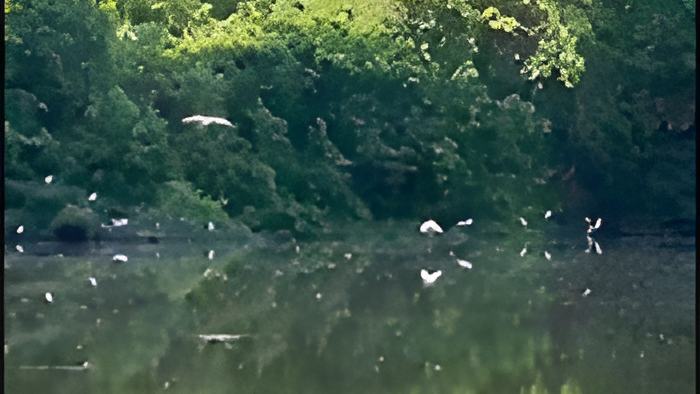
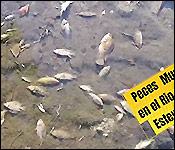
Tonight, the Department of the Environment is investigating another fish kill in sections of the New River in the Orange Walk District. It's gotten so bad that the stench of decaying fish has been wafting into the town as well.
So what's causing it and who's to blame? Today, the Chief Environmental Officer Anthony Mai told us that the fish kill appears to be linked to extremely low levels of dissolved oxygen in the river.
Anthony Mai, Chief Environmental Officer - DOE

"The Department of Environment has been responding to fish kills in that particular area for many years. We, responded to this fish kill and we have collected data. So we have a fair enough idea of what have, what's the possible cause."
"And as you know, in 2019, the river underwent the a state of eutrophication which degraded the water quality, and the ecosystem. The bad level. In fact, you know, it was all over the news. Everyone knows about that particular incident. And, since then. So we have been doing work before that. But since then, we've ramped up the monitoring, and activities within the particular watershed. So we have done a significant amount of activities to reduce the trips and pressures today that are in the river. And so we went out on, Monday, March 16th, and we collected data and data that we have shows that the dissolved oxygen from the Toll bridge all the way to San Estevan and three miles past San Estevan, the dissolved oxygen where it was was extremely low in all the different sites that we sampled. So the way we conduct our sampling is we, we collect sampling in terms of the column, the water column. So we take measurements, at the surface by feet and at ten feet. And then we also do the left and right side of the river. So we do that for each site. And we have that sampling site at the toll bridge. We had one, what we an era we call by maracas, we call Lamanai River tours. We had one in front of L&R's liquor, one in front of BSI's, Belcogen discharge. Sorry. Back against discharge. One in front of discharge. We had one in the middle of our. It dropped down one by seven. Bridge, one in trail form, one in San Esteban, and then the final one three miles downstream from San Estevan And from our samplings that we did an early test. We could observe that the dissolved oxygen, was extremely low. We have data to show that the dissolved oxygen, for example, in the middle of our drop down was around 2.54mg/l. Right. And so from an ecological standpoint, in the aquatic ecosystem become stress when it dissolved oxygen is that three micrograms per liter and below."
The Department of the Environment said the issue was first reported around March 10 and appears to have persisted for roughly a week before conditions began showing signs of improvement. The department also recorded elevated levels of chlorophyll, indicating increased algae growth. Excess algae can consume large amounts of oxygen in the water. When asked if the dry season will cause this issue to continue and potentially worsen, Mai said he just cannot confirm that as yet.
Anthony Mai, Chief Environmental Officer - DOE
"So we believe that the, the high level of well, again, the growing levels of, algae at the lower end of the river, may have depleted some of the water causing the fish kill."
"It's difficult to say because, again, nature equalizes itself, slowly over time. Right. What I could tell you is that we have had significant intervention in terms of the type of, the source of pollution that goes into the river. Right? So from a pollution, management standpoint, we have a record of the point source of discharge and non-point sources of discharge.So the non-point sources of discharge are difficult to identify and measure because, the pollution is diffused into the aquatic ecosystem. So in terms of new river for upstream for marine drop, there's a lot of agricultural activities. And the farmers for that they use nitrates and phosphates or fertilizers. And the fertilizers when it rains, rushes into the river, right, and gets into the river. So it's difficult to measure and pinpoint. Exactly where and how it is, is entering into the water for the ecosystem."
"And so with the dry season upon us, can we expect that this will worsen? Like I said, it's it's it's a possibility. And it's difficult to say because what we have observed is that since 2019, when it was at its worst point, the river has been rebounding. Right. So we see the fish kills being, less frequent and less intense. So this picture was not as bad as some of the issues that we had to deal with in the past. Right. That means and suggest us that the river is slowly coming back to equilibrium, coming back to a level where it could at least remain or maintain some level of healthiness."
The Department of the Environment will continue monitoring the river and analyzing samples to better understand the conditions that led to the latest fish kill.