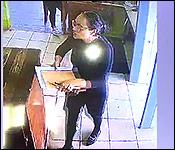
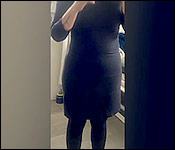
Yesterday we told you about Attorney Leslie Mendez's complaint against the authorities at the Belize Central Prison. Just over a month ago, she was denied entry into the prison to see her clients because of her attire. Prior to being sent away, though, the prison officers asked to check her documents, which is protected under attorney client privileged confidentiality.
Mendez said she mulled over it for a month, deciding whether it was a battle worth taking on. But even after all this time, the humiliation and frustration has not dissipated, and she took the matter to the High Court - which told her to make a formal application.
She spoke with us today, and Courtney Menzies has that story.
This was the attire attorney Leslie Mendez was wearing on May 1st when she went to visit several clients at the Belize Central Prison. It was a long sleeved, knee length dress under which she wore dark stockings.
But despite being almost fully covered, she was not allowed into the prison - they say her dress was too short. So, her clients were made to wait before meeting with their attorney. Instead she was turned away and forced to change.
Today she explained that the concerns were brought up only after she refused to show the officers her documents.
Leslie Mendez, Attorney

"I have serious concerns about the fact that I am being, that prison guards are asking to inspect my documents that are subject to attorney-client privilege."
"I have serious concerns that in almost in response to that, issues were raised about my attire. And in fact, it was the basis, it was that reason why I was denied access to my clients on that day. I think what is important to understand, bringing up an issue like that in a space like the prison, when I am there in my professional capacity and telling me that my dress is too short, is something that immediately changes everybody's eyes on me."
"And I immediately feel almost inappropriate and almost sinful, right? Because the implication is sort of that you've been, you're dressing provocatively. And so you can't access the clients. And that is, to be quite frank, that's a humiliating experience."
"I do not believe that I was dressed inappropriately, even if I was dressed inappropriately on that occasion. I thought that a warning would have been sufficient. And I thought that some support for me to access my client, if it is that there was a serious security concern, if it was that perhaps the prisoner sometimes behaving appropriately at the sight of an inappropriately dressed woman. That perhaps some support for me then, for me to be able to still have access to my clients on that day."
And she feels she's being victimized because of the cases she is currently involved in.
Leslie Mendez, Attorney
"There was a decision that was made to ensure that that specific rule is very much imposed and strictly imposed on that day and that does cause me some concern, especially in the context when I have currently five matters representing inmates against the parole board."
Reporter
"Mr. Murillo has said that there is no way that the prison guards and prison officers would have known about your cases in front of the parole board and that he always sits as an ex officio member. So it would have no bearing. He says the two things are completely separate."
Leslie Mendez, Attorney
"Right. And he's free to say that. All that I can say is that when I was there, at least what the prison guards represented to me is that they attempted to reach out to him to see if I will be able to get access."
"He says he saw the cameras and that I was in fact inappropriately dress and I don't have, and I can't have access to my clients. I think the point is as well is that the optics, even if that's not the case, I can't go into Mr. Murillo's mind and try to figure out. The context is one where he himself made a decision to deny me access to my clients. The optics is absolutely bad. When I have six applications where I'm challenging parole board decisions, decisions that are not usually challenged by the way."
And she emphasized that while there are rules, she says they must be applied reasonably. And in this case, she feels that apart from victimizing her, the prison authorities also denied her clients their rights.
Leslie Mendez, Attorney
"It feels, yes, villainizing. I don't think that the intent was to villainize, right? But that's how it feels because who, who bear the consequences of that? Who was denied access? Who had to drive all the way back to Belize City to come and change like, like a high school student, right? To gain access to her clients. It feels that way. Certainly it feels that way. And my point is, again, rules should still be applied reasonably in its context. It's not something that they have had a concern with me before."
"And so I think, again, I think that a warning would have sufficed. Again, I don't believe that I was inappropriately dressed because I had on the black stockings. This is exactly the reason why I was also hesitant to even raise this issue because then it becomes a question of was she inappropriate dress or was she an appropriate address?"
"When the question is, what really should justify prison authorities denying access to their legal representatives, denying the inmates access to their legal representatives? What really should justify something like that?"
"And a dress code might, but again, a dress code needs to be applied in a very reasonable manner in the context in which we are working."
Mendez's position gained support today when the Bar Association issued a release saying that, quote, "While the Bar Association cannot take a position regarding the details of the complaint, it is important for us to state that it would be gravely concerning if the Belize Central Prison, or any of its employees, used underhanded and veiled tactics to undermine the legal rights of incarcerated prisoners, especially their right to speak with their legal representatives. The rules of the Belize Central Prison are not to be used to humiliate legal representatives or to detract from meaningful representation of those incarcerated. The Bar Association hopes that the Belize Central Prison will properly address the complaint of Ms. Mendez so that there is no recurrence of this or any similar incidents." End quote.
For his part the CEO of the prison Virgilio Murillo has declined to get into the back and forth - he simply says the prison has requirements for outfits worn by visitors - which are known by Mendez and have never been an issue in her many years of visiting clients at the prison.