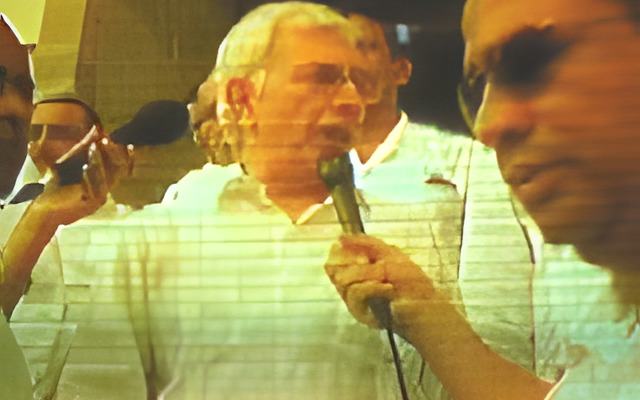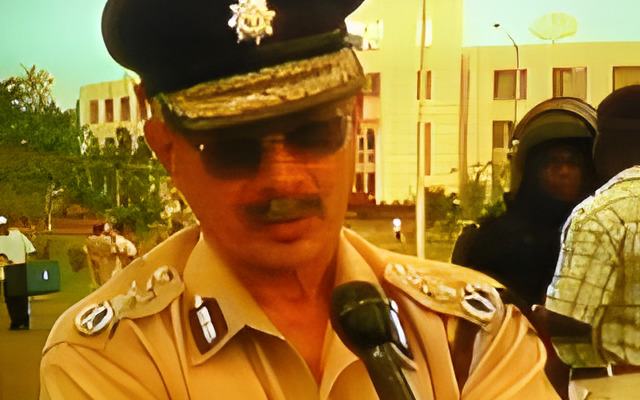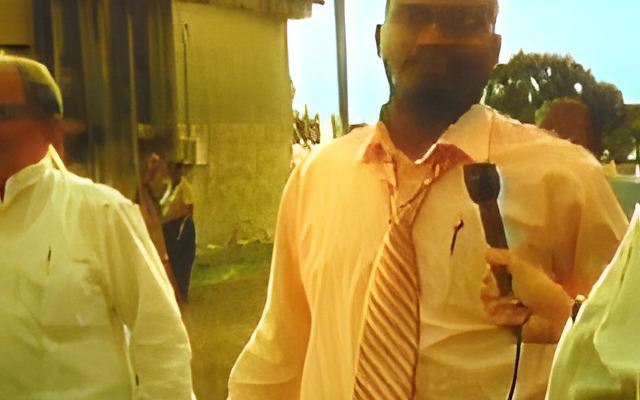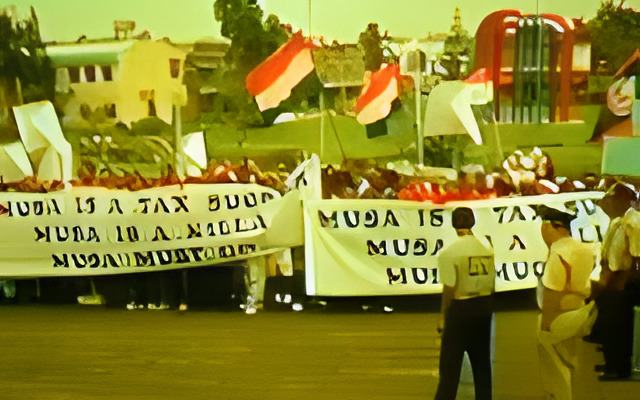

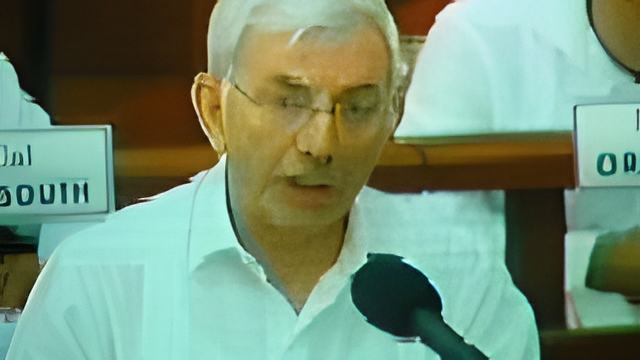
Beset by controversy and foreboding, it has been the most widely anticipated budget in the Musa administration's 6 years in office and apparently, it will be the most unpopular. Most importantly the budget raises taxes and defers the payment of a promised raise of pay for public servants. And while that was the action inside, outside chaos prevailed for a good part of the morning as the Opposition bussed in a crowd estimated at 750 supporters.
We'll have coverage of all the action and activity both inside and outside the House, but we begin first with the budget speech and the two main areas of contention: the raise for public servants and the increase in taxes. We start with the raise, where the Prime Minister made it clear that the IMF recommended retrenchment but his Cabinet chose instead to bite the bullet and keep the workers, but hold off on the raise.
Said Musa, Prime Minister
"Since signing the Collective Bargaining Agreement with the public officers and teachers in February of 2003, we have honored our commitment to raise the salaries of junior and senior public officers by 5% and 8%, respectively. We have thus raised public officers' salaries as well as the amounts paid to pensioners twice in two successive years, which cost the public purse many millions of dollars. We intend to honor the final increase under this agreement, but we ask the unions to join the national effort of working to reduce the fiscal deficit and focus the resources on the priorities of health, education and poverty elimination."
"We think this is a very reasonable request considering the benefits that have been enjoyed over the past six years. After consultation with the respective Unions, therefore, we propose that the agreed increases in salaries for all public officers, and the increases for pensioners, be staggered over the next 3 years beginning July 2005."
On the matter of new taxes, the budget estimates show that government hopes to collect $91 million more in taxes going from $410 million to $501 million in tax revenue. That's an increase of 22% in just tax revenue, but according to the Prime Minister it is distributed to those sectors that can most afford it.
Said Musa,
"But it is wishful thinking to believe, as some of our social partners argue, that merely improving our collections on current taxes would close the finance gap. Regrettable as it is, and as much as it goes against the grain of a PUP government that is noted for having significantly reduced taxes over the past six years, we have to face the hard reality: new revenue measures are necessary."
Dean Barrow, Opposition Leader
"...You are trying to padlock us. You are talking now about raising revenue measures and increasing taxes without even giving people outside a chance to hear. The loudspeakers that are normally there you have removed. We are not going to tolerate this."
[Opposition members stand up and walk out of House Chamber.]
Prime Minister continues...
"For this very reason we are proposing an increase in various business taxes. These are taxes that should be absorbed by business people and not passed on to the consumer and the relevant government agencies and activists will, I am sure, be vigilant to ensure that this is the case and that they will expose any attempt to pass this tax on to the unsuspecting consumer."
"We therefore propose to raise: trade and other business taxes that are presently at 0.75%, 1.25% and 1.5%, to 1.75 %, except for radio, television and newspapers, for which there will be no tax increase; business tax on professionals, from 4% to 6%; business tax on banks under the Banks and Financial Institutions Act, from 10% to 15%; business tax on Banks in PIC groups of companies to 8%; business tax on real estate agents from 4% to 15% on their commissions; business tax on gross casino earnings from 4% to 15%. However, in order to protect small and medium enterprises, we propose to raise the threshold for businesses taxable under business tax from $54,000 to $75,000. Business that gross $75,000 or less shall no longer be required to pay business tax. Small businesses provide significant employment, and encouraging small businesses to be established and to grow is a key aspect of our struggle against poverty."
"We also propose to increase the environmental tax from 1% to 3%, and to increase the environment tax on vehicles over 4 cylinders to 5%, with a view to reducing the number of gas?guzzling and polluting vehicles such as the ubiquitous SUVs. The Environmental Tax does not apply to locally produced goods and has several exceptions for basic items. We propose to triple the tax on firearms, except for shotguns used by farmers."
"And then, finally, there are what are popularly known as the "sin taxes". We propose to double the excise on alcohol from $30 to $60 per gallon, to increase the excise on tobacco from $4 to $12 per carton, to double the excise on soft drinks, and to increase the excise on beer by 100%, from $1.80 to $3.60 per gallon."
"Yes, we have had to propose new revenue measures, but we have been effective in reducing the amounts we needed to raise by sharply reducing government expenditure, and we have chosen the measures carefully to ensure that those best able to pay, bear a fair share of the burden, while avoiding undue hardship to public officers, teachers, and the working class. That is the PUP way. For those of us in leadership positions, painful lessons have been learnt. The road ahead is hard, and we are under no illusions about that."
In the nearly hour long budget presentation, those were the two main points.