

Last week you heard Belize Natural Energy Directors Susan Morrice and Sheila McCaffrey just go off on government and its proposed 40% income tax on oil companies. According to the Irish-women who are at the helm of the first company to find oil in Belize, government is killing the goose that lays the golden eggs. Well today, the petroleum experts at the Ministry of Natural Resources held a press conference to say that those golden eggs are for Belize and if the goose wants to leave them behind...then haul!
Ismael Fabro, CEO - Ministry of Natural Resources
"With respect to BNE's threat, we believe that was said more in haste in terms of their sprits not being in agreement with the increase in taxes. I don't believe that they will follow up on that."
Andre Cho, Director of Petroleum
"To add to what Mr. Fabro said, if they leave we will tell them, 'thank you.' And an option will be for the government to hire a services company, as a services contractor, to produce the field for us for a percentage."
And that's the kind of self-assured hard line the Ministry of Natural Resources came out with today. CEO Ismael Fabro, oil consultant Dr. Ramanathan Ramanathan, Chief Environment Officer Martin Allegria and Director of Petroleum Andre Cho made it clear that it may be a small oil field, but it is precious to Belizeans.
Ismael Fabro,
"Imagine, since this find BNE has already exported 344,000 barrels of

oil and sold 24,000 barrels locally. That amounts to somewhere around US$19 million. Just think of what the future of this industry could look like.
Today we believe that in the Spanish Lookout area, for example, that there is a potential ten million barrel field. This is not a lot of oil in the big scheme of things but it is a non-renewable resource that if properly managed and extracted can yield US$700 million. We must ensure that we gain an equitable share of the profits from this field, bearing in mind that for every barrel we produce from the ground, there is no replacement."
And to get that, Belize must get 50% of the gross as realized through the production sharing agreement and a 40% income tax which, a table showed compares favorably to other countries.
Ismael Fabro,
"Another accusation was that somehow the tax involved was, and I quote, killing the goose before the egg is hatched or that we risk chopping off the leg of this infant, before it even started to walk. Well our responsibility is to ensure that the Belizean people are given a fair share for this obviously valuable resource.
But even with this in mind we are far from executing geese or amputating legs. In fact in the presentation by Dr. Ram, you will see just the opposite. Instead we will show that compared to others in the industry, Belize is being more than fair in this proposed tax."
Dr. Ramanathan Ramanathan, Oil Consultant
"We hear that the proposed increase from 25% to 40% would kill the exploration
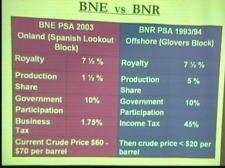
in Belize and terminate all the activities in Belize. This is most surprising."
Surprising because in 1993 a company Belize Natural Resources, with pretty much the same partners as BNE, agreed to a less advantageous agreement when oil was selling for a much cheaper price.
Dr. Ramanathan Ramanathan
"The BNR took the production sharing agreement, PSA, under much higher fiscal terms and that too for an offshore bloc when oil prices were lower than $20 a barrel."
Now oil is selling for more than three times that price, and surprising to Dr. Ram, Belize Natural Energy is bawling on hard times and, in his understated way, Dr. Ram made it clear that he just doesn't buy it. He turned to BNE's most recent allegation that government will get an unfair 64% take with the new tax.
Dr. Ramanathan Ramanathan,
"The conclusion drawn was that 40% tax rate was too high, that the company cannot operate with its only 36% take."
But when broken down to real working figures that 36% just doesn't add up to Dr. Ram.
Dr. Ramanathan Ramanathan,
"So for one year, at the present rate of 2,800 barrels per day production, there will be a total production of about one million barrels valued at $70 million. Out of this the government will get $13.57 million at the tax rate of 25%. Since it is a 50/50 split according to the company, the contractor will also get more or less the same amount that is $13.57 million. The remaining is the cost. How much? $42.86 million. In other words to get a profit of $27.14 million, the cost will be $42.86 million. In this oil business, that is over 60% of the value of the crude produced. This is very high and very unusual in the industry's practice for a field, an exploration bloc, like Spanish Lookout."
Very high for Spanish Lookout because exploration there is a
Andre Cho,
"To give you a metaphor, it is a piece of cake. It is ready made."
And what is the cost to produce on barrel of oil in an area as accessible and connected as Spanish Lookout.
Dr. Ramanathan Ramanathan,
"This cost also was projected by the company before the start of the project. They have said that it is about $3 to $5 per barrel towards this cost. Once the development costs are completed, the production cost per barrel might

even be less in the range of $2 to $3 per barrel. This again, I am not saying, one of the directors of the BNE has confirmed it recently. That is the cost of the easy accessibility of the terrain."
And because production cost is so low, there's no reason the cost needed for development should be as high as BNE states it will be and Dr. Ram used BNE's own statements to illustrate this.
Dr. Ramanathan Ramanathan,
"Since the field is already having a cash flow, revenue generation will be sufficient to take care of the field development. This, I must say, the company has said it before starting the project."
So how much is actually needed?
Dr. Ramanathan Ramanathan,
"For a block of this size, and with all the available geological and geophysical information, minimum of fifteen to sixteen million dollars may be required."
And according to Dr. Ram, government should not have to pay for an aggressive exploration programme.
Dr. Ramanathan Ramanathan,
"The government 'take' percentages are directly proportional to the costs of operations. There is absolutely nothing wrong if a company wants to be aggressive in its exploration policy and invest more money to find more oil but it should not be at the cost of the government."
And while much of the talk right now is about the accounting, the bottom line is the money, and according to Fabro, since January, Belize Natural Energy has seen a lot of it by exporting 344,000 barrels of light sweet crude which has earned BNE US$19.6 million. Of that nearly US$20 million, how much has gone to government coffers? Well, only US$300,000. That was paid at the end of the first quarter, and the payment for the second quarter was due at the end of June.
As we understand it, the payments are delayed by the ongoing technical reviews of the figures. Government's full, final and formal position is expected to be finalized when the petroleum economist Cleavon Lewis comes back from Trinidad next week. One of the points of contention is expected to be the transport cost of one barrel of oil which BNE has fixed at US$18 a barrel, a figure which government believes is overstated.