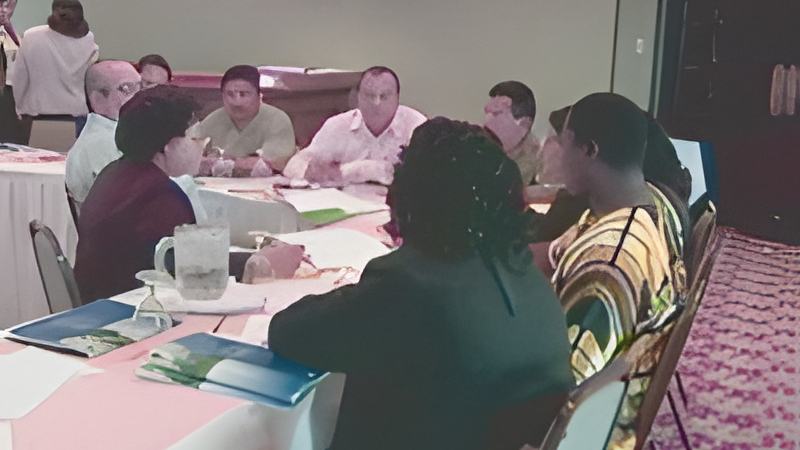
If we were to look at HIV/Aids trends over the years we are sure to find out that this scourge is here to stay. Because of this those at the frontline have to always keep strategizing and re-strategizing to come up with ways of successfully combating the disease. Now the strategy is aiming lower, a lot lower that the traditional marks. They are looking at children, from the youngest ages that are enrolled in school. Today the Ministry of Education held a workshop at seeing how they will hit their target audience.
Alfonso Noble Reporting,
Senior Ministry of Education personnel including the Minister Francis Fonseca were today involved in a one-day workshop that is expected to plot the course of HIV and Aids education in the classrooms. Michael Morrissey the senior consultant for UNESCO office in the Caribbean says that this workshop crucial.
Michael Morrissey,
"Originally when the Aids epidemic began it was viewed as a short term emergency and what we've come to realize now is that its going to be with us for a very long time, many decades, maybe even a century ahead and so the role of the education sector is critically important so that we can sustain the education of young people right from early childhood thru to university in both prevention and reduction of stigma and discrimination."
Hon. Francis Fonseca,
"We know that many of our students, many of our teachers, are impacted, their lives are affected by what's happening with HIV and Aids. So we have to be really clear as to our role and what we have to do at the Ministry of Education to support these students, to support these teachers, and to provide an opportunity, using the school system, the education system, to provide accurate information about HIV and Aids, to dispel some of the myths, some of the misinformation that is out there on HIV and Aids."
But when it comes to HIV and Aids and the manner in which information is passed on to students both Fonseca and Morrissey agree that it is going to be a challenging process.
Hon. Francis Fonseca,
"Very upfront we have to accept that it's going to be very challenging. We have a church state system of education in our country which we respect and which we believe has served our country well. So we have to have a very clear message: yes we have to talk to our students and our children about abstinence, very important, but we also have to speak to them very importantly about responsibility and making the right choices. We can't ignore the fact, the statistics are clear, the data is accurate, that our children at very young ages are engaged in sexual intercourse. We can't simply ignore that fact. That is the reality."
Michael Morrissey,
"It's a big change for teachers really, if you're thinking of teachers as the main transmitters and values and skills and knowledge. Teachers, as parents, just like parents being a bit nervous about talking to children about these issues. But now it's a matter of life or death. Its not merely a matter of morals or early pregnancy, its now a matter of life and not life."
Hon. Francis Fonseca,
"In education what we have to do is focus on our curriculum in the schools but we have to do it in a manner that's very inclusive. We have a comprehensive discussion with all the stakeholders in education. One of the critical issues of course that faces our young people, students and teachers, who have been impacted by HIV and Aids is discrimination. So we have to implement a policy in all our schools, throughout the education system, of zero tolerance to discrimination against our students and teachers. As we have to ensure that we provide services, support services to the students and teachers. Counseling in particular is very important."
Because of that Fonseca says that the ministry of education is already working at ways in which the HIV and Aids education will be introduced into the classrooms.
Michael Morrissey,
"There has been teaching in Belize through the healthy lifestyles curriculum and through the health and family life education curriculum, in some schools, in some classes. But that has been slow in developing, slow in getting off the ground. What this retreat today, the Minister called and we supported, is really a wakeup call for all his officers, his Chief Executive Officer, his Chief Education Officer, and all the divisional officers that its really a critical business for the Ministry of Education to ensure that this is taking place."
Hon. Francis Fonseca,
"In the curriculum we've introduced what we call the health and family life education program as part of the curriculum. That has started already and so we are working on that through the QUADS Unit of the Minister of Education. But we recognize that the next step really is to go out there and educate and inform and sensitize the teachers, the students, and very importantly the managers of the education system, the administrators of the education system."
Michael Morrissey,
"Over the next year to three years I expect things to be happening much more at the classroom level."
Hon. Francis Fonseca,
"What we are doing is putting in place a health and family life education program. As a component of that family life and health education program we will talk abut HIV and Aids education. So it's already there in the curriculum, healthy lifestyles is already built into the curriculum. We're teaching our kids about healthy lifestyles. As a part of that curriculum they are learning abut HIV/Aids, the impact it is having on our society, and as I said with the new HFLE program that we are implementing, that will go into greater detail about HIV/Aids, how it is contracted, and how you can make the right choices to avoid getting that disease."
The workshop concludes today.
7NEWS produced for broadcast by News Director Jules Vasquez
Edited and Prepared for the internet by Keith Swift