
The National Climate Change Office is preparing to attend the 26th United Nations Climate Change Conference of Parties. That summit is also known as the COP26, and it is supposed to bring the world's nations together to discuss the acceleration of the 2016 Paris Agreement. That's the conference where 196 states agreed to collectively take steps to mitigate against climate change by reducing the global average temperature to well below 2 °Celsius.
It is believed that if the nation-states can achieve that goal, then the devastating impacts of climate change will be significantly reduced. It's a problem that Belizeans became very acquainted with over the last 2 years. There was a severe drought in 2019, and then massive flooding caused multiple major hurricanes last year.
And so, the National Climate Change Office is getting ready to make meaningful contributions to COP26, which will be held later this year in Glasgow, Scotland. Today, the Chief Climate Change Officer granted the press a teleconference interview to discuss the ongoing effects of climate change in Belize, which includes persistent soil erosion of the country's coastal communities. Here's what he had to say on the topic:
Dr. Lennox Gladden - Chief Climate Change Officer
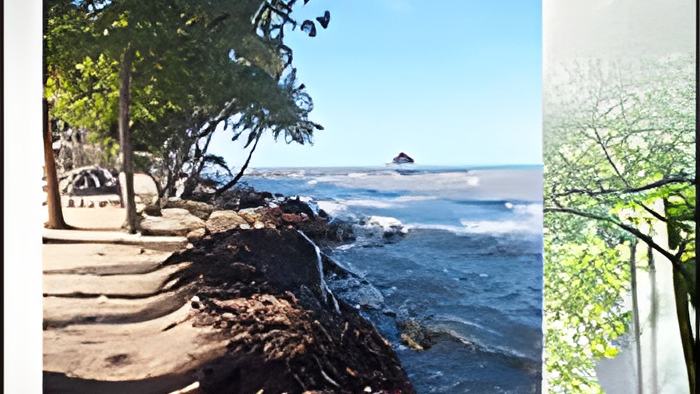
"Our reality, this is what is happening in the southern part of the country, where you see, of course, some coastal erosion, and later on in our discussion, please remind me, in case I miss sharing some of the important pilot initiatives, that we're currently embarking on to combat some of the effects that we're seeing here. How are we addressing? Well, they're 2 guiding documents, when it comes to addressing the challenge we're facing, as it relates to climate change. As I mentioned before, there's our national policy, and the National Determined Contributions. The National Determine Contributions, or the NDCs, as you see from the brief description from the bottom, it embodies the efforts by each country to reduce nationals emissions, and of course, adapt to the impacts of climate change."

"Belize, of course, is a member of the Alliance of Small Island States. So, as a negotiating body, we negotiate under them. But, nationally, we still have what I consider our positions, in this case, especially if we're looking at the Conference of the Parties, this one coming up in November in particular, right, our key focus national is, of course, climate finance. But, if we're looking at climate finance, we also have to factor in a certain level of accountability and transparency. So, as an authority, we're taking the necessary steps in the development of a national maritime reporting and verification system because this is a requirement when we're looking at overall accountability. We need, of course, to measure, and without measuring, or if you've never measured, it's difficult to manage. So, of the key thematic areas that we will be looking at, going into this year's COP, apart from - well it's climate finance and also technology. We can't forget the science because even when you make a comparison between the current pandemic and climate change, that was something that was highlighted in one of our original discussions, to say that it is a data-driven - it's a science-driven occurrence."
We also asked Dr. Gladden about ongoing initiatives in Belize to mitigate and hopefully reverse the impacts of coastal erosion. Back in 2017, our news team took you to Southern Belize, where residents had lost valuable land and seafront properties, swallowed by the sea. Dr. Gladden told us that at this time, there are projects that are planned for Hopkins and Dangriga:
Dr. Lennox Gladden - Chief Climate Change Officer
"Currently, in collaboration with the Coastal Zone Management Authority, and of course other stakeholders, we've formulated and put forth a project proposal to the Adaptation Fund, and through this proposal, it's a coastal protection proposal focusing on Dangriga and Hopkins. And it should be a significant investment to slow down some of the effects of the coastal erosion that you saw in the images that I shared earlier. Another initiative that is currently ongoing [is] we're working along with the Belize Association of Planner is to look at some of the social implications within these areas. So, yes, we are taking some of the necessary steps to mitigate some of the impacts that are happening. As I said, this is only a portion of the country that we'll be focusing on. I know they're other projects that have already targeted other portions of the country. But, as an office, these are the two localities that we'll be focusing on to try and of course reduce some of the impacts that I showed earlier."