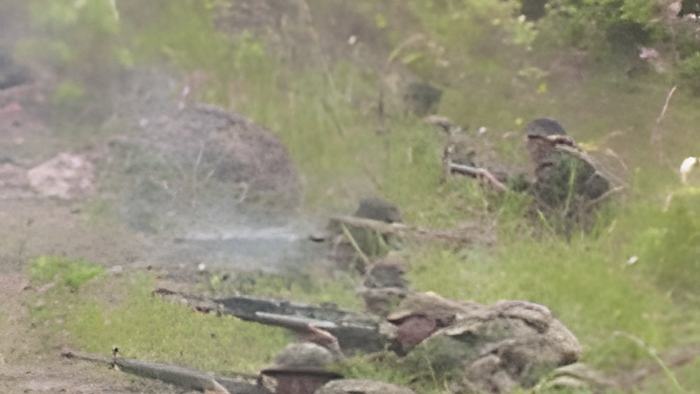
Guatemalan soldiers are training in Belize's jungles. It's not an encroachment; they are invited guests of the BDF who are giving them the opportunity to learn jungle warfare from the local experts. If it sounds slightly strange to you, that's the same way it sounded to us, and videographer Lewis Munoz went to the Las Cuevas area in Mountain Pine Ridge to see if "kaibiles" are now "camaradas."
Jules Vasquez Reporting,
It may look like a real firefight but this is just training, for 21 soldiers from 5 nations. The soldiers are from Germany, Canada, Barbados, Jamaica and Guatemala, and they are here to learn about jungle warfare. But if you're wondering what Guatemalan soldiers are doing learning about warfare in Belize, so were we.
2nd Lt. Juan Gonzalez, Guatemala
"We don't get to train much in the jungle. Every now and again we do training so there are things here, for example to live off the jungle, things that we don't normally apply. It helps us a lot."
Lt. Ruben Tewes, Guatemala
"Our training and the Belize Defense Force training is pretty much the same. However there are some differences because we follow the American doctrine and you guys follow the British Doctrine. But its basically the same thing, we focus on the same type of environment, which is jungle warfare, and its good learning. We take the jungle training in Guatemala however coming here we go through a reviewing period and then you learn some more tips you can apply to your tactics which I am sure will improve our tactics."
2nd Lt. Juan Gonzalez, Guatemala
"It's a bit of different tactics used from the way we train compared to the way you train and I think it's a lot we can learn because all tactics are different and some things can be applied to do things a little better. So we can take some and that can be helpful."
Brigadier General Lloyd Gillet, BDF Commander
"Over the last two years we've been engaged in confidence building measures with the Guatemalan Armed Forces and we have widened and deepened the relationship. At the moment we have Belizeans in Guatemala undergoing their caybeeles course which is the special forces course that they have to offer. We have another officer attending their course and we've been engaged in the language exchange program. So this is just a part of widening the relationship. Building confidence."
Building confidence - but is it eroding a key tactical advantage for Belizeans soldiers? Commander Gillett says no.
Brigadier General Lloyd Gillet,
"Guatemala as far as I know is not a hostile nation. We have diplomatic relations with them, we have a commercial relationship with them, and we're currently engaged in confidence building. We're currently engaged in OAS facilitation process, we just signed recently a new confidence building measure, so I don't consider Guatemala a hostile country. In fact I think they are a friendly country."
And like the General, these Guatemalans say that it's not a political issue - it's military fraternity.
2nd Lt. Juan Gonzalez, Guatemala
"I wouldn't say that Guatemala and Belize are opposing countries. There
are political problems with the territorial dispute but I don't think that should affect us in the military because there is no way that we would have a military confrontation for the territorial dispute, I think its more political."
Lt. Ruben Tewes, Guatemala
"I've never seen that as a problem. I think that that's on a political level. It's up to us now to demonstrate to each country, both the Guatemalans here doing this training and the Belizeans doing the training in Guatemala that we are not different from each other and that both armed forces are capable. We are making very good friends here and I hope to see them in the future, somewhere else, not in a tactical situation, as friends."
Friends...seems a stretch, but that's what these soldiers looked like today as these fighting men of different nationalities held the line alongside each other, all enjoying the new experience.
Lt. Jabinger, Germany
"We in Germany don't have a jungle so in Belize the advantage is that there is a jungle."
Lance Corporal Lincoln, Jamaica
"Back home we don't have a jungle, we only have bush. We do bush training but the jungle is much different. When you find snakes, tigers, and so forth. So forth I've encountered one rattle snake and that was great."
Lt. Gilbert Worrell, Belize
"My civilian job is a high school teacher and actually I am on long leave, some vacation, and so I decided to use some of my vacation to come out here and learn military tactics which I could definitely use when I go back to my parent unit. As a volunteer soldier I only do soldiering part time, that is on weekends and special occasions like this one."
Captain Angelo Manzarick, Canadian Forces
"For the Canadian Forces jungle training is one area where we don't have much expertise and in this global climate we can see a threat anywhere in the world and we've got to be able to operate in the jungle, in the desert, and everywhere."
Corporal Griffith, Barbados
"At least I've learnt something new and I know I'll take it back to impart it with my training comrades back home."
Captain Angelo Manzarick, Canadian Forces
"For Canadians to come down here and operate, it will give our soldiers the ability to work anywhere and not fear their environment."
All these soldiers are here as part of an exchange agreement: they get our jungles, we get their expertise.
Brigadier General Lloyd Gillet,
"A lot of the training courses that we need to run BDF come from abroad. We don't have any officer training capability in Belize. We don't have a lot of the technical training capabilities that we need for a army in Belize. And therefore the aim is for us to work with what offers us a comparative advantage, that is jungle training and then offer that to those other countries so that in turn they will offer us training in those technical leadership areas that we need."
And the BDF maintains that its technical advantage is that while you can put a classroom anywhere, you can only get this jungle warfare experience and expertise in one place, Belize.
The training runs for six weeks.
7NEWS produced for broadcast by News Director Jules Vasquez
Edited and Prepared for the internet by Keith Swift