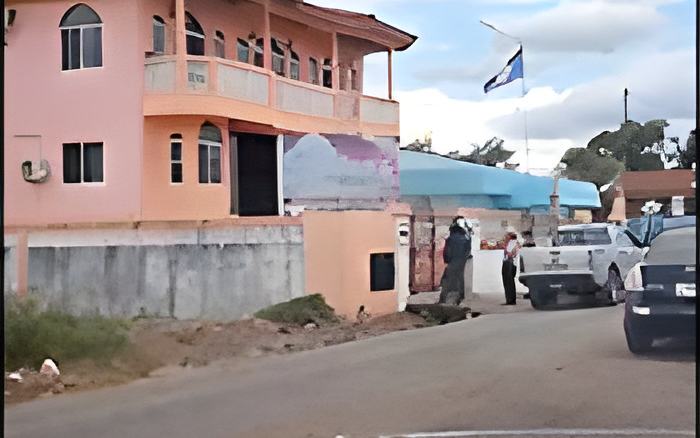

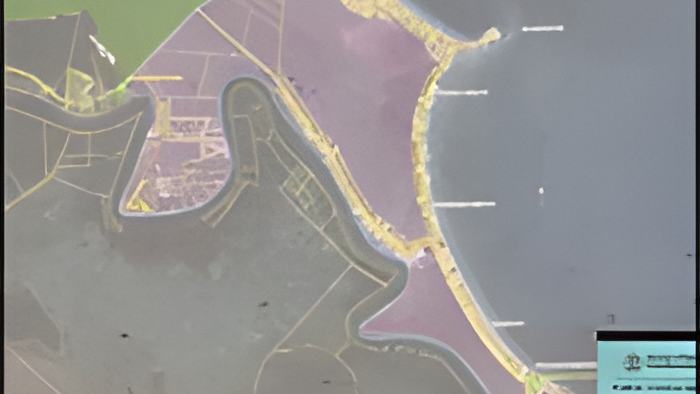
The Ministry of Rural Transformation and Local Government says recent public consultations between the communities of Hopkins and Sittee River are part of the Ministry's process to address the longstanding village boundary disputes between the two communities.
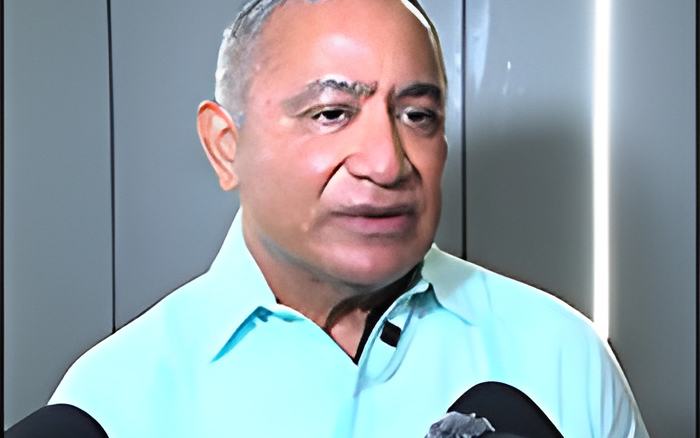
Director of Local Government, Clifford King explained that an independent commission was appointed under the Village Councils Act to review, mediate, and make recommendations on disputes involving adjoining villages. In addition to Hopkins and Sittee River, the commission is also examining boundary concerns between Placencia and Seine Bight:
Clifford King, Director Of Local Government
"You will recall that the ministry put out a press release some weeks ago on an initiative that it is currently carrying out to address village boundary disputes in certain villages in the south. So under the Village Council Act, particularly Section 3 of the Act, the minister responsible for village and village council has the authority to declare boundaries for villages. And that provision also allows the minister to set up an independent, appoint an independent commission to review, mediate and make recommendations to him on villages, on adjoining villages that have boundary disputes. Now, the issue that you're referring to as Sitte River and Hopkins is more than just about Sittee River and Hopkins. As a matter of fact, this appointed independent commission is looking at village boundary dispute with Placencia and Seine Byte. And this independent commission now by its standing orders is set up to look at village boundary disputes where they exist across the country. So it's not only about these particular villages. Of course, we're starting with these villages for the simple reason that for a very long time, we in the ministry, as a part of our mandate, we are responsible for the delineation of municipal and village boundaries. But the effort to delineate, declare and gazette village boundary is a very costly exercise."

"And it has not been done as a matter of fact, there are only a few villages in Belize that has defined boundaries. All other villages operate with what is called traditional boundaries. And so the issue of Placencia and Seine Bight, Hopkins and Sittee River is at the forefront because for many years, we've been trying to get these four villages in particular to agree on their village boundaries so that those village councils can be very clear about the scope of their authority, the extent of the authority. Because knowing your jurisdiction is part of your governance tool. You need to know what you're responsible for."
"The commission work is to gather data, seek stakeholder input, and then to take all that information to assess it, to analyze it, and use it to make very strong and rational recommendation to the minister about where the boundaries should lie between adjoining villages, if you follow what I'm saying."
"And part of the tool, the method, the methodology that the commission is using is to have public consultation so that members of the general public can weigh in on their perspective, weigh in on what they believe, what they think, what evidence they have, what history is telling them about where these villages have traditionally lied so that that information the commission can have for its consideration."
While acknowledging that some comments made during the consultations were passionate and, at times, inflammatory, King stressed that the commission remains focused on conducting a transparent and evidence-based process to minimize unnecessary tensions.
Clifford King, Director of Local Government
"It is very unfortunate that some comments that were made in all the sessions were not aligned with the protocols that were established. And it's unfortunate that a part of these things is people's response to it, organizational response to it. What we don't want is an inflamed situation. We don't want a situation where these comments will be used to inflame negative pushback. We want the commission work to take due course. As we said to all stakeholders in those public sessions, there's always recourse. There's always recourse for any decision that any government takes or anybody takes. And we should allow these processes to manifest and complete themselves. And then we see where it goes. But certainly, me having my position as a particular organization is fine. It's fine. Me having a position as an individual is fine. What we don't want are circumstances where these positions become sensationalized. They become inflammatory. They become reasons why there is social disorder. We don't want that to happen. And so we call on everybody to be very mindful, to be very respectful of these processes. These things are provided for in law because of this exact reason. We on the ground cannot always adjudicate our own circumstances and we need intervention. And the job of the government is to regulate. The job of the government is to intervene. What you want is to have the confidence that the government is doing it in a very open and transparent way. And that is the work of the commission. That is what we're talking about. That the work is being done in a very substantive and a very transparent. I'll validate this for you. When the commission began its work in October, the commission met with all the village councils, explained the protocol, explained the terms of preference, explained the standing orders, explained what it is intending to do, allowed each of these respective councils to make their substantive claims. Those substantive claims were disclosed to the respective parties. Each party was given a chance to make counter submission. They have all done that. And now we are using the public consultation to give the general public, even though it has been the responsibility of the respective village councils, to engage these people. The commission did not take it for granted that they would. So the commission went out and made sure it got its information. So the process is very clear. It's very open. It's very transparent. And there is opportunity for people to be engaged through their village councils."
Residents and stakeholders have until June 15 to submit additional information through their respective village councils for consideration.
Hopkins Residents Had Words For Sittee River
And while last night we posted some clips from the Sittee River consultation on May 30, those comments were made in response to interventions made the night before at the Hopkins consultation. One of the participants Andrew Castillo while making his stance known, added that tensions did not increase until the immigrants occupied those spaces:

Andrew Castillo, Participant
"I just want to reiterate that historically, those spaces that Sittee River is claiming is all areas we traversed as kids I have fun memories of those places and I can't give you the details because it's an adult version but for Sittee River to come and claim these spaces it's all about the economics. Listen, just follow the times when there's a claim for those spaces, again like somebody had said it is all economic and I will venture to say that when these immigrants came and settle in those places that is when this contention took place because when Hopkins and Sittee river was staying side by side without immigrants we had no contention whatsoever. As a matter of fact if you're moving to Sittee River what you do is go on that side because you respected those natural boundaries but all of a sudden the immigrants they came and they start to sell the low spaces now we have contention."
PM Supports Regional Digital Resilience
Yesterday we took you to the technical workshop of the Economic Commission of Latin America and the Caribbean where they focussed on strengthening data security among Caribbean countries.
Today was the policy dialogue where Belize's Minister of E-Governance-who also happens to be the Prime Minister-attended to discuss the region's political commitment to digital resilience. The PM discussed how each country plays a valuable role in protecting each other's data systems.

John Briceno, Prime Minister
"I think what we are having here is a regional meeting from the Caribbean in what we call an innovative idea referring to Data Embassies. And a Data Embassy is simply like an extension of your embassy that you have in a different country which is considered your own space as a country, like for instance the embassy in Belize in Washington, that is ours and the laws do not apply to that space. And so we are finding more and more now that everything is based with data and there are constant threats, violence, wars, you have hurricanes for instance in the region and earthquakes, cyber attacks, and so the idea is for us, for countries to look at different countries where you can say okay I am going to leave my data in, let's say Barbados or in St Kitts and then all, a copy of my data is stored in that country but that belongs to Belize, it is governed by Belizean law, it is going to be Belizean jurisdiction. And so we are working with that as a region and hoping we can come up with a declaration today and support the issue of data in the embassies and then in I think in December we will have a meeting in Brazil of the entire region. It is an innovative idea that has seen its time, it is coming and is something that will quite likely be done worldwide."
PM Says Belizean Deportee Chose To Stay In "Safe Third Country"
Two weeks ago we told you about the Belizean deportee who chose to be deported to Saint Kitts and Nevis under a safe third country agreement. As acting Minister of Foreign Affairs we asked the Prime Minister about this today, and if he knows why the individual decided not to deport himself to Belize.
John Briceno, Prime Minister
"I have no idea. That has come to my attention more than once. I've heard in the news. But if he wants to come to Belize, all he has to say is he wants to come to Belize and he will come to Belize, that is the agreement. You go to either your country or you pick another quote unquote "safe country.""
Court Of Appeal Upheld Jalacte Village Rights; GOB Will Go To CCJ
Government recently lost the appeal of a High Court case between the village of Jalacte and the government of Belize. The village took the government to court after they felt their customary rights were being violated when GOB laid down a road from the Dump area to the edge of the village. The court of appeal upheld the decision and has ordered that GOB pay damages caused to their lands,
When we asked the prime minister about this today he told us that they plan to appeal to the CCJ:
John Briceno, Prime Minister
"We believe it is a wrong ruling. We believe that the Chief Justice or the judges, yeah we don't agree with it and I'll say that respectfully, and certainly we will appeal. We believe we can overturn that ruling at the CCJ."
Reporter-
"Because if you let that hold then it is going to have….significant impact on what is happening in the south right now."
John Briceno, Prime Minister
"Yes I believe I answered that question yes."
PM Explains NBC Concession
Last week cabinet gave its approval of a proposed concession agreement between the Department Of Transport and the National Bus Company to establish what is called "an operational framework" to facilitate the investment by the NBC. Here's how the PM explained it today:
John Briceno, Prime Minister
"What happened is that the minister made a paper to cabinet along with Senator Coye, Chris Coye. And what they did is they are saying that for the National Bus Company, or the NBC, to get these routes as a concession is allowed within the law and regulation; that is basically what we did."
Reporter-
"So it is not that money?"
John Briceno, Prime Minister
"No monies have been addressed. They are still finding how they will be able to address the...."
Reporter-
"It's routes?"
John Briceno, Prime Minister
"Yes what about it?"
Reporter-
"So why was that needed?"
John Briceno, Prime Minister
"Listen one of the problems we have been having with the bus runs is you get a yearly license. You can't take that license and go o the bank and say "I want to borrow to buy a new bus or a very good bus" because you don't know if the bank will say what if next year they don't renew? So the idea is you need to be able to give these long term licenses but under certain conditions. You can get a long term license if a license, if you will improve your bus and if you want to bring a new bus or whatever it is. The standards of the bus that the transport department has set, and pretty much that is what is happening."
Sacred Heart College STEAM-ing To The Future
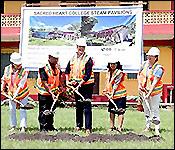
And,finally, a groundbreaking ceremony was held at Sacred Heart College today for a STEAM Pavilion to be built on the compound, funded by the IDB and the Global partnership for Education. The facility will provide students with a science laboratory, a modern recording studio and an integrated mechanical and electrical room. Here are the highlights from that ceremony today.

Ingrid Acosta, Sr. Program Coordinator, Project Execution Unit, MoECST
"This program was designed with our students in mind to respond to the needs that were generated by the covid-19 pandemic but also the shift in education that we are moving our students into the fourth industrial revolution and we needed to respond to those changes so this program really addresses not only learning gaps that were generated during the pandemic in the foundational scales in English and math but we are also trying to create avenues and platforms for students to become more innovative and explore new avenues. We were here last year in November distributing chromes books and we were also back earlier this year in January with the science and technology unit from the ministry to host an hour of Ai for our students. And today we are here to commemorate the start of the construction of an esteemed pavilion."
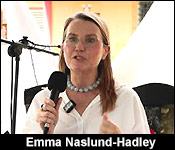
"Its a space that will help our students to expand their possibilities of their adjacent next. You don't know what is out there, you don't know what you don't know but this space will be where you can explore, you can create and you can transform ideas into realities."
Emma Naslund-Hadley, Principal Education Specialist, Inter-American Development Bank (IDB)
"So today we are celebrating much more than the construction of a new building we are celebrating possibilities and this pavilion is the result of a shared vision and a long standing partnership between the government of Belize and the inter American Development bank. And the joint vision that we have is that every student in Belizean, wherever he or she may live will have the opportunity to develop the talents needed to thrive in the 21st century."