
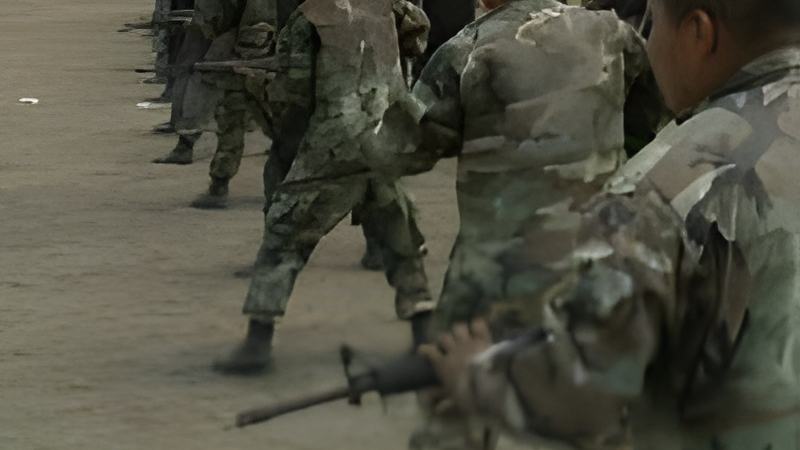
More than one thousand soldiers from the U.S. Army, the British Army, and security personnel from 14 Caribbean countries have descended on Belize. But it isn't a military emergency, it is the 2007 Trade Winds Exercise. The training began last week and it's focusing on disaster relief, humanitarian assistance, crowd and riot control, and martial arts. The martial art portion of the training is where our coverage begins.
Keith Swift Reporting,
The football field at Price Barracks has been converted into a virtual battlefield. These soldiers represent 14 countries and this morning about 100 of them were practicing martial arts technique. The drill instructor is Gunny Sergeant Richard Torrez from the U.S. Army who says this isn't kung fu fighting.
Gunny Sgt. Richard Torrez, U.S. Army
"They will leave here with a better sense of confidence that they can achieve anything with their bare hands to the weapon they have which they carry with them into battle. So if they are barehanded all the way from 500 millimeters to 500 meters, that is a reactionary gap they have so they should leave with a better understanding and more confidence in themselves so they can push themselves pass the limit and still operate and still fight after they are fatigued."
Danito Lopez is a Captain in the Dominican Republic Army with ten years of service. This type of training is new to him and his cohorts from the DR Army.
Capt. Danito Lopez, Dominican Republic
"In my country we don't have this type of training and so in the beginning I wasn't planning on doing it but I saw the motivation in the other soldiers and I joined."
Keith Swift,
What do you hope to leave here with?
Capt. Danito Lopez,
"Well I think soldiers, with this training, are going to be doing good in my country because we will continue with this."
Another part of the exercise is non-lethal weapons training. This is a real 12-gauge pump action shotgun. The only
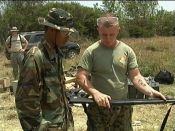
difference is that the bullets are made of beanbags. Watch this:
[Firing Shotgun]
Corporal Eddie Reece from the U.S. Marines says the non-lethal firearms training isn't to prepare soldiers for the battlefield - it is for battles waged in the streets.
Cpl. Eddie Reece, U.S. Marines
"It is to more disperse a crowd than lethal ammunition. They are very effective because you can get a crowd to disperse and leave the general area without shooting and harming someone."
And that non-lethal show of force is where Belize's riot squad or, as they prefer to call it, Crowd Control Unit comes in. Assistant Superintendent of Police Roy Joseph is a member of the riot squad and is participating in the training.
ASP Roy Joseph, Belize Police Department
"It will be very useful I can see because it will enable the personnel to refrain from using lethal force like unarmed combat, breaking falls, and all that kind of stuff."
Keith Swift,
So you think you'll be able to use these skills?
ASP Roy Joseph,
"Oh definitely, definitely without the shadow of a doubt."
And perhaps no one knows more about crowd control than members of the Haitian SWAT team. Captain Calixte Charlemaone says they've seen their share of civil unrest.
Capt. Calixte Charlemaone, Haitian SWAT
"This is very important because it gives us an opportunity to know other countries and share tactical things."
Among the 14 participating countries is a contingent of 35 soldiers and police officers from St. Kitt's and Nevis. 30-year-old Corporal Vanessa Parris and
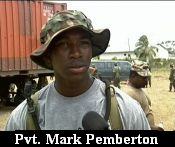
23-year-old Private Mark Pemberton are from St. Kitt's.
Pvt. Mark Pemberton, St. Kitt's Defense Force
"We don't really have threats as most other countries but it will very much assist. I basically learn how to assess situations other than how we do it back home. The Americans taught us their ways of dealing with certain situations. It is basically more or less the same."
Cpl. Vanessa Parris, St. Kitt's Defense Force
"I hope to take back all the knowledge of course. I hope that when I get back home I'll be able to relay some of the information and techniques and so forth that I have learnt here to the people back home in the St. Kitt's Defense Force."
And that's what the Trade Winds exercise is all about - soldiers from across the region training side by side on the virtual battlefields - sharing techniques, tactics, and time.
Training wraps up this weekend.