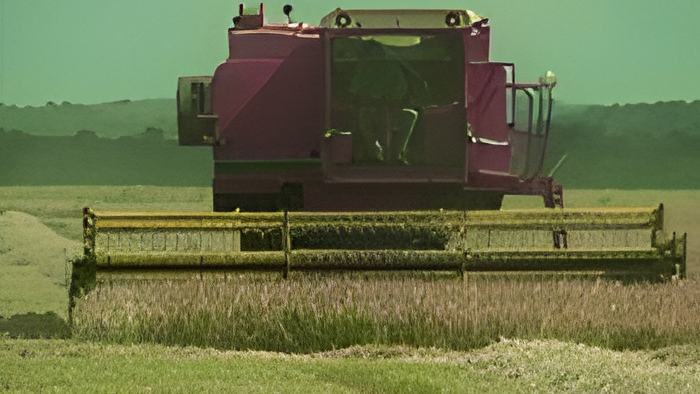
Rice is part of the national dish and this year Belize can boast that not only is it self-sufficient in rice production, in fact, it's enjoying a surplus. Mostly that's the product of a powerfully productive consortium of rice producers coming together to combine their resources. It's paid off in a record yield. Yesterday I went to the extreme northwestern edge of Belize's territory, the rice country in Blue Creek where I found out about the economics and the dynamics of Belize's biggest harvest yet.
Alfonso Noble Reporting,
These fields, acres upon acres of rice paddy in the Blue Creek area seemingly perfect in size and spread is where the rice is going to be coming from for your next dinner plate. While the past couple of years have been difficult for rice producers, this year’s rains have come as a relief and the fields now show that it is a year of plenty.
Abe Rempel, Circle R Products
“We have a good crop this year. It’s been really good and that’s due to continuo rainfall and people really putting their hands together and working together. It gives us anywhere between 5,000 to 7,000 pounds per acre. When we look at an average, on the upland rice, it is about 3,000 to 4,000 and that is why we call it a bumper crop. Now that entails we will have an extra amount of rice for this year which could overlay to next year or we can sell it on the export market. This is one of the best years for rice in Belize and you can see it from the field we have here. Belize Food Supplies, the four companies, will be producing 30 million pounds of rice pad, that is what we have and converted to mill rice, that works out to like 18 million pounds of milled rice.”
And those 18 million pounds of rice that are now being harvested by the growers are representative of a large portion of the rice that will make it to the market in Belize.
Abe Rempel,
“The partnership is producing 75 percent of the national crop this year which will be 39 million pounds of rice. In terms of consumption, it is estimated that Belizeans consume 1.5 million pounds of rice for the month and that’s more or less 18 million pounds a year. So it will mean that we would be able to feed the country with what’s being produced by partnership.”
But even as Belize Food Supply representing four mills in the Blue Creek area, is able to feed the country this year, with its bumper crop yields there may be stocks that carry over because Moreno says the industry is being threatened by illegal importation of rice from Mexico.
“We estimate illegal importation to be somewhere around 300,000 to 500,000 pounds of milled rice per month. If you convert that to money, that’s about $250,000 that is leaving the Belizean economy which could stay here and generate basically more employment. What will happen this year, since this is a bumper crop, if the illegal importation continues at the level that it is, there will be carry over stocks to next year which means we will have more rice than what we can consume locally. It will require that we look for an outlet for the extra rice that we will have. That is the only real thing we will be able to do at this time. We have been averaging a million pounds of rice being sold per month so the group is aware and knows that that’s what we can sell presently in the local market. If we can take control of the illegal importation, we can increase that because in June and July, we had actually sold 1.2 million pounds of rice on the local market. So if we can take control of the contraband, I think it will be better for the industry on a whole.”
And already the industry is proving that it has potential both for providing quality rice as while producing the volume that is necessary to feed the country and tapping into export markets. Circle R’s Abe Rempel says all this is because they have been able to tap into and use technology.
Abe Rempel,
“You have to have the technology, you have to have the access the machinery to actually till it, and in a week’s time, whenever the weather is right, you can utilize your machinery and make them become more efficient and doing more acreages. If you just do one acre, you still have to have the machinery which doesn’t produce enough value for you if you just do a small acre. So if you can afford and if time and everything allows, you can become a lot more efficient by utilizing what you have in terms of personnel, machinery, and just all the equipment that you have to have in order to bring out a good crop and a good yield.”
And because of that good yield, the producers brought out anyone who wanted to come including Senator Godwin Hulse and the Chamber’s Kevin Herrera. He says that as the rice producers’ representative they need to know what is happening on the ground and see how they can assist.
Kevin Herrera, BCCI General Manager
“We have been working seriously with the small farmers in trying to address many of the problems and issues they face. Is rice up and coming, yeah I think it’s making a rebound. I think the important thing though is that we look at assisting the farmers in whatever way we can. The contraband rice coming into the country is not helping the farmers. The continued increases in the cost of production is not assisting the farmers and those are issues that we have to continue to assist with.”
For now however while the rice industry in the north seems to be doing well, that assistance is still needed because while nature was kind this year showing how good it can be it may not always be that way.