
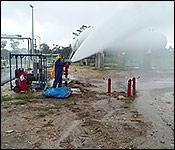
Last night, we gave you an inside look at the National Gas Company, and how this recently established enterprise is working to ensure that cooking gas - colloquially known as butane - is always available for the Belizean public to purchase.
Belize's daily and monthly consumption of LPG is a small drop in the bucket when compared to all of the other consuming nations of the world. But, to ensure that there is no shortage on the local market, the National Gas Company purchases, and stores over a million gallons of the highly flammable fuel on your behalf every month.
That's a lot of butane that could feed a major industrial catastrophe, and so, the company spared no expense in implementing a custom fire protection system that is based on high international standards. The company's professionals are studiously following the US code known as NFPA-58. They discussed their fire safety procedures with us last week Friday, and Daniel Ortiz reports:
Because of its importance in protecting you, the Belizean LPG consumers, the National Gas Company should actually be a government-controlled entity.
Its main purpose is to ensure that your daily LPG source isn't suddenly cut off due to external shocks that could happen on the world market. But, any government administration would be hard-pressed to raise the 60 million dollars that it cost to build it. So, the Barrow Government entered a partnership with Belizean private sector interests on behalf of themselves and other Belizeans.

Daniel Gutierez - Spokesperson, National Gas Company
"Several years ago, the Government of Belize realized that it was in a disadvantageous position in terms of having a full understanding of what the pricing mechanism was for liquefied petroleum gas in the country of Belize."
"Belize was the only country in the region not to have a marine terminal of its own. The rest of the countries in Central America had realized that they needed to be able to bring in bulk imports of LPG to deal with price, to deal with transparency, and to deal with energy security for their countries. We were behind, and something had to be done about it."
"National Gas Company is really an entity that was designed by and financed by Belize's private sector, predominantly. There's one foreign investor in the equity part of National Gas Company, but really, it's a minority. The Bowen, the Roe Group of Companies, the Bedrans in Cayo - Belizean businessmen and women took a chance on a Belizean project."
"Twenty-five percent of this project is owned by the Government of Belize."
"The IDB decided to come in as a part of the banks financing this project. The IDB was very interested in what this project could do for energy security."
"The facilities in Orange Walk and Belmopan, and the loading skid here at the marine terminal at Big Creek certainly set the bar very, very high, and bring Belize on par with what is happening, in the major industrialized countries, where LPG is concerned."
So, what did the National Gas Company's executives spend 60 million dollars to create?
Apart from all the bells and whistles at 3 modern LPG facilities, major expense was incurred to make it transparent for customers. Also, there was a hefty price tag for all of its safety features.
Marvin Vanzie - Operations Manager, National Gas Company
"That's where the costs come in because to do it right, you have to use all the right material, brought in from the right locations, to make sure that you're as safe as possible. An example in place being, we wanted to do an underground pipe from the dock to our facility, and that required long lengths of pipe of the right size. Now, you can't use any pipe. We had to import the right steel, the right thickness, with the right paint jobs, and do the right inspections before you bury it. And when you do bury it, according to the code, you have to have the right layers of different kinds of material and then also protect it using sacrificial anodes, so that you know that corrosion is not gonna be an issue for the foreseeable future."
For all of the company's butane and propane storage, other features were included to detect any fuel leaks that could result in an industrial fire.
The professionals at NGC are well-researched on the potential catastrophes, such as the LPG explosion which occurred in San Juanico, Mexico, back in November 1984. 36 years later, that incident is still regarded as one of the World's worst industrial disasters; as many as 600 people died.
Marvin Vanzie
"Let say there is a leak, and that's why we have what we call LEL monitors, and they basically detect if there's an explosive mixture in the air. Those are kept low to the ground so that you could detect it because that's where your LPG will more than likely flow. If those devices detect that is a leak, the system shuts down. It will give alarms up to a certain level, but once it goes on beyond that level which it dictates as dangerous, everything shuts down, pumps, valves everything. Then, you go and deal with it. The reason why you do that is that the first thing you want to do as a response to an emergency like that with a leak is deal with the source."
"If that then turns into a fire, for whatever reason, then that's where we have our fire protection system. We chose the fire monitor version, which allows us, at a distance, to spray water at a tank. It's a very, very large diesel pump that's stationed by the sea. So, we have an unlimited amount of water to be able to spray."
And again, if any high-risk or life-threatening situations should take place with the company's LPG storage tanks, the control room has remote access.
Marvin Vanzie
"When it comes to safety and emergency response, they could shut down everything. With a click of a button at this distance, even in Orange Walk or Belmopan, he's able to stop everything, close off valves and make sure things are safe before another team then responds."

Sergio Caliz - Control Room Operator, NGC
"It's a pretty state-of-the-art facility, and it's pretty new. So, when it comes to that, I don't see anything like that happening any time soon."