
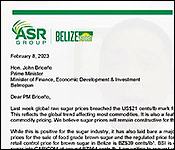
As we've been reporting, ASR/BSI has written to the Prime Minister asking him to consider an increase in the controlled price of brown sugar, which hasn't gone up since 2001.
But, the Prime Minister said on Wednesday that he just can't see his government approving an increase that will directly affect the most vulnerable Belizeans.
Today ASR BSI had a press conference via Zoom to say that they're hoping the Prime Minister and Cabinet come around to see the wisdom in their modest proposal:
Shawn Chavarria, Director of Finance, ASR/BSI
"We are hopeful that the prime minister will give it further consideration along with cabinet, because we've outlined what we believe to be some very strong economic arguments for why there should be an increase in the price of brown sugar. As you mentioned it hasn't moved for 22 years and when you consider the fact that inflation has increase significantly in those part 22 years, the cost of production, all the factors of production in land capital and labour has gone up, those make compelling arguments and so from our standpoint its creating a market distortion where its below the world market price for sugar at the moment, it's below the cost of production and considering as we said that it hasn't moved for 22 years. We think those are strong arguments for why there should be an increase in the price."

"The price increase that we are asking from 39 cents to 65 cents per pound, if you look at the impact on average family of 4 persons, is about 36 cents a week. So that is not a very significant impact, but in terms of the benefit to farmers, we would expect that based on the amount of brown sugar that we are selling at the moment, farmers would see an improvement in cane price of about one dollar per ton of cane."
Currently, the controlled price for a pound of brown sugar is 39 cents per pound - but we'll give you a dollar if you can find it anywhere for less than 49 cents per pound. In fact, some places are selling it as high as 75 cents per pound.
So, of course the government is unwilling to consider a 26 cent increase in the controlled price - because that will send the actual retail shelf price close to or above a dollar per pound.
So, is ASR/BSI and the cane farmers being victims for a broken price control system? We asked today:
Shawn Chavarria, Director of Finance, ASR/BSI
"The perception with the consumer is that we have been increasing the price for sugar when in fact we haven't and so for us its affect us negatively in that sense, because the average consumer might believe that we're taking more and we're passing on cost, which is not the case. So we're not benefitting when these prices go up, but we do know that there is some challenges in terms of having the resources to enforce and try to stop price gouging in the marketplace."
Jules Vasquez
"So you all are really victims of a dysfunctional price control regime where the state is unable to enforce the price controls as always, so now they are saying well you can't increase your 34 cents, because your 34 cents - if you increase that to 65 cents as you are proposing, it will actually increase the shelf price which is dysfunctionally dis-regulated. It will increase the shelf price to over one dollar per pound. Are you all being victimized by a non-functional or dysfunctional price control system?"
Shawn Chavarria, Director of Finance, ASR/BSI
"I think it's more a function that it's taking too long for these price controls to be revisited. 22 years is too long a time for any adjustments to be made."
And while ASR/BSI along with the Corozal Sugar Cane Producers Association and the Progressive Sugar Cane Producers Association are asking for an increase, the powerful Belize Sugar Cane Farmers Association is, typically, singing from another song sheet. They do not support the increase and are instead asking the government to help them re-visit the commercial agreement with ASR/BSI.
Today, Chavarria noted that in this often divided industry, even the simplest things can get very complicated:
Shawn Chavarria, Director of Finance, ASR/BSI
"It just shows how I guess sometimes even the easier of things are so difficult to come by in this industry. Its just so politically sensitive that you would think all stakeholders come together and jointly do a lobby like we did in 2014. You have parties holding different views, but we always maintain that we should be making decisions based on facts, based on figures and based on strong economic arguments and so we will always that position, that approach and we hope it's the one that government takes on board."
The last time an increase was given for white sugar in 2014, the BSCFA supported BSI, but it does not this time.