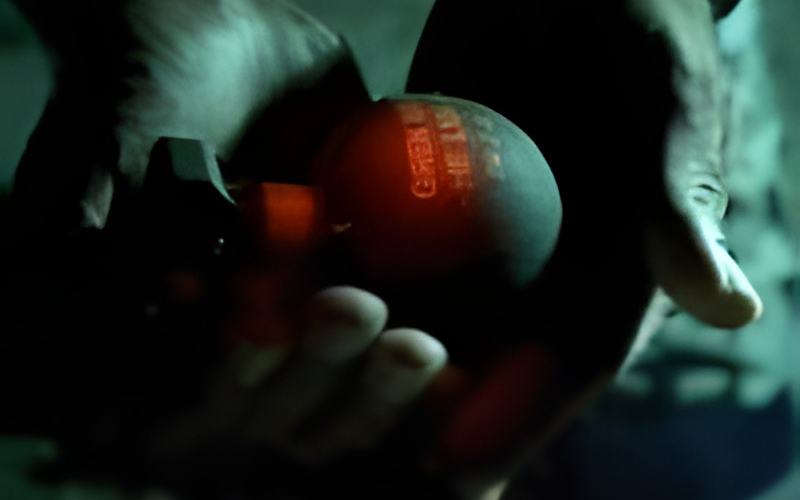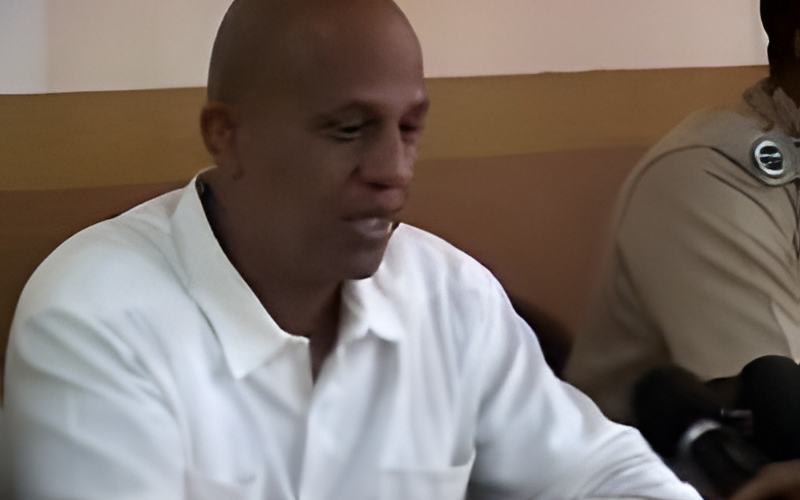

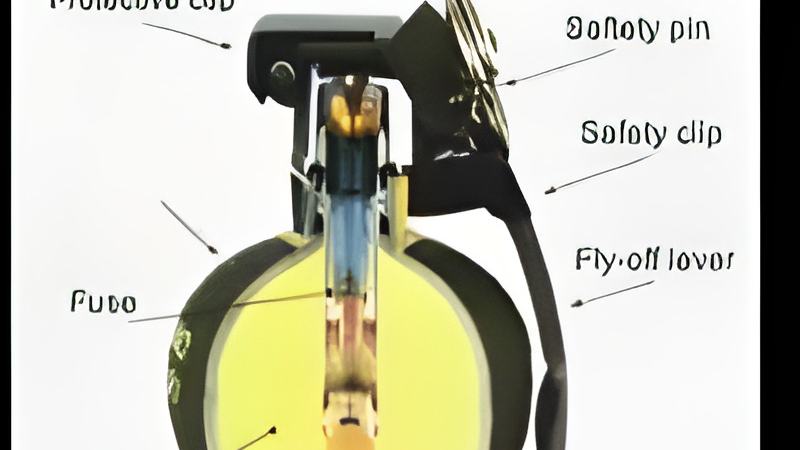
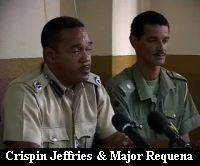
At the press conference this afternoon, more details were given on the grenade. The first thing you need to know is that it is an offensive grenade designed to kill. This differs from the one used on Mayflower Street on May 16th was a defensive grenade designed to protect. Major Requena gave more details and discussed the potential for harm to innocent bystanders.
Major James Requena, BDF Bomb Expert
“It is a high explosive fragmentation grenade. This grenade is designed for offensive purposes, for military use. The grenade has a delay mechanism of three to four seconds, from the time the safety clip is removed and the fly off lever is released and thrown, this can be thrown up to forty feet from where one is standing. The lethal impact area, or what we would call the kill zone, is 15 meters or approximately 50 feet. Anything within 50 feet radius would die instantaneously.
It has a casualty radius of 230 meters that you can still find shrapnel flying. The reason I specify this is the location where it was found was near vehicles that had glass, we had metal, we had the KHMH front entrance which is filled with glass, and we have Alliance Bank on the opposite side which is fully glass. Just the sheer impact of the explosive wave would have shattered the glass. People standing near it would have felt the impact.
Fortunate for us, the person or persons were more nervous or were inexperienced
in handling it. The safety clip was removed but they held on to the fly-off lever and someone assisted them in tying the plastic bag. They tied it a bit too tight over the fly off lever and when they threw it, the bag didn’t open to release the fly off lever. The reason I guess is they thought about the time and they thought if they had released it, they would have been in the impact area also.
As Mr. Jeffries mentioned, the paper clip that you have is the only thing that we could find to replace the safety clip. I proceeded to straighten it, one of the paper clip, and we had an emergency plan that if I failed to put it in, or it slipped, there is an open water drainage between KHMH and Alliance Bank, there is where we were going to put the grenade to soften the impact and all we would have is a great big splash of water, rather than having people injured or reducing the impact.”
Crispin Jeffries,
“Those grenades, regrettably, is closely related to drug distribution. It is a problem we face, we are aware of it, and we’ve been working at it. We’ve since detained a number of persons. Those persons detained include one person who on a previous occasion had a grenade and others who we believe can lead us to other grenades around Belize City.”
The other important thing about this grenade and it was not brought up by the head table in the press conference, is that it is a British grenade. That is a very important point because we have British forces training in Belize. And they also train with the BDF. So could the grenade have originated from there? We asked the question but it clearly was not a reasonable point of conjecture that the head table felt comfortable discussing.
Major James Requena,
“The L109Ai is a British grenade. However what I can’t tell you for sure is that it is from British Forces training unit in Belize. It is a British military grenade but they support other countries. I cannot tell you definitely that that grenade we found is from their unit here in Belize.”
Jules Vasquez,
Sir it is like finding Dutch cheese in Holland, the British do use that grenade in training in Belize.
Major Requena,
“Well I would say yes and we do use those types also.”
And while the issue of the origin of the grenade was more or less bitten off, our sources say it is something that police are looking at closely.