

“You can’t put the toothpaste back in the tube” – and that’s about the same way most people seem to feel about crime: that there’s no way to make a long term reversal of the ever increasing crime wave. But that’s the job of the Crimes Control Council. They were commissioned in April, and pressed to come up with meaningful long term solutions and quickly. It’s a difficult job, but they say that pressurized carbon produces diamonds, so could the 13 member Commission in 6 months produce a cocktail of strategies is meaningfully and measurably curtail crime? They launched their proposals today, and we’ll let you be the judge.
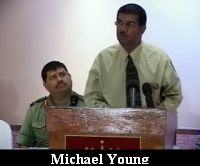
Michael Young, Chairman
“There is no debate about that, the question which has so many citizens writing and calling in at the talk shows is how do we address this problem. Do we simply hang people, increase penalties and punishments for crime, carry out more raids by the police and the BDF? This is what people are wrestling with and this is what the Crime Control Council established in April of this year has been dealing with.”
The answers are in here: the National Security Strategy and the Crime Control Council Comprehensive National Plan. The strategy has 11 far reaching goals and the plan has two phases. The first starts today.
Michael Young,
“First in the initial phase is Operation Guns which consists of a program to immediately attack gun possession and use. It provides for an amnesty
period of one month which begins today, 1st of October, during which there will be a drive for the delivery of firearms, ammunitions, and explosives. The amnesty for clarity does not extend to explosives.
The returning guns to offices in the districts, Youth for the Future in Belize City to the CYDP and to the Police Station and in the districts it will be Youth for the Future and the police stations and by arranging it in that way those who come in will be exposed to an opportunity to say listen, ‘I want to do something, I want to change my life.’”
And a lot of the plan is based on the individual’s initiative for personal reform. And the community’s good.
Michael Young,
“The crime problem is not a we and they situation, meaning we the law abiding and they the criminals. Crime transcends class and race. Organized crime demonstrates that some of the biggest criminals in the world are some of the wealthiest people in the world. The natural extension of all of this is that crime is therefore a community problem.”
Hon. Carlos Perdomo, Minister of National Security
“The old ways of doing things are not good enough. Crime and violence festers in places where infrastructure, education, and opportunity are lacking.”
But to launch a revolution in crime fighting and strategizing, they’ll need money.
Michael Young,
“Of course for this we need funds. A couple of business establishments and have already committed to contribute. An account has been opened in the name of Crime Control Council.”
They are also seeking funding from the Caribbean Development Bank. But they are convinced this effort can make a difference and fairly quickly.
Michael Young,
“We should give ourselves about a year in the first place to see how we are doing in relation to this issue on crime. I am hoping in a sense that I am wrong and we will see maybe some dramatic results in six months.”
Belize’s murder rate is 30 per 100,000 citizens; the Council says that if the plan and strategy work, they should bring that down to 15 per 100,000. Presently Barbados is the only Caribbean country under 10 per 100,000. At the end of the amnesty period on guns, which comes at the close of this month, a gun court will be established.
And today the Opposition sent out a press release blasting that idea and also criticizing the council for not inviting Opposition representative Lisa Shoman to the launch. The Opposition concludes that the plan, “falls far short of what is required for the crime situation in Belize to be seriously addressed.”