
As one of the centers of Mayan civilization, Belize is archaeologically rich, and every year research teams from mostly North American Universities find valuable and important artifacts in these 8,866 square miles. But the closest we seem to get to them is maybe seeing some documentary on the Discovery Channel some years later. Well, in a series of features with the institute of archaeology we'll try to correct that and ease that feeling of disconnection as we tell you about some of the important recent archaeological finds in Belize. In tonight's first installment, we'll tell you about an old paddle a very old paddle which may not look like much but carries in it, the secrets of a thousand years. Dr. Jaime Awe explains.
Alfonso Noble Reporting,
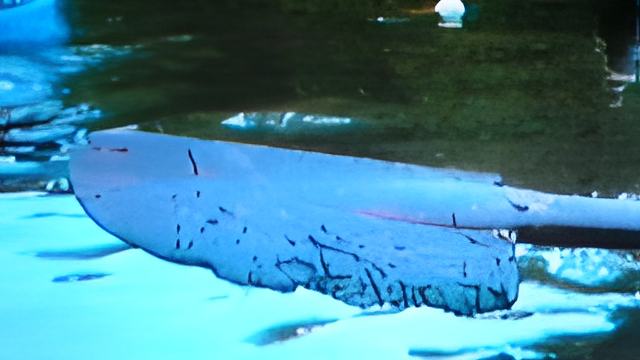
It may not look like much, not much more than a beat up old paddle with a very worn edge but this tool dates back to the late classic period of the Maya and carbon tests have confirmed that it is about 1400 years old.
Dr. Jaime Awe,
"It is the first wooden paddle ever discovered complete and preserved in the Maya region."
It was found here in the Payne's Creek National Park in the lagoons that populate the area. The discovery was made by a team of archaeologists from the Louisiana State University in June of last year.
Dr. Jaime Awe,
"The paddle is about 1.43 meters long or 4.69 feet. It is made from a type of sapodilla and it was found buried in peat with the blades sticking out just underneath some of the more recent deposit of soil and other materials in Payne's Creek Area. The paddle is also interesting in terms of its shape because it does not look like one of the modern paddles we use and you can see where because this section here was not buried in the peat, worms were able to get to it. Often people ask how these things are preserved well in water. The reason is not so much that it is in water. It is because of the peat. If you have wooden materials that are buried in peat, there is very little oxygen. Oxygen is the worst thing for preservation so by it being buried in a very low oxygen context it allows it to be preserved for thousands and thousands of years. When we look at these artifacts, like if you look at these artifacts, the first thing we try to see is if are there any objects of this type illustrated by the Maya from the past. If you go to one site, you can look and this is a mural painted inside a room and paddles here are much different from the one that we found at Payne Creek. However if you go to this drawing, which is actually a carving on bone that was found at Tikal which is closer to Belize, here you can see these two individuals using paddles that, if you look at them close-up, are identical to the one that comes from Payne's Creek National Park. So it tells us that perhaps the shape and forms of paddles in this area may have differed slightly from those used up in the Yucatan."
Awe says this find fills in important information about the Mayas.
Dr. Jaime Awe,
"It tells us unequivocally that the Maya, who were producing salt in this area, were transporting the salt via canoes. What is important, a lot of people don't realize, that in the tropics you require at least somewhere between 7 and 9 milligrams of salt per day for good nutrition or for you to remain healthy. So if you imagine that this area had several million people at the time, if you were producing salt in Belize, you could do very well economically. An interesting story is told by Columbus on his last trip to the Americas. People usually think he only made one trip, he actually made four. In 1502 he sails from Hispanoila, which is the Dominican Republic today, and goes right into the bay of Honduras, not too far from Toledo, and he comes across this large ocean going canoe that was traveling south, it was filled with Mayan people, in fact I there were about…I can't remember the exact number but somewhere between 15 and 20 Mayan people in this large ocean going canoe. Some people were paddling but they had lots of goods like stone tools, cotton materials, honey, etc which they were bringing from the Yucatan traveling south to trade with other people who living up the valley."
With the picture now of Mayas going out on the oceans on canoes confirmed by the find of this tool, Awe says this is an almost unmatched discovery even if you include the spectacular jade head.
Dr. Jaime Awe,
"If I were to rate the importance of this discovery, I certainly have to give it somewhere around a 9 with 10 being the highest. I think that discovery of jade objects, most people find it in every tomb that you excavate, but do you find paddles anywhere, no; 99.9% of the time you will not find it. So that makes it unique. The second reason why I would rate it that high is because we really have poor understanding of how the Maya traveled back and forth and so this confirms the use of maritime and riverine trade routes with the use of canoes."
The LSU Research Team has found evidence of salt factories all along Belize's coast. The 1200 to 1400 year old paddle is currently undergoing a conservatory treatment where it is being dried out of all its moisture for further preservation.