It's being called the best Belizean CD ever. That's very high praise, but trust us Cult Cargo, a Belize City boil up has earned it. The CD captured vintage Belizean recordings made in the 60's and 70's. It was re-discovered and released last year in the United States to rave reviews from major magazines such as Rolling Stone and Entertainment Weekly. With all that buzz, Benque Viejo's Stonetree Records fought to secure the rights to release it locally. A launch party was held this morning at a fitting venue, the Birds Isle where many "floor shows " that spawned the finest era in Belizean recording music. We were there to find out what's magical about this recording.
Jules Vasquez Reporting,
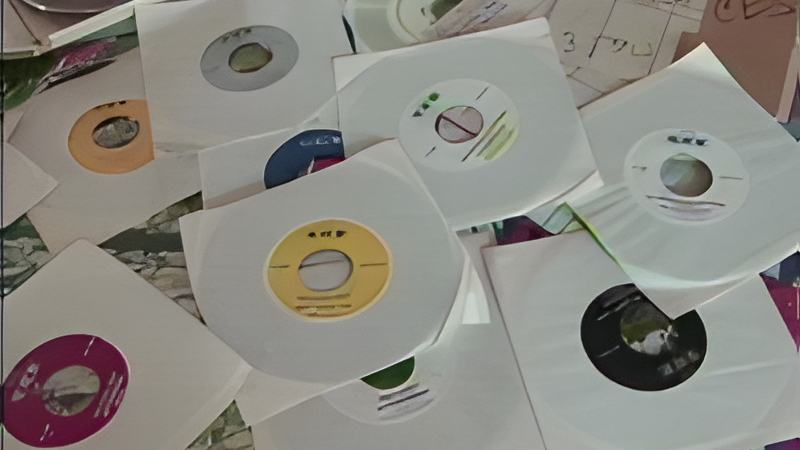
These 45's and LP's are the gems of the golden era of Belizean music recorded in the 50's, 60's and 70's: the professionals, and Lord Rhaburn, Frankie Reneau' mass in blues on this. All of them emblazoned with the distinctive CES label.
The owners of CES is Compton Fairweather, who in his unassuming style, reigned over the golden era as an unlikely kind of music industry kingmaker. More engineer than businessman, Fairweather recorded 156 songs, all Belizeans musicians over two decades at CES. But after 1980, they fell into obscurity until a Chicago based label called the Numero Group, dealing in soul rarities, stumbled upon one of his recordings.
Ivan Duran, Stonetree Records
"It all started in 2004 when three courageous record producers from the States discovered a fun 45 that was originally recorded in Belize by a band called Soul Creation. Rob met Mr. Fairweather and the enxt step was to unearth the boxes of master tapes in Mr. Fairweather's basement in Brooklyn, New York. All the tapes were still there. All the tapes were still there but in very bad shape."
In very bad shape indeed. They looked like this, stored for four decades the only way to restore it is to bake it. That's right bake it in an oven for 10 hours at a constant temperature. After that, producers have one chance and one chance only to play it back and transfer it on a reel to reel.
Ivan Duran,
"So its painstaking process that these guys went through, I understand they spend over a hundred hours in mastering. For those who don't know, this is considerable."
And the results are also considerably better.
Ivan Duran,
"For those who remember the original recordings from LPs, if they compare to the sound that is on this CD, it is at least 50 times better."
Indeed, the bass is rich, the highs crisp, even the man who recorded the masters is impressed.
Compton Fairweather,
"The end result that they came out with really surprised me and then I began to get nostalgic about all the things we used to do."
And they did so much, now 12 of those studio gems fully restored are collected on this disc called a Belize City Boil Up. Duran, himself an engineer and record producer has high praise.
Ivan Duran,
"I am totally convinced that this is one of the very best CDs ever released in Belize's history.
First of all what Mr. Fairweather with those recordings is nothing short of amazing. The quality of the recordings, technically speaking, is almost perfect
and to listen back to those records today, and I am admitting that some of the best recordings ever in the history of Belize happened in the 50s and 60s. It is quite a wake up call. For example Stonetree has been releasing music for ten years now in Belize and those recordings from the CES are as good, they are different, obviously technology has changed, but the quality captured from the those musicians is amazing. Then there is another aspect which the musicianship on those records. To me that is what strikes me the most, the high level of musicianship that those bands used to have is something that we don't see in Belize anymore. And we don't see it in Belize anymore because bands are much smaller, musicians tend to rely more on computers, more on sequencers and keyboards, and for example all those bands used to have nine, ten, up to 12 musicians playing. Obviously a live drummer, which to me is the essence of all these recordings, if you listen back to it, to me that is the main difference between now and then. It is the live drummer. That is the person who kept the beat and tied everybody together."
DJ Morgan who's been playing it on the radio feels the same way.
Kenny Morgan,
"Basically it's a revelation for me because it brings forth a whole new side of the Belizean musicians that many people aren't or weren't existed, the fact that Belizean musicians were playing at that height, that quality, and that standard of music and not just Belizean music but diverse forms from the funk into the lain standards into jazz rhythms. It was a revelation, that is the best way I can find to describe it."
For Lord Rhaburn it is not a revelation, just the product of an era when the music mattered.
Lord Rhaburn,
"The thing is that for a long time we have good music because people used to dance so we had to play good dance music. Long ago, people used to dance and dance, your mommy and daddy used to be one of my main…., and we had to play sensible and sweet music and that is the way we went off recording too. We didn't believe in just playing ordinary. We always wanted to go some way."
And now that somewhere is back...into the future:
Kenny Morgan,
"Younger listeners for the most part have been taking to the music and

for the older folks it is something that they knew, something they grew up with, they are familiar with it, they were dancing to it, falling in love to it, and now hearing it re-mastered and totally enhanced. The quality is improved making it far better listening than when it was originally released. It is also something that the older folks are looking at and seeing where the Belizean musicianship has in their mind deteriorated. We are not seeing that quality and that level of musicianship in our artists these days and that is basically the main comment that comes forward."
Lord Rhaburn,
"The only problem with the younger ones is that they don't like to practice. They have the talent but they seem to be carefree about it. Probably this CD will inject some pride in most of them."
Kenny Morgan,
"I think this could serve as a bridge to inspire our younger, our current musicians to try to emulate and follow in the footsteps of the old musicians."
And while it forms a bridge one wonders how could it have all been lost:
Jules Vasquez,
When I heard it I say how could this have died. Evan Hyde wrote in the Amandala this week that he alluded to the it and it is subject no one wants to talk about but monopoly radio wasn't interested in this kind of music.
Compton Fairweather,
"Especially the celebration music because they were banned really and that's where we sold the music, you know the 10th of September songs."
Jules Vasquez,
So those were banned?
Compton Fairweather,
"Yes Henry Young can tell you about that, that I think Sefe was instructed not to put it on."
Jules Vasquez,
So this music died or it was killed as a political…
Compton Fairweather,
"Well now we know it went to sleep and it woke up."
It's woken up indeed - and now, this bubbling boil up is urging everyone with a some soul, some funk, and some Latin to dance along.
Lord Rhaburn,
"I would invite all Belizeans to get a copy of this album and this CD."
Cult cargo: a Belize City Boil-up is available at record and gift stores across Belize.