
Last year we brought you a series of features with Dr. Jaime Awe which looked at various fascinating aspects of Belize's Mayan legacy. We had a close look at the jade head, we debunked the crystal skull and took you into an unusual Maya sauna. Well, this year Director of Archaeology Dr. Jaime Awe is back. The series picks up again just in time for the archaeological symposium that's coming up next month and we spoke to Awe about a previously unseen discovery that tells the tale of a history written in blood and conquest.
Alfonso Noble Reporting,
Spanish records say that in the mid 1600's the Spanish conquest saw priests and soldiers deployed from Fort San Felipe in Bacalar, Chetumal christianizing or killing the Maya they found in their path.
Dr. Jaime Awe, Dir. - Institute of Archaeology
"From Chetumal we know that the Spanish priests, and sometimes soldiers

to protect them, would travel down to the Rio Hondo, come out to Corozal Bay, down Corozal Bay to where the New River comes out to Corozal Bay. They would travel upriver and they would stop on the way at Lamanai where the Spanish built a church, that was destroyed. They built a second church at Lamanai and that was eventually also destroyed. Then they traveled down eventually to the Belize River and there is a church as well. And then from there up the Belize River and into the Macal River and to the town of Tipul. From Tipul they would then go over land to the lakes 'til eventually they went to Flores, Peten or Peten Itza. So that is the main route that the Spanish used to take.
We know that the Spanish built a church but that was Zach Xus but eventually that was burnt in the 1637 rebellion and then the Mayan went down to this place called Hol Nah and it is right in that area of Roaring Creek that the sword was discovered."
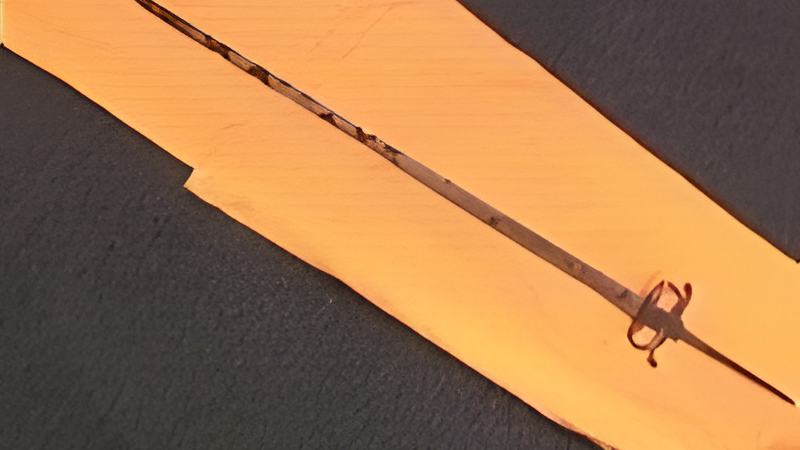
The sword that Director of Archaeology Dr. Jaime Awe refers to is this. A French rapier that was found inside a cave in the Roaring Creek Valley area of the Cayo District.
Dr. Jaime Awe,
"The sword as you can see is a full length sword. It is not a massive cutlass obviously so quite likely it was the sword of some type of Spanish job man. It is like I said the closest we have been able to match it with is a French Rapier. Okay now some people might say that is French and it is not Spanish. But what we must understand is that in Europe at the time, these people doing wars with another or when they attacked a ship, if they captured some French, they would take possession of their weaponry. So it is not rare that you would have British with swords made in Germany or in Spain or in France and vice-versa, Spaniards with swords that were German or French made or Dutch made.
So the sword then is a full length. There you can see what's called the hilt. Some parts are broken because it got rusted, this would have been what protects your hand from the fighting. The handle here was likely wooden and it very likely too might have had another attachment that was round. That is
all part of the hilt here. Those are missing as is the wooden handle because it does not preserved very well. You can also see some little chips and nicks here and there. Whether those happened in pre-historic times or just from normal processes in the time that it has been left there, over the last few hundred years.
Every indication is that this sword dates sometime around 1650 plus or minus x number of years. It was likely taken from a European by the Maya and placed in that cave, perhaps as an offering. That is one option. The other option is that some European who was exploring in that area may have lost his sword inside the cave. But that is a very unlikely possibility because let's face it, if you go hunting or if the only weapon that you have is a sword or your gun, and you stop to rest at a cave or somewhere like that, you wouldn't leave and go without your gun or sword. You would go back for it. So it is more likely then that this was purposely left inside this cave."
And Awe says this was likely left in the cave by the Maya. Documented in Spanish records is resistance and open conflict that the Spanish encountered in the area. In Lamanai for example we see the remains of a burnt church where a rosary and metal book markers have been found. Those encounters saw the Maya battling the Spanish, killing them and taking possession of their weapons as trophies.
Dr. Jaime Awe,
"The capital of Peten today, which is called Flores Peten, used to be known as Nuk-Peten, some people also used to refer to it as Tah-Itza. It was the capital of the Itza Mayan province during confrontation period. We also know that the Maya in that area and in Belize River Valley Region decided to revolt against the Spanish and it also starts out in the 1620s. In fact around 1622, 1623, this Spanish priest by the name of Friedel Delgado, he went to this area and left a community and they were captured by the Mayas and subsequently sacrificed. They had their heads cut off and placed on sticks. When this other Spaniard captain who found out about it, by the name of Francisco Mirones, he decided to send some more soldiers to investigate this and they went out and they came back and on a Sunday in 1624, while Mirones and his Spanish soldiers were listening to mass, the Maya got in the community, captured them, and then hung them, and also beheaded Mirones and his men. Now obviously these guys had weapons and the Maya would have taken these weapons from them.
Sometime around 1637, the Maya in Belize also revolted against the Spanish. In fact they burnt down the church at Lamanai. We also know that there was a Maya community, which means white sands, at Roaring Creek. There was also a Spanish church there and the Mayas burnt that church down.
The discovery of this sword in this cave sort of goes well with what we have found before. It just adds to this whole idea that the Maya, probably in their revolt against the Spanish, are taking Spanish objects like this sword and because this things are exotic, because they are special, they feel that hey we can offer these to our Gods."
And Awe is looking at those offerings of hundreds of years ago and cross referencing those artifacts with historical records.
Dr. Jaime Awe,
"This is very interesting archaeologically because it is a historic cared artifact unlike as you mentioned the clay pots and the other artifacts that we normally find in the caves. What it tells us is that this interaction was not a very smooth transition from Maya occupation and Maya rule to European conquest. In fact it was because of this resistance that eventually the British come into an area where Spanish ruled and never being completely imposed. Had that not happened, Belize might not be what it is today. That is the implication, that if the Maya hadn't resisted so successfully, that later on, remember eventually a lot of the Maya started to die from some of the diseases that were introduced by the Spanish, they also started to escape further inland and away from easy contact with Europeans. But had they not resisted the Spanish for so long and so successfully, the British would not have found Belize as empty of Spaniards as they very likely found it and consequently, I think that more than anything else sets the stage for the development of modern Belize."
Modern Belize that unveils a centuries old rapier that has everything to do with who we are today.
The sword which was found by a park ranger of the Institute of Archaeology will be featured in the upcoming archeology symposium between the 5th and 7th of July.