
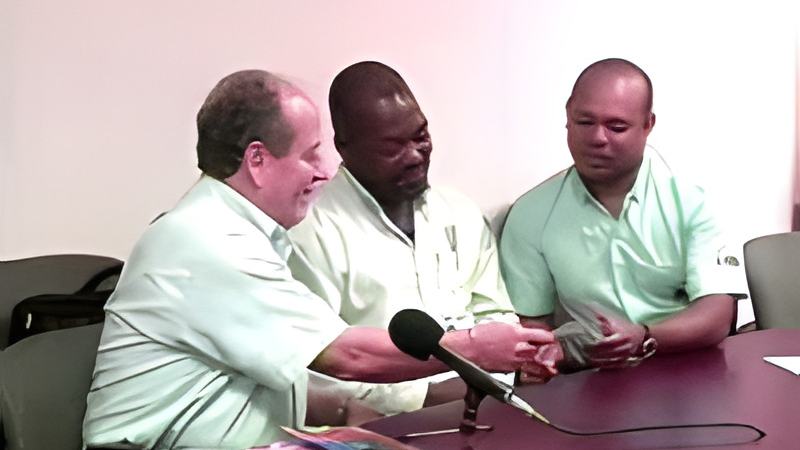
The Inter-American Development Bank will meet next week in Washington to approve a US$25 million policy-based-loan for balance of payments support. Technical talk, but what it really means is money in a hurry, and lots of it, to bail Belize out of massive debt. And while the IDB lends big, today it proved that it also gives small. A $12,000 grant wouldn't even pay the banking fees on Belize's debt, but it will go a long way to preserving its reef. We found out how today as money was handed over to the Meso-American Barrier Reef System.
You've all seen spots with this logo on this very newscast. It's about the Mesoamerican Barrier Reef System Project - they protect the reef system that stretches from the tip of Yucatan to the Bay Islands of Honduras - 80% of it in Belize. The ads worked for us, but MBRS says, it didn't work for them.
Noel Jacobs, MBRS
"The truth is that a lot of the video spots and the TV spots we've done for the past five years and for which we have spent over US$100,000, the impact has been almost zero."
The problem is both language and the medium of dissemination.
Noel Jacobs,
"If you really want to get out to the community where you want to have the desired impact, you must be able to communicate at their level; in their language, in their style."
And their "style" refers to lifestyles and language.
Noel Jacobs,
"The English and Spanish information is not doing it, it is not cutting it. We have to produce a lot of the stuff in Maya, we have to produce a lot of the stuff in Garifuna, and in the case of Maya - both Ketchi and Yucatan Maya."
And getting the message to those communities is important if they are to contribute to the protection of these undersea treasures.
Noel Jacobs,
"The people who do the most fishing in this coast are the Garifunas. You may not know that. As of late, it is difficult to find any Maya who is still doing fishing. And so the bulk of the messages targeting the fishing industry from day one, should have been, for the large part, in Garifuna."
And now this new radio show hopes to correct that - in fact it's the only way to get the message to fishing communities.
Noel Jacobs,
"We know that for the fishing community, the most effective is the radio because even in their boats while they are fishing, they have battery operated radios that they listen to in the evening and nights. Some of them, when they go to fish, they don't come back to the mainland until three weeks later so they wouldn't see any TV until three weeks time, they wouldn't get any newspaper until three weeks time."
Now with this $12,000 check from the IDB, the MBRS will be able to syndicate 28 episodes of a radio show in the Garifuna language. It will air throughout the region, and they hope it will meaningfully impact human behavior and fishing practice.
That money was donated under a cultural grants programme. Those wanting funding for cultural projects like this one, are advised that the IDB office in Belize is now accepting proposals to be approved for next year's budget.