Last night we told you about the winners of the PSE, well tonight we'll tell you about the losers. But we warn you that term 'losers' has nothing to do with the students who took the exam or the teachers who taught them. Losers is the term the PSE designers and education policymakers would put on these children because last night close to 3,000 students got below the passing mark on an exam which is clearly not a accurate reflection of where standard 6 finishers are in their educational development. But tonight, we hope to show that these children are not failures or losers, not at all; in fact they are talented and resourceful, and often brilliant but in the case of the PSE, they are victims of a system that rewards best cases and punishes those who come form disadvantaged backgrounds.
Today we visited two city schools that came in at the bottom of the PSE rankings. Wesley Upper School averaged 179 points or 45% and St Luke's Methodist averages 166.9 or 42%. That's far below that national average of 211 or 53%, which is already woeful. So what went wrong, and whose fault is it? Keith went to find out.
Keith Swift Reporting, [keithkswift@gmail.com]
Looking into this classroom of standard six students at St. Luke's these look normal children, working in groups at the end of school day. But according to the PSE, these bright school children are some of the worst in Belize. That's the message that the PSE sends them and their teacher Darrell Humes says it is unfair...and for these kids it's a crying shame.
Darrell Humes, St. Luke's Methodist School Teacher
"There were those who cried when the results came out and honestly I felt sorry for them because I think they should have done better and they knew they should have done better. I think with what we leave them with, some of them may get the idea that they are failures. I don't blame them because the exam in a way does not, I say, cater to the average Belizean child; it caters to those who will do well. It tells most of our children that you know what, you will not succeed. Every year we see so many children who do not make a grade that they can accepted to high school with. Some of them have proven that grade wrong but I think the message they get from it, by and large, is that you just stay where you are with the 36% or whatever grade below the accepted passing mark."
And that's what the PSE told these students at Wesley Upper School. They didn't top the exam and in fact their school ranked amongst the lowest but regardless of what that test said, they have all been accepted to top high schools.
Keith Swift,
What high school have you been accepted to?
Antonio Matus:St. John's but the Wesley acceptance hasn't
come yet.
Keon Munnings:St. John's but nothing yet from Wesley and ACC.
Jamie Escobar:St. John's but no reply from the others.
Betran Noralez:St. John's but no reply from the others.
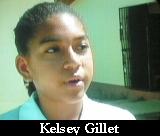
Kelsey Gillet: I'm not sure as yet, I'm still waiting for two more letters and I've already been accepted to Palotti so that's one choice.
Keith Swift,
What do make of what all they are saying that because you come from a public school, you can't do as well as students in private schools?
Antonio Matus: Its not about the school, its about how smart your
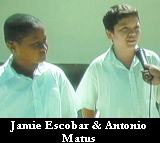
child is and how good he can take in what they teach him at school.
Jamie Escobar: Its how well you study, how well you behave in school, and how well you can listen.
Betran Noralez: Its how well you study, how well you work in school, how well you pay attention, and how well you listen.
Keith Swift,
Do you think you would have done better at a private school?
Antonio Matus,
"I would think I would come in the top 10 or 25 if I were to get that kind of education. In private schools it is better. The thing is most of the schools are poor and they don't have things to teach well but other schools (private) have a lot of money; they can make it easier for the kids to see, they can teach them by objects and so on."
Keith Swift,
But you got 97% on the Math so did coming to a public school affect your learning?
Antonio Matus,
"No."
Marlette Lacayo who teaches standard 6 at Wesley says where you go to school does affect performance but that is because of the other factors like conditions in classrooms.
Marlette Lacayo, Wesley Upper School
"Right now its very hot Keith. I myself as a teacher am very uncomfortable because I feel the sweat dripping down my back, my children are agitated, and these are the sort of conditions that I have to work under. I want to tell anybody that teaching is never as easy as it seems here in Belize and definitely being a public school is not helping. If a child comes to school hungry, they don't hear you yet the teacher; they are not learning anything. Unless the child has figured out a way how to operate on an empty stomach, hey don't let any ghost fool you, that child won't be learning to the level that you would want him or her to. I personally don't think private means better. I beg to differ. I believe here at Wesley Upper, and I am certain at other public schools, that the teachers really go all out for these students and put in a whole lot but at the end of the day we cannot dismiss the circumstances surrounding the students who come to public schools."
Circumstances these future SJC and Palotti students have overcome here at Wesley Upper and circumstances which graduates of St. Luke's Methodist have historically defied. Our Indira Craig, BTL's Karen Bevans, and CNN's Kendis Gibson have all walked through the gates of St. Luke's Methodist. That's proof for you that there is nothing wrong with these schools and in fact the problem lies elsewhere.
Darrell Humes,
"I think we do a good job at St. Luke's here, not only academically, but we give them a confidence that when they leave here, they will be successful. We have quite a number of successful people in our society; to name a few your very own Indira Craig passed through this school, we have Miss Karen Bevans from BTL who passed through here, we have Miss Joan Burke at Family Life who came through here, and we have Mr. Duncan at First Caribbean Bank, they are all students from this school. We do what we are supposed to do here but I wish people would see that. Most of the times I think schools like St. Luke's, we get a very unfair rap, people don't look at what we do here, they only see the other schools because they are out in the front and we are labeled because of the ghetto. But when you have 3,000 students out of approximately 6,000 children making less than 50% on the exam, we know something is wrong with the exam."
Keith Swift,
So how is failing? Is it the students or the system?
Darrell Humes,
"I would definitely say the system. A lot of times they blame teachers and they blame children and the system fails to look at itself. It's the system that's failing and government should stop pointing fingers and say the schools are doing badly. Look at the situation: you give me 50 children to teach and prepare for an exam and you talk about me not doing my job, I think that's nonsense."
So where do we go from where? There is wisdom in a recommendation from 12-year-old Betran Noralez. He survived the PSE, barely passed it, and is now moving on to SJC. He says it wasn't worth it and students should never have to sit through it again…ever.
Betran Noralez,
"I think its better when the school accepts you for your report card and not for the PSE because the PSE makes you get frighten or something and then you might get low on it."
The national average was 211 and about 49% of students got below 50% high schools like SJC and Palotti are relying less on the PSE for as an entrance determinant. PSE results are however still the main determining factor in admittance for a large number of high schools.
Related Stories
. Whose on Top of 2005 PSE
. 2005 PSE Results: From Bad to Worse