
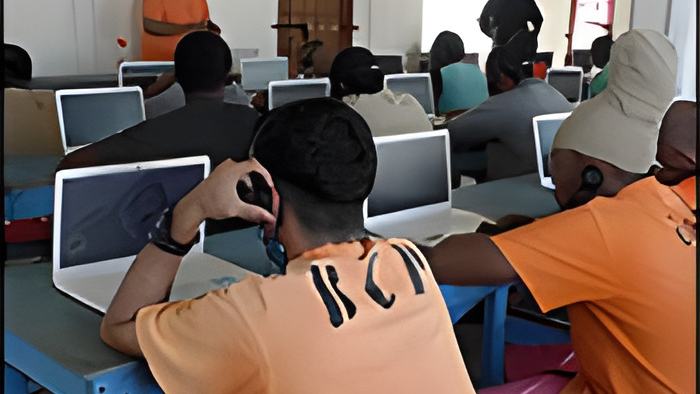
As we told you earlier, it's a long road ahead for pension reform, but the prison has upgraded its methods of reforming prisoners. They've integrated more technology into their education curriculum, along with a learning program called "RACHEL." Now, inmates who, in their previous lives, had no idea who to use a computer or read a book have a second chance at getting a basic education.
And they've also gotten brand new Chromebook laptops to use the program, rather than the pen and paper method they'd been using before. Now, these prisoners have the opportunity for a better life once they leave the prison.
Courtney Menzies went there today and has this story.
More than 200 Chromebook laptops were donated to the men currently at the Belize Central Prison to aid in their education and rehabilitation.
Many of these prisoners never had access to this kind of technology, or they dropped out of primary school, and their education was forever at a standstill. But that changed with the launch of the RACHEL Program - Remote Access Community Hotspot for Education and Learning. And each of these Chromebooks came full equipped with this program, which the Director of Education explained will take their learning to another level.
Avil Steadman, Dir. of Education & Rehabilitation, Kolbe Foundation
"That it is very important and very key in our rehabilitation program because in prison, education is key because education helps them to change their mindset, the way they look at themselves, also boost their self-esteem to say, you know what, I can learn, I can be a better person and by giving them education, it takes them to that level where it helps reduce this crime."
"They have the literacy program for those who haven't even touched a computer, finished school, or been to school consistently, so we have guys who are learning to read, just learning to read through ABC, sounds, and putting words together. We also have maths and English for those who are on a higher level so they get the academics, problem solving, and it goes right up the ladder until about standard 6. Then we also do vocational theory which includes plumbing, electrical, masonry, carpentry so they learn to do that on a theory level so they would watch videos and read the documents."
And the facilitator for the remand section explained this program is a game changer for the prisoners, some of whom didn't even know how to read or write.
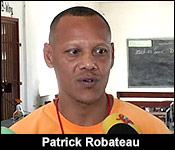
Patrick Robateau, Facilitator, Remand Section
"They have a lot of programs on there that we didn't see here before and for me being here for over 21 years, I have seen the drastic change in education on a whole, so it is a far way step up now than it was back then and the guys them, some of them dropped out of school, so individually, each person have a headphone, each person have their own laptops so they learn at their own space and own time."
One prisoner explained that he dropped out of standard three with no reading skills, while another who has already graduated from the program said he started out not even knowing how to spell his name.
Demas Mendez, Prisoner (2 Years)
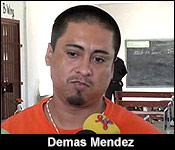
"Everything was exciting because we didn't have any program so it gave us a lot of excitement to have one hour recreation more rather than staying inside. It's teaching me a lot too, I didn't know about computers but right now it's a lot better for us because in society we didn't know about it so right now I came here to the prison and learnt a lot."
"I'm in the class of phonics to learn to read and write a little more because when I was out there, I didn't love school so I came here and did a little graduation of phonics."
"Right now, I feel great of myself because it's something to open my eyes, when I go back into society, I can teach my son or someone else that doesn't know how to read."
Marlon Young, Prisoner (3 Years)
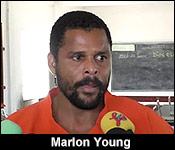
"The first time I came to prison, the same way I came in, the same way I went out, but this time I come to prison, I heard about Rachel program so I introduce myself into it because I couldn't read at all, I didn't know the sound of the ABC's, I didn't know the sound of the letters, nothing, I couldn't even read at all, not even spell my name. In society when I used to work, I used to get my cheque, but I used to put an X on my cheque and that used to make me feel a kind of way. But due to this opportunity that they gave us, the Kolbe Foundation, to learn how to read and be someone, it took me on another level to understand life to be someone who can succeed in life and now I could spell my name. My name is M-A-R-L-O-N, Marlon, Y-O-U-N-G, Marlon Young."
The donation of the laptops and the introduction of the program to the prison was a Rotary donation, courtesy of the Rotary Club of Port Moody. One of the members explained how he and Belize's Rotary Club were able to collaborate.
Alan Stjernegaard, Rotary Club of Port Moody
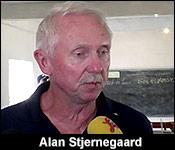
"So a number of years ago, we've come here numerous times to help the people of Belize. We were involved in delivering containers of medical supplies and school supplies, and on one of these trips down here I met Cisco Woods, whose a local Rotarian, and we started to discuss the larger programs in Belize and we talked about literacy, education, gangsters, the need to break the cycle of poverty and crime, and we talked about how maybe the prison would be a good place to start with a literacy program. So we went away and did some research and we came up with a Rachel program which is published by World Possible so we collaborated with that, got it back to Belize, did a test run and then we did the big rollout you see here."
Courtney Menzies:
"Does this signify a progression towards more technological advancements here?"
Francisco Woods, Board Member, Kolbe Foundation/Rotary Club of Belize
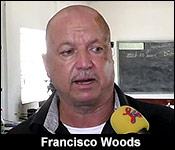
"Absolutely, well, our goal is that when an inmate comes, when we have an inmate that we can empower them so that when they go back out into the society, because they will go back out, they have the knowledge that they can easily start their own business or be able to get a job."
Approximately 500 men are currently in the Rachel program, including those from the conviction and youth sections.
Woods hopes that the "RACHEL" program can also be used in schools, and has so far been implemented in St Martin's De Porres.