

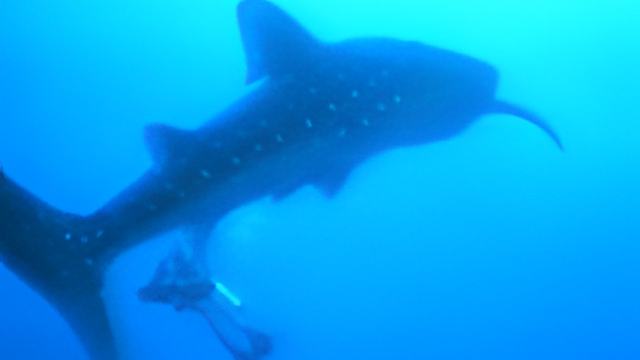
You can take the reef, the Mayan temples, the rainforest trails, and the beachfront resorts...all that, and still, it's hard to find a spot more special in all of Belize than the Gladden Spit. The "Spit," as it is known, lies at the extreme eastern edge of Belize's territorial waters and is straight across from the Placencia Peninsula. What makes it so special? Every year, between April and July, the spit is the stage for a spectacular undersea show starring the rare and unrivalled whale shark. In the past 12 years or so, the site has become a peerless tourist attraction, and tourists flock to it and the nearby Silk Cayes on a yearly basis to be a part of the events that take place there. It's good for the economy, but it strains the ecosystem. And that's where Friends of Nature comes in. Alfonso Noble was out at Gladden Spit yesterday to find out what Friends of Nature is doing to protect one of the most special undersea events in the world.
Alfonso Noble Reporting, [From Gladden Spit]
Every year during the full moons in the months of May, June and July, this spectacular flowering of life erupts at Gladden Spit, off the coast of Placencia. Hundreds of thousands of fish, mainly Dog and Cubera Snappers gather here for their annual spawning ballet, which apart from being one of the true marvels of nature, ensures the species' continued survival. But while it's a dance of new life it is also
one of death. Accompanying the spawning are these magnificent animals, 30 to 50 foot whale sharks that also come to Gladden Spit, to feed on the spawn.
Dwight Neal, Marine Coordinator - Friends of Nature
"Gladden Spit has sort of a main attraction that most people know about internationally, not only locally, and that is the spawning aggregation that happens annually for about 4 months out of every year when the snappers aggregate at the point which is called Gladden Spit itself. We've counted over 5,000 or sometimes 10,000 fish aggregating to spawn. This is part of the reproductive cycle of these fishes and there are other fishes that take advantage of that situation. So Gladden Spit area has been known by the fishermen for many years because they've traditionally fished during the aggregation, something during the months of May, June, and July. Sometimes fishermen from all the way in Dangriga would come down to this area to fish particularly the mutton snapper. We've subsequently found out that not only the mutton snappers spar here. You get the dog snapper, cubera snapper, and in fact some of the researchers that we are working along with, staff from Friends of Nature, have recorded over 20 different species of fish that spawn in the area. As I said earlier there are other fishes that take advantage of this, for them it's a free meal and the whale sharks are one of the species that take advantage of this spawn activity and so annually they show up as well whenever they know, just as we do, that the fish will be in the area."
Add that to the reef system and the Silk Caye, it's one of the most enticing places in the seas of Belize. But such beauty is accompanied by a fragility that needs protection. It is offered here by the Friends of Nature Conservation Group that co-manages Gladden Spit and the Silk Caye Marine Reserve. They carry out patrol surveillance, collect marine scientific data and create public awareness about the area.
Dwight Neal,
"The role of Friends of Nature is to work with the stakeholders to make

them aware of what is here at Gladden Spit and the importance of maintaining, protecting, preserving. I notice I didn't say conserve because we don't want people to get the impression that it is a situation where you have it up on a shelf and you dust it off occasionally and that's all you do. Of course the reserve has to work for the benefit of the stakeholders so we still allow people in and as you mention the fishermen are there. What we're doing is we're working with the fishermen to ensure that numbers that are harvested are sustainable."
But this kind of work is expensive and Friends of Nature last year applied and received a grant from the Protected Areas Conservation Trust of $216,700. Yesterday, PACT was out in the field assessing the work carried out after the 1st year of the 3 year project.
Sharon Pererra, Senior Project Officer - PACT
"The project that was funded is based primarily on three management issues. One is to conserve the existing fish stock of Gladden Spit and to regulate the multiple uses of the reserve. Two is to provide sound scientific data that would be incorporated into future management action and three is to mitigate any impacts to the traditional users of the area by providing alternative livelihoods. One of the components of the project is to demarcate the western boundary of the Gladden Spit Marine Reserve and to put in place marker buoys to demarcate the boundaries and marker buoys that will delineate the zonations of the reserve. This demarcation is key or contributes towards patrolling efforts of Friends of Nature within the reserve and they will provide training in the from of fly fishing to traditional fisher folks of the area long with a educational campaign; creating an information brochure about Gladden Spit. They will also continue to monitor the spawning aggregation of the various fin fish species out at Gladden Spit as well as continue he activity of the whale sharks within the whale sharks within the Gladden Spit/Silk Caye Marine Reserve."
Dwight Neal,
"Probably 80% to 90% of the funding we get we raise from external sources. PACT has been one of those sources. We've gotten from other areas like the GEF Small Grants, we have international foundations like the HOPE foundations, but certainly PACT as a local donor agency has played a remarkable role in realizing the importance of providing the kind of support it does to organizations like Friends of Nature to allow us to do the kind of work we do."

So far Friends of Nature has put in place demarcating buoys and markers to ensure that damage to Gladden Spit and Silk Caye Reserve is kept to a minimum. Shane Pech is the head ranger at the reserve and has been in charge of most of the work carried out so far.
Shane Pech, Head Ranger
"We have six mooring buoys at this present moment and six demarcation buoys and five marker buoys that mark the no take zone in the Gladden Spit/Silk Caye Marine Reserve. The mooring buoys that we put in is for people that come in that uses the reserve that they don't throw their anchor to mess up the grass bed or the coral bottom; so they just tie on the mooring instead of throwing in their anchor. For the demarcation buoy it marks the reserve from the north to the south end, in and out, and in the middle. When you enter the reserve you'll see buoys and then that marks the reserve. The buoy that marks the no take zone is similar to the buoy that marks the reserve. In the no take zone there is nothing to be taken from there, no fishing allowed, no commercial diving, nothing like that is allowed in a no take zone. Around Silk Caye we have the no-take zone, it is a mile around the caye, and its very important because there is where most of the tourists, when its not whale shark season, come and snorkel around the caye. So if we don't permit diving and shooting spear fishing in that part then the fishes and lobster and conch come in there because they know that they won't be hampered. Its like Laughing Bird Caye after they turned that into a no-take zone there has been much more habitat for more fishes, more sea life."
Sea life like this, a symphony of spawning and the always stunning appearance of this behemoth of the sea.
PACT grant funding covers work of the Friends of Nature Group for the next two years.