
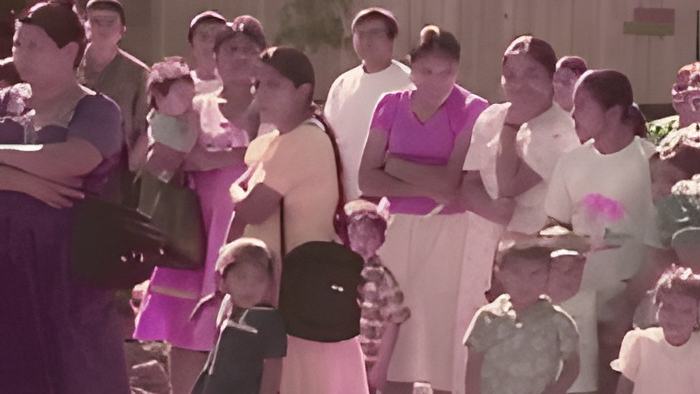
According to the national poverty survey, Toledo is the poorest district but perversely, it's also been the beneficiary of a number of programs targeted at alleviating poverty, many which just don't work leaving funders frustrated and the poor...still poor. While arguments can be put up as to why there have been few success stories, it doesn't mean that assistance is not going there anymore. In fact there still is just that now there are new strategies to make sure that the assistance to the district is going to the right place and that at the end there are tangible results. On Friday we visited programs being funded the Global Environmental Facility and protected areas conservation trust to see what the new focus is.
Alfonso Noble Reporting,
A handicraft sales outlet in Rio Blanco, an apiary in Tumul Kin and a gibnut rearing facility in Laguna Village. What could these projects have in common? Seemingly nothing. But in reality they are connected as part of GEF and PACT funded programs, these projects are linked together to enhance the protection of a swath of land in the Toledo District known as the Moho River watershed. The aim is to minimize impact on the watershed while providing livelihood alternatives.
Pablo Mes, Teacher - Tumul Kin
"These organizations that you are visiting today are strategically located within the Moho River Watershed and their work focuses on the development of these communities in a sustainable way and in terms of building individuals, both to better represent themselves, but beyond that as well to better sustain themselves economically. Now these three projects are fundamental. They do not only seek to address conservation issues but it seeks as well to give back some thing tangible to the communities which they can use. By having these people who live here, that are working with this project, they build ownership of these initiatives that are happening and I think sustainability in terms of the life of the projects, in terms of what will happen beyond the life of the project, its crucial and if you look around the various initiatives you will see today, you will see people who are
in this place, who live in this region and that key component of ownership is one that the different organizations who are working in this community are putting at its core. This is for the people."
And those involved in the programs like Eduardo Coy who is one of 12 persons poised to rear Gibnuts in Laguna and San Marcus villages says the idea is to ensure that these rodents will be around beyond his generation.
Eduardo Coy, Gibnut Rearing - Laguna Village
"Our intention is to raise gibnuts so that in the future our younger generations would know how gibut looks. We are interested in raising gibnuts so that we could produce. People always like to destroy and deforest, especially like right now we can't find any big trees, everything is going down."
Florentino Pop,
"People hunt and they hunt for gibnut, they hunt for peccary, they hunt for several things and also it shows that the gibnut has a high value on the market and so we look at that aspect first and then we look at how it connects to our promotion of the protecting the wildlife sanctuary. If we reduce the number of hunters in the sanctuary, we would have less fire incidences and that is one of the things that has been killing the wildlife sanctuary, the fires. Since after Hurricane Iris we've had three major fires. For us to do this gibnut project, it will not only support the reducing of fires but it will also provide for the improvement of the food chain for the wildcats. This is a demonstration project, its not a project that we are implementing, it's a demonstration we want to learn from and show that this way is a viable way of addressing the impact."
But while addressing the impact on the environment is one thing, providing alternatives is another. Pablo Mes is a teacher at Tumul Kin Center of Learning and he says that is what is being looked at by the projects. At his school, the funding is going toward training students and villagers in the area about bee keeping.
Pablo Mes, Teacher - Tumul Kin
"The idea is we would like to further develop the skills, the knowledge of present farmers or prospective farmers in beekeeping and for them to be able to use those skills in their farm that they have. But beyond that we also have involved our students and the idea behind this is that the students themselves, at the school, are learning skills that they can take back to their communities and apply there. This project that is being funded by GEF and PACT is one that focuses not only on developing the economic status of the communities but another advantage to the project is that it promotes, its an ecologically friendly initiative. In the backdrop of everything, the bigger aspect that all of these projects, or all the work of these organizations I should say, that is hat we are challenging. We are challenging the issue of poverty."
And nowhere is that challenge more evident that in the Rio Blanco National Park where women from the villages of Santa Cruz and Santa Elena got this sales outlet. For the women here, the benefit is almost immediate as 35 members of the Rio Blanco Women's Group will have somewhere to sell there wares.
Juana Canti,
"Before we didn't have nothing because we had crafts here and when the tourists came they came walking and we decided to come together and see how we could have crafts."
Marcus Sho, Santa Cruz Alcalde
"Before they would just go to the market in Punta Gorda but since they had this office here, when the truck or jeep or what ever passes in Santa Cruz after a mile and a quarter and they come and sell their crafts. That is why I realized as the Chairman, and I told the community and the women, why because sooner or later the children would have had an accident on the road since they are running after the bus and that's why we have in mind to discuss with the women and then they can organize it."
Juana Canti,
"We are going to use our craft and we are going to sell like soft drinks, water, and chips."
Selling chips, it may seem like a very small initiative but in reality Mes says that it's meaningful especially in a district where projects have come and gone with almost no visible results.
Eduardo Coy,
"I think it will work because many projects came up but sometimes it failed but we want to see if this could develop."
Combined, PACT and GEF funding for Rio Blanco, Tumul Kin and Aguacaliente is in the region of US$135,000. The Moho River water shed covers and area of over 200,000 acres and is home to some 17 communities.