Ever since the Africanized Bee appeared in Belize in 1987 it has steadily overtaken indigenous bee population. Accompanying that change has been what's become known as swarming season. That occurs between May and June, when bees forge out to establish new hives. For communities that have bee populations, swarming season is the worst! And today we found one such neighborhood at the corner of Mahogany and Jasmine Streets. We rolled up with the relief team from the department of agriculture and here's how that went.
Call them the Bee Team, the Belize District Department of Agriculture Response Unit. They've pulled up at this house on Jasmine Street in the Lake Independence area to eradicate a large beehive that's lodged itself inside the walls of the home.
Elderly resident Doris Bennett is asked to wait outside as the team goes to work. Our cameraman Luis Munoz had to put on a bee keeper's outfit to get up close enough to tape without being harmed. Though there was a chink in his armour, (or should we say a hole in his glove?) he was all tied up, rigged up and ready to go.
While we taped, the Department's Winfield Baptist did the hard work, which
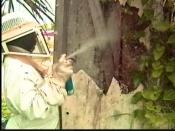
means hammering open the side of the house and letting loose with a lethal dose of Sure-Tox. Under attack, the bees battle back, leading to intense swarming.
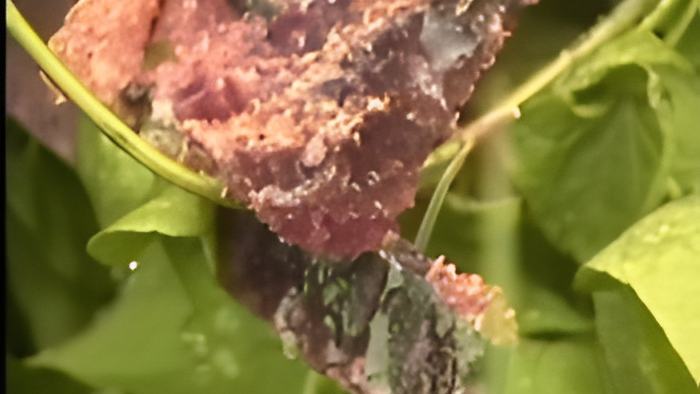
But swarm though they may, their fortress is being dismantled, exposing ripe and golden honeycomb structures, dripping with honey. Turns out there's more than one large bee's nest in the siding of this house, there's another at the back, and to get to it, that section of siding will also have to be broken open. For this team, it's all about eradication; someone else will have to do the repairs. But who?
Doris Bennett, House Attacked by Bees
"I have to try get it fixed back and then I don't have any money."
Jules Vasquez,
And you don't have any means of fixing it?
Doris Bennett,
"I will have to try

and beg them to fix it for me because I don't have any money to fix it, the side of the house. I will have to beg them to fix it for me."
And while that's the very unfortunate downside, for this neighborhood which feels as if it's been living in a prison, it is a huge relief.
Area Resident #1,
"From long time those bees have been at that lady's house and all in my bathroom, all in my kitchen, and they bit my son on his ears. My son has a big thing on his ears right now and they are bothering us."
Area Resident #2,
"They bit my brother on his eye and then they come into our house and sting us when we are sleeping."
Area Resident #3,
"All the time they molest us. They go into our house."
Area Resident #4,
"Its true they affect my life in my neighborhood in a very hard way because we can't open the doors, we can't open the windows, we have to stay lock up like we are in prison. They chase the kids when they come out to buy. They are acting like they are human beings. We just got tired of it because this is like over a year and change this is happening. It is a big relief now because I can open my door and everything because it's really terrible. They drone right in, we get sting on our forehead, our back, and it is really annoying and disgusting."
And while these two large hives were eradicated, Andrew Harrison, the Belize District Coordinator says it's best to call as soon as you see bees around the house.
Andrew Harrison, Department of Agriculture
"Once somebody suspects they have bees in their house, they can call the department, leave their name, their contact number, and address so that we can go and take care of it. Like this one here today, this is very advanced so it's more problematic for us to control it and also for the neighborhood."
Now free of the worry of swarming bees, this neighborhood only has one concern.
Area Resident #4,
"Somebody from the area, Mr. Hyde needs to come and deal with these people and see what he can do for them because look at the condition in the yard. Look at the living condition. It is really not healthy and they are two old people who aren't working."
If you have bees in your area, here's what to do: call the district agriculture office, leave your name, phone number, address and tell them what bee activity you've noticed and where. Then you'll need to buy four or five cans of Sure-tox or fish, because the department only provides it free to public spaces. But before you call, the department stresses that you must differentiate between bees and wasps. The department will not respond to wasps or wasp nests as these can be contained without professional intervention.