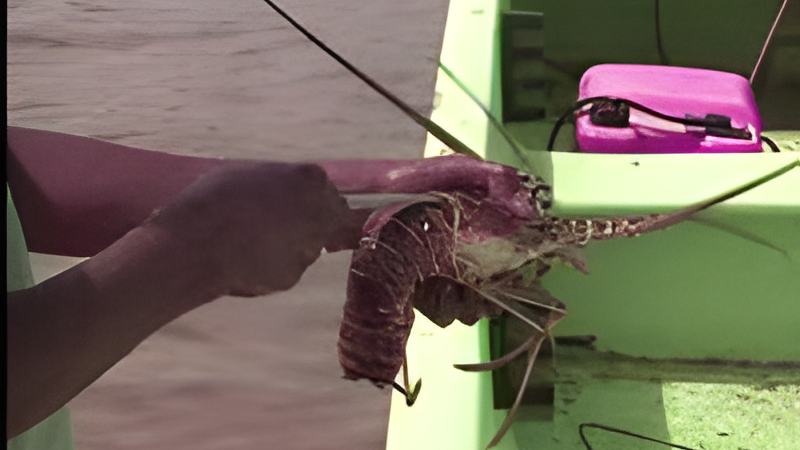
In January, we followed a group of fishermen from Monkey River to Punta Allen in Mexico where they learned new, sustainable methods of lobster is harvesting. Their trip, and the follow-up, was financed by the Community Management of Protected Areas Conservation Program, COMPACT. 7 months later we found the same fishermen back in Monkey River where they are fully implementing what they learnt and this weekend we found out that it's already making a difference.
Alfonso Noble Reporting,
Traditionally this is how lobster is brought in from the sea. Baited traps are thrown into the water and within 7 to 10 days, they are hauled up and the catch is collected. But tradition is becoming unsustainable and now the haul is shrinking. Because of this there is an urgent need to do things differently. And the fishermen in Money River already are.
In January they were invited to visit the small fishing island of Punta Allen in Mexico where they learned how to build and deploy lobster shades. As part of a COMPACT program now the new way of doing things is being fully adopted. On this day we caught up with them as they were loading their skiffs with the traps and setting out to sea. With the use of global positioning equipment Eloy Cuevas, who's been fishing these water for the past 35 years, put down his shades. He says it's a different way of doing things and it's sustainable.
Eloy Cuevas, Fisherman
"This is more lasting. When you put this down you are looking at twenty to twenty five years the least out of one of those concrete shades. So it is a big improvement. This is very sustainable and that is exactly what we are looking for in the marine environment. The palmetto and the zinc last about a year and then pieces scatter over the seabed where, eventually if that continues to happen, it would damage the whole marine environment around Monkey River. We eliminate of that cutting of the palmetto, the zinc process, which would damage the marine bed. So this is a great improvement for all of us in Monkey River."
After adopting the Punta Allen shade technology the fishermen here in Monkey River say they expect a smaller catch but hopefully next year it will be better.
Alex Garbutt, Project Coordinator
"The lobster season is very poor right now but with all the juvenile and stuff they are seeing in the concrete, they are hoping for a better season next year."
Eloy Cuevas,
"We are seeing a big improvement in juvenile lobster and I must say that the kind of habitat that the concrete shades provide for the juveniles, and also the adult. We are seeing a lot of juveniles right now but I believe
that next season it will be a big improvement in our production because the difference now is that everybody used to use a stick to harvest lobster and that is a very bad way of harvesting the lobster, especially out of shades or anything because when you hook them, that blood which the lobster bleeds out, damages your area."
Percival Gordon, Monkey River Chairman
"Right now it is working very excellent. So far with the little monitoring we are doing right now and these shades here and we are seeing a very big improvement man. Right now there is a lot of small ones so that is good. The wooden traps are not really like a nursery, it just something we set on the bottom there for about three to four days and then we go back and pull. So right now the crayfish they get a little smarter and we have to get smarter too so with those concrete things set on the grass bed bottom, it is a more nursery for the babies because in the traps, we don't catch the babies. So right the traps aren't doing anything to the shade.
Right now we're seeing a lot more juveniles than adults so that looks very good to us because before we weren't seeing the juveniles at all; we were just seeing one one adults. Right now so far I could say with the juveniles and the big ones, the adults, I think the season will be a very half and a half season but a next year, two years, if we protect the juveniles we will have a much more better season in a next couple years to come for sure.
All the fishermen are serious right now because we know we will have some big ones for next season so everybody is trying to do their best this season so that we could protect, patrol, and keep those small ones for the next year or three years and I feel that all the little kids will be happy because we can take them out and show them how the lobster population grows because of these same things we got from Punta Allen."
But while the shades are working in Monkey River, there are aspects of the program that need to be modified like the manner in which the lobsters are caught.
Percival Gordon,
"In Punta Allen the water is pretty shallow so with us when we dive down like maybe twenty or twenty five feet of water, we have to make like two or three dives. So when we take this down to the bottom and set this up by the shade, when we make the two or three dives, and make the crayfish come into the net, we don't have to hassle ourselves. We can come up, take our time, and one man could go down, and just take the net off the shade and loop it up and bring up all the crayfish. In Punta Allen, the nets those guys have, they could stand up on the bottom and they could just bring the crayfish in. So they could make one dive and do it but we have to make more than one because it is deep."
And while the fishermen here have been able to adapt the technology to their needs they also have to ensure the sustainability of the crustacean in other ways. That means implementing a monitoring system where every single lobster that is brought in is cleaned, weighed and recorded to get accurate data on how the program is working. Because as Cuevas put it:
Eloy Cuevas,
"This project is not just for we, the immediate fisherman who is using the marine resources right now. We are looking at a long term project where our kids will be coming up and they will want to harvest lobster out of those things. The kids going to school right now, the next ten years from now, those same kids will be harvesting out of the same concrete shades that I am harvesting out of right now. So it is a long term project. This is not a one season or two season, we are looking for a long term project and trying to make the production improve, try for a more sustainable way of harvesting. So it is a whole better way of using the marine environment."
COMPACT will continue supporting the program until the middle of next year.