
Last night on the news we took you to Silk Caye, Placencia, and Gales Point Manatee to show you the worst of the erosion affecting those coastal and lagoon central communities.
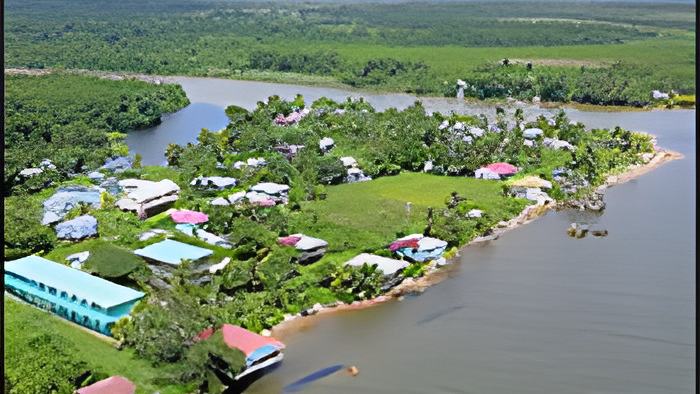
And tonight in part two of Cherisse Halsall's investigative report on countrywide erosion, we're heading further south to the coastal village of Monkey River, a village whose very existence is threatened by the coastline that once made it a sight to behold in the south.
And as a conclusion to last night's story on loss, damage, and erosion, we take a look at the human cost in Monkey River's struggle to stave off the ravages of the sea:
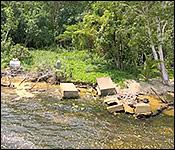
But while the Cemetery in Gales Point is safe for now, it's counterpart further south in the remote village of Monkey River is already fighting the ravages of the sea.
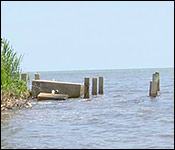
There are cultures that say that you don't own the land until your ancestors bones are buried there but what does it mean if the bones that tie you to the land are being slowly washed away. This cemetery is almost gone but Monkey River still buries it's dead here, they say that those born in the village wouldn't want to rest anywhere else.
But it's far from just the dead who are being threatened by the rising tides; the struggle with nature is also displacing the living.
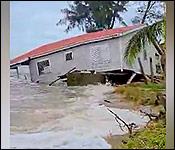
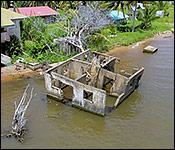
This house was lost to the extreme outer bands of hurricane Julia.
We were perhaps some of the last people to stand underneath it. We asked the village kids if they played upstairs but they said it was haunted.
Haunted perhaps by the specter of a sea that has gone from provider to predator, pulling their home into its depths.
We saw this house threatened in 2017 when it's resident Claude Morey told us:
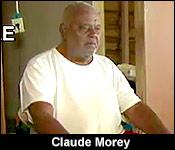
Claude Morey, Monkey River Resident
"If things get worse that I can't handle or that I can't live then I got to move. That's for sure."
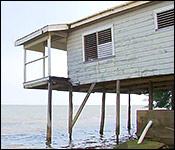
And today, just 5 years later this is all that's left of Morey's home. Residents say that his children came and took him to the U.S.
And that's the fate of many residents of Monkey River who once lived on the seafront. This house was the home of the village grocer but that store is ancient history, its vendors forced to move on and the structure itself all but swallowed by the sea.
And it's no different for the village's children today. Two of our village tour guides live here with their dad in a downstairs apartment that's only habitable at low tide.
Derwin Garbutt, Resident, Monkey River
"You see that area I have. To put that there to block the wind because when the tide gets high the water goes in so if I don't have that in place there and um it goes all the way through."
"At one time we had water in our room I mean you know all our stuff got wet up but you know that's why I put that in place to keep the water out otherwise it would just be..."
It would be the man or woman versus nature battle that the chairlady herself fought when she was just a child. She told us how her childhood home was washed away right in front of their eyes.
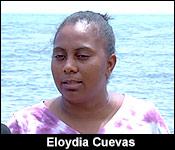
Eloydia Cuevas, Chairlady, Monkey River
"We were just kids I mean we used to play on the beach and then there were no beaches eventually our house, we watched our verandah, the first thing was gone and then eventually we had to move."
"It was scary, it was very scary for us you know losing your family home, the home that you grow in and you know as I would say I wasn't the oldest but the middle child in the bunch so I had younger than me older than me and we talked about it we were scared."
Today her father who ultimately lost his property says he's worried about the loss of the village itself.
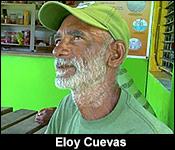
Eloy Cuevas, ChairLady's Dad, Resident, Monkey River
"I had to move 20 something years ago because the water got under my house."
Cherisse Halsall:
"And what was that like just watching the water take the land away? Well I'll tell you the truth it's not a nice feeling because when I first moved to that. Spot to live I had beach like this bout that I would say about 50 meters, 50 60 meters of. Beach, al that was in front of my yard and I watched all that erode away until it got under the house."
But despite the elemental and perhaps futile struggle to tame an increasingly chaotic natural environment, these families have endured; they seem to have no desire to leave their village.
Eloy Cuevas, ChairLady's Dad, Resident, Monkey River
"This is home, this is home right and besides that it's one of the best place to live, you know. We have both the Ocean and we have the river so you have very few places like this. So I don't think anybody who lives here right now, I don't think they want to go and live anywhere else."
They didn't leave after the earthquake of 2009, and they're not leaving now
Colin Young, Executive Director, CCCCC
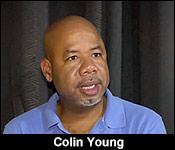
"There is documented signs from the earthquakes where there has been that compaction so Monkey River has sunken a little bit and then there was the hurricane that destroyed that destroyed all of the vegetation. At one point most of the large trees right in Monkey River had disappeared and that allowed an even faster sinking of the sand."
"Monkey River is in a sense a harbinger of what is to come for many other communities, not just in Belize but in the Caribbean but it is not solely caused just by climate change."
Still, the situations in Monkey River, Gales Point, and even the Cayes are the kind of loss and damage that should be poised to benefit from COP27's historic fund. Now it just remains to be seen whether they can access that money before it's too late.
Cherisse Halsall, 7 news.
And since our visit to Monkey River efforts have been made by the same crew that rebuilt Silk Caye to shore up the Monkey River Coastline.
Eworth Garbutt and his team were there in October putting down sandbags and building fences to keep the beach in, and the water at bay.
It remains to be seen if those minimal efforts will in fact make a difference in Monkey River, a village that remains on the brink.