
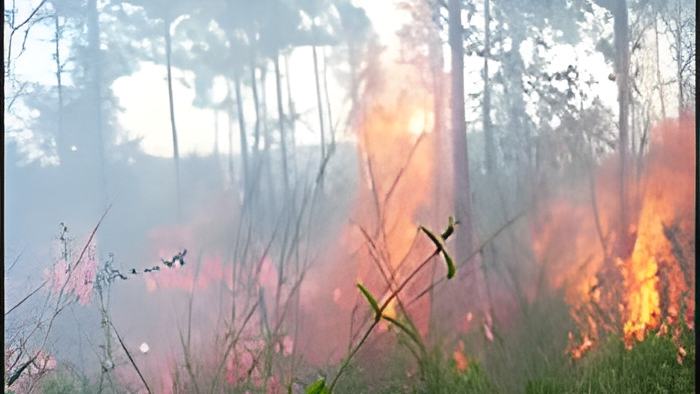

Yesterday, we took you to the Mountain Pine Ridge Forest Reserve, where you saw what the Forest Department calls a prescribed burn. But with the fire season starting on the 15th of this month, those types of fires aren't the only ones you'll see. Typically, the George Price Highway, known as the central Belize area, is rife with wildland fires. And most of the time, these fires are lit by man, but then spiral out of control. Between 2001 - 2021, 50,000 hectare of Belize's forests were lost to fires, and 2020 was recorded as the year with the most tree cover loss. And this year, with the combination of climate change and hurricane Lisa, the fire season is expected to, well, fiery.
But the Forest Department, along with their partners are prepared, and yesterday they gave the media a firsthand look at their preparation, complete with a prescribed burn. Courtney Menzies was there and has this story.
Courtney Menzies:
"The blaze behind me is a controlled burn, set intentionally by the forest department to keep the pine forests healthy. But most of the time, fires aren't this manageable - they burn indiscriminately, devastating eco systems and threatening property and lives. And with the fire season only a few days away, the forest department is gearing up to tackle wildfires - particularly manmade ones that threaten to destroy Belize's forest reserves."
John Pinelo Jr., Deputy Chief Forest Officer
"Our protected areas are our lungs in this country, they are also our jewels that we advertise to everybody when they come here for tourism, for natural resources, timber is still a big product in our country, now we're looking at biodiversity, not only just the timber, water management, soil management, wildlife, all of these things are important and if you start losing forests, you start losing all the other things that I just mentioned, so it is important to manage it."
And while there are some legitimate reasons for lighting fires, Pinelo says most of the time, the fires that rage out of control from an illegal method of hunting, especially along the highway.
John Pinelo Jr., Deputy Chief Forest Officer
"What we have annually is mostly manmade fires. Sometimes in these areas we have fires caused by lightning, that's not normal, but manmade fires are what normally we see if you drive on the western highway, on the George Price Highway, you will see fires a lot in the dry season, most of these fires are lit by people because they burn what is on the ground and when the new chutes is coming up, the animals come to eat the need chutes and so it's an easy place to hunt. But they don't manage the fire, the just light it and leave it. And when the fire burns out these areas in the savannah and start going into the broadleaf forests, that's when we start getting all of these losses of the eco systems. And broadleaf does not come back from fires, it does not regenerate easily, what happens is that the broadleaves die and you have other maybe undesirable trees or plants that take over these areas so you start getting a loss in the area of broadleaf cover."
But even farmers with their burn licenses can ignite an agricultural fire that may blaze out of control. Pinelo explained that this tends to happen when they don't follow the proper procedures.
John Pinelo Jr., Deputy Chief Forest Officer
"One of the biggest things they do is burn the fire at the wrong time. If it's windy, if it's too hot, if you're trying to do it by yourself, those are all no's. If it's windy, the wind will blow the fire fast, you won't be able to take care of it, and the fire will burn higher, like if you blow your barbecue coal, you see the fire start up, that's basically what happens when you have wind, you have more fire coming out than you expect. If you're burning during the day like right now, it's extremely hot, so usually you need to burn in the evenings. You need to make a fire line as Mr Chun said. A fire line is where you actually cut a clearance around where you're going to burn so when the fire reaches that area, it stops. You also need to stay there, until the fire is done because if the fire jumps across to the other side then you don't know where it'll go."
And one village in the Cayo district has adapted the best practices to try and preserve their pristine hills. San Antonio has 5,000 residents, and 80% of them are farmers, but the chairman has ensured that they are ready for the fire season.
Aaron Tzib, Chairman, San Antonio Village
"I think there's been a great change in the village and the farmers now have learnt that to keep the jungle green, because I have a slogan, let's go green and clean, from ever since I've been village chairman, but I see the farmers now are not cutting jungle, are not doing slash and burn, they're just doing the system that they've been taught, plowing the land and doing new type of farming."
"Before, I used to know that the farmers used to just burn like one farm as we learn today, then it crosses to the other farm, but then even, because San Antonio is surrounded by hills, and that's the beauty of the village, and before I even used to see that all those hills are smoking every now and again but now I can see that those hills are beautiful and green."
But not all forest fires are bad fires. The Forest Department works along with private companies like Bulridge Limited to conduct prescribed burnings - which help get rid of debris like fallen leaves that could potentially become a disastrous fire - especially after a hurricane.
Nidia Valdez, Forest Manager, Bulridge

"Because we are a company that does reduced impact logging, sustainable forest management, and civic cultural practices - civic cultural practices are actually one of the main things that we focus on, which includes prescribed burning, thinning, bark beetle control."
"Before and after logging, we would need to prepare the land for regeneration so before we do our reduced impact logging operations, we would have to do a prescribed burn, and we do a cool burn after our logging operations to get rid of whatever debris is remaining on the ground, to reduce the fuel load on the soil."
John Pinelo Jr., Deputy Chief Forest Officer
"What they do is that they burn the areas before they go in and log to make it clearer for them to work, the area is better for them to work, and also they want to make sure that they get rid of the fuel load on the ground because that is a big issue for us, if you keep getting leaves falling for years and years on the ground and you don't burn it, when we do have a fire, it will be uncontrollable, we won't be able to take care of it."
"Another reason for prescribed burning is if we want to do natural regeneration where we make the soil available, open, that the trees can drop their seeds and the seeds will hit the ground and start regenerating naturally."
And these prescribed burnings require a lot of preparation - water trucks on the ready, forest officers at specific locations, each with their designated responsibilities, and an extremely detailed plan that companies like Bulridge must prepare and submit to the department.
But while they ensure that their fires are always controlled, this isn't always the case, and those that start wildland fires can get, at the maximum, a couple years imprisonment or a few hundred dollars in fines. However, Pinelo says they're working on upgrading their legislation.
John Pinelo Jr., Deputy Chief Forest Officer
"We're reviewing most of our legislation right now, in fact we're reviewing the wildlife preservation act and we will also get to the point where we'll review the fire act to make sure that we make it modern and that the penalties that are caused when people light fires, so yes we will review them and get to them and eventually we will make it modern. We can then have stricter penalties for people lighting fires."
And their goal is to have the authorities treat wildland fires like the disasters they really are, in hopes that Belize can preserve its forest cover.
Courtney Menzies, 7News
The Forest Department is hoping that through media appearances, community outreach, and ads, that they will be able to raise awareness and that residents will act with more caution when igniting fires.