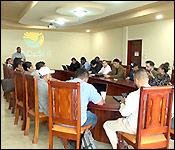
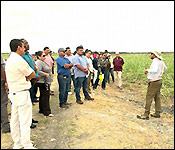
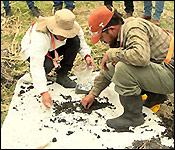
The Caribbean Community Climate Change Centre held a project review meeting this morning in Orange Walk on a newly implemented project funded by the Green Climate Fund. The project focuses on encouraging farmers to expand their sugar cane varieties through the use of climate smart agriculture, such as mechanized harvesting and the integration of an irrigation and drainage infrastructure. Jomarie Lanza took a tour of the fields and here's her report.
The future of these cane fields now lies in the hands of "BAC-SUF" which stands for Building Adaptive Capacity Of Sugarcane Farmers in northern Belize. It's a 25 million US dollar pilot project being led by the Green Climate Fund through the Caribbean Community Climate Change Center. The team spearheading this project hopes that they can turn around the industry in Belize by deploying smart farming practices. Today was a walk through session for the project stakeholders, providing them with an update on some of the issues and challenges since its implementation.
Darrel Audinette, Project Manager, CCCC
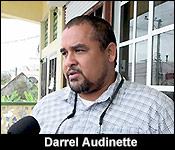
"Under the project what we have done is that we have started its implementation but it has been delayed because of the fusarium outbreak that has been affecting the industry this is a fungal outbreak that has been severely affecting our ability to implement project activities particularly the fact that the project is envisioned to establish sugar cane nurseries that are then going to support us with the replanting of 10,000 acres of new varieties so because that is a critical component in terms of start up and fusarium has been a major issues we have not been able to start those, we do not want to make those investments and run the risk of those investments not being fruitful."
"So what we have done is we have continued to work without partners, what we have leaned more towards is to ensure that we have clean seeds, clean seeds in the form of tissue culture seeds in terms of hot bath treated seeds and so first and foremost is to ensure that the source clean the seeds, the seeds are clean, we work now in terms of the land preparation to ensure that soils are effectively made available they are clean, all other management practices are in place these are critical to understand is that these are all elements that were already part of the project so these are, we are not changing anything in terms of our project this was already envisioned to take place so I'd like to say that we were not planning for fusarium but the project was designed to address factors like fusarium so that is where we are right now we are trying to move on those nurseries and the re-planting process."
If they manage to successfully replant 10,000 acres with new sugarcane varieties that have exhibited climate tolerant characteristics, more that 5,000 persons can benefit from this directly, and, in turn, 87,000 indirectly through the transformation of the sugarcane industry,
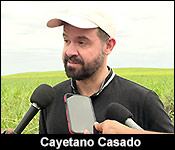
Cayetano Casado, Regional Manager, GCF Secretary
"The GCF was created under the United Nations convention against climate change to channel funds from developed countries to developing countries to fund projects that would enable us to achieve climate change objectives and this is done in 2 big dimensions what we call climate change mitigation that is the removal of a green house gases that are the main cause of climate change but then what we then also call climate change adaptation which means facing the impacts that climate change is having on the ground, and is expected to continue having on the ground."
"This is a climate change adaptation project so this falls under that second category and with this project we are intending to achieve and enhance the adaptive capacities of the sugar cane farmers in northern Belize to the impacts of climate change that are already being felt and are expected to be felt according to the climate modules."
"So far the project is still in its initial stages but the design is sound, the design is looking at the overall farming the overall crop system so not only the crop varieties themselves, making them more resistant to dry spells for example. But also the techniques being used for soil management so to ensure that we have water retention, organic matter retention and also water management to ensure that in periods of dry spells you have enough water to make the crop survive but also if there are floods to make sure that you are draining the water adequately and the crop is not drowning and then also the project is looking at the overall value chain, which I think is very important its not just supporting the farmers but then also supporting the overall value chain to make sure that you have a climate resistant value chain."
Farmers who are eligible to partake in the project can receive up to 40% in grant funding for replanting using climate smart agriculture technologies, but again it all depends on the success of the project, since funding is expected to be disbursed in phases.

Candace Leung-Woo Gabriel, Portfolio Management & Climate investment, GCF
"So this project is funded by the GCF with grant funding 25 million, 13 million co financing and it is meant to focus on the farmers and making sure access to the farmers is met. So how the project was designed and structured it is to, GCF comes in and de-risks the investment so in the project we actually fund the mechanism to give the seeds to the farmers so that risk is alleviated. And they get the funding for the seeds to begin that process and also the training is encompassed within that and not only just the seed provision and the training but to create that market mechanism and to ensure that the process is climate smart so there is continuity after the project which is about 5 years."
"So how the project is set up they are more or less like co partners with the 5Cs so how GCF comes in we are like the overall supervisory role, the 5Cs is on the ground with partners and BSI and they are like starting off the intimate phase of the project like what we are seeing here in the field but the next step is after they come in they have to partner with an activity they have the partner with the farmers and how our sort of funding comes in we make sure that certain activities are done before we disburse another set of funds and that is how we monitor that activities are done according to the project."