
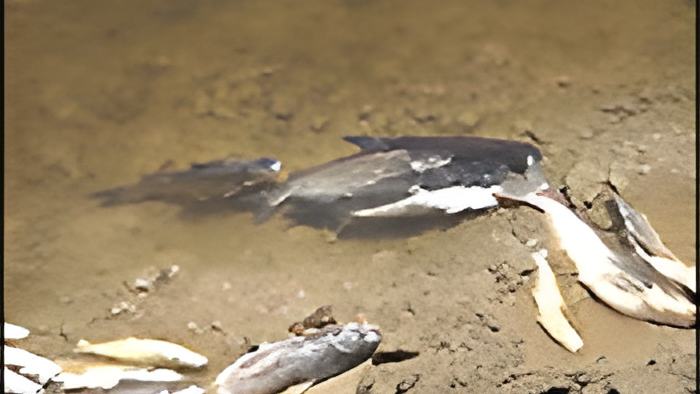

The fish kill affecting communities along the Belize River Valley continues tonight-it is puzzling environmentalists and troubling residents. Today our news team traveled miles of the river to witness the environmental impact firsthand.
While dead fish remain visible in several areas, one location in particular raised serious concerns. Our team visited Labour Creek, a waterway connected to a network of canals leading toward Santander Sugar.
Unlike the main Belize River, the creek appeared significantly darker in color, with noticeable algae buildup and a muddy, sludge-like substance coating portions of the water.
While there is currently no official confirmation linking the creek's condition to the ongoing fish kill, the observations raise important environmental questions as the investigation continues. Information obtained by our newsroom from sources familiar with the matter suggests investigators are examining whether an organic discharge may have entered the river system, reducing dissolved oxygen levels and contributing to the fish mortality.
But that is just a theory. The Department of the Environment is investigating and is expected to release its findings once finished.
But while they investigate, the fish are dying. We spoke with Conway Young, representative from the Community Baboon Sanctuary in Bermudian Landing. He said many persons in those communities rely on this river:

Conway Young, Representative - Community Baboon Sanctuary
"So I don't think anyone has seen the amount that we've seen on the Belize River. So that's definitely concerning and alarming."
Reporter
"When it comes to the species of fish, what are you all observing?"
Conway Young
"Um, from the pictures that we've seen, um, a, a variety of catfish. Uh, we call them river lobster as well. So, so, um, we've seen crabs. We've seen freshwater snooks. Um, those are the one that I've seen that I, that I can identify."
Reporter
"How do the persons of the Belize River Valley benefit off of the Belize River? What are some ways?"
Conway Young
"Um, a lot of people still do subsistence fishing. Um, and so they're relying on that. And then more importantly as well too, that most of the small cattle ranches depend on the river to access water for their livestock."
"Um, so that's the other major ways that, that people rely on the river."
Reporter
"When it comes to what the authorities have done, um, have they warned you all as yet?"
"Have they had any discussion with community leaders about what is going on?"
Conway Young
"I don't know the extent of the, of the information that, that they've shared, but what we know is that they did, did come out with a team. They did some samples, and they said that they will get back to us. Um, but to date, I, um, I haven't heard anything back from them as yet, so we're still waiting."
And while the community suffers, Belize City's running water and drinking water supply could be affected. Both Bowen & Bowen's Crystal water plant and the BWSL water treatment plant at Double Run are downriver from the contaminated area.
In a statement to our newsroom, Bowen & Bowen said it is aware of the reported fish kill and has intensified monitoring of its water treatment and quality assurance systems. According to the company, continuous testing indicates its operations remain within its strict quality standards, and it is maintaining communication with Belize Water Services Limited while monitoring conditions.
Belize Water Services also confirmed it has activated its Emergency Response Plan. The utility said it has been monitoring reported water quality concerns in villages along the river and has detected minor changes, primarily involving dissolved oxygen levels. BWSL stated that these changes have not affected production at its Double Run Water Treatment Facility and that its teams are conducting hourly water quality tests while continuously monitoring key parameters to ensure the safety of the public water supply.
We have reached out to Santander but as of news time we have gotten no response.