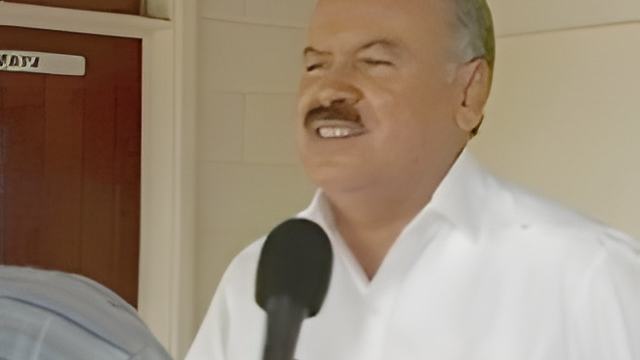
And while we've given you the highlights of the parliamentary business at today's session, the political business continued outside when Jules Vasquez and Ralph Fonseca got to talking about BTL's practice of changing money on the parallel market. It's a widespread practice but it is unlawful. So how was BTL permitted to change US$100 million over four years? Fonseca said he never knew about it.
Jules Vasquez,
It would seem unlawful at least and they have changed $100 million between 2001 and 2005 in that way.
Ralph Fonseca,
"I don't know that they are still continuing that practice or that they were carrying on that practice. What I've been hearing is all types of things coming from people like yourselves. What I understand from the BTL people is that they had a set procedure which was put in place by Pannell Kerr Foster. That procedure was put in place from I think 2001 which explained exactly what steps must be taken to exchange foreign exchange whether it was through a bank, through a casa de cambio, or with some other proven private sector enterprise. And that certainly did not include any step where they took money and gave it to someone, regardless of who that person was, even if it was a bank, without getting the U.S. dollars back."
Jules Vasquez,
Were you aware that BTL had changed $100 million, over the four years, between 2001 and 2005, you were Minister of Finance for three of those years.
Ralph Fonseca,
"No."
Jules Vasquez,
You were not aware of $100 million?
Ralph Fonseca,
"No I did not know that that was happening, I, like everyone else. There's a bank, the Central Bank, there's the FIU, there's the Board of Directors of BTL, there's external auditors of BTL. The Minister of Finance doesn't look into people and say how much foreign exchange did you change outside of the formal system. That is not supposed to happen, number one, and number two there are mechanisms in place if that is happening to take care of it."
Jules Vasquez,
But what BTL was doing was...
Ralph Fonseca,
"I did not know that BTL was buying US$100 million."
Jules Vasquez,
If you had known it would have been state sanctioned money laundering.
Ralph Fonseca,
"If we had known that they were doing illegal transactions, we would have had the proper authorities look into it."
Jules Vasquez,
But sir US$100 million over four years and as Minister of Finance you were unaware of this large movement of money? The Central Bank was being called on to come up with the money, they must have felt some ease.
Ralph Fonseca,
"Well did you know about it, you know more about what's happening out on the streets than myself, you're out there everyday. Did you hear about it? Did you hear about the US$100 million? How would I have known in my office in Belmopan? It is ridiculous."
Jules Vasquez,
You run the Central Bank, the Central Bank must have been aware there was no pressure from BTL.
Ralph Fonseca,
"I don't run the Central Bank, again you're showing disrespect to the Central Bank Jules. Now you're disrespecting the Central Bank. With all the millions of U.S. dollars that you make you're disrespecting the Central Bank and you'll have the people at the Central Bank starting to look at you and the F.I.U."
We assume that it's in the same fantasy world where Channel 7 earns millions of U.S. or any kind of dollars, that Minister Fonseca found what he just called a BTL management protocol for changing money, developed by Pannell Kerr Foster. In fact, we are informed that protocol was developed by the finance department headed by Gaspar Aguilar. But there is something to what the Minister said: Pannell Kerr Foster was involved and the firm did make an important intervention on the money changing practice. 7NEWS has obtained a letter from Pannell to BTL management, dated 10th August 2004 under the heading "parallel market dealing in U.S. dollars." The letter was sent from the auditors to BTL's Board of Directors. It explains that BTL had been buying significant volumes of foreign exchange on the parallel market noting that management was, "obliged" to do it, but that it is, "technically, contrary to the exchange control regulations." The Pannell letter goes on to warn about the dangers of the parallel market stating that it: "does not provide a proper paper trail that permits adequate documentation of transactions." The August 2004 letter concludes that: "while we have found nothing to suggest that anything questionable has been going on, the risk is fairly obvious because of the volume of currency purchased in this way." Again, that warning was sent to the board in 2004 when government had a representative on the board, no less than the Prime Minister's brother, Billy Musa. Of course, the board never heeded the warning because BTL would have been forced into an almost impossible business position if it had relied on hard currency from the Central Bank.