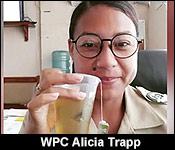
Now, when that little confrontation happened, PC Alicia Trapp, was in her civilian clothing right at the front line.
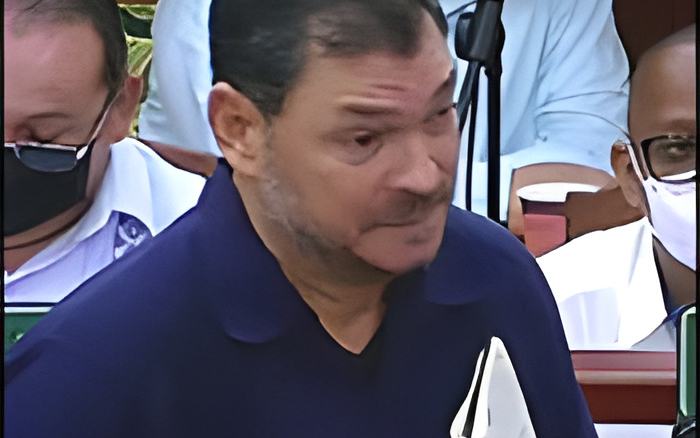
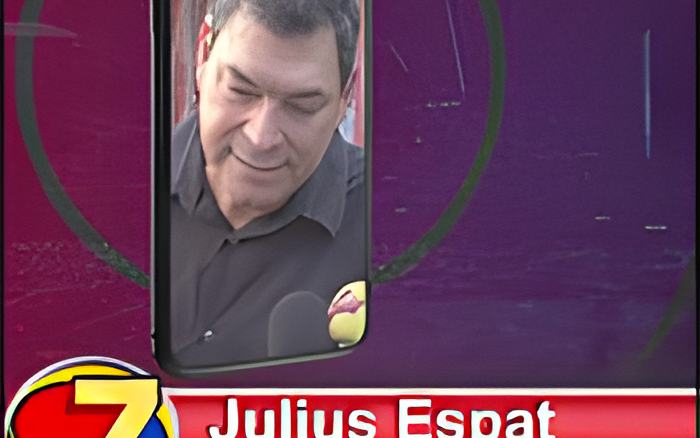
She was in the thick of the day's political hurly burly and and famously did a Facebook live accusing the PUP Area Rep. Julius Espat of berating her verbally and pointed out that she was violating the rules of the police department by showing allegiance to the UDP village council slate.
Yesterday, her police boss, Commissioner Chester Williams, said in a press conference that she has opened herself to disciplinary charges for indirectly identifying herself publicly as a party supporter of the UDP. Also, according to the Commissioner, her extended commentary on Facebook violated the department's social media policy.
Since the airing of that news item, the issue raised has become the subject of a bigger political controversy in which the UDP is alleging that Constable Trapp's constitutional right to freely associate is being violated.
Constable Trapp has since retained attorney "OJ" Elrington to defend her interests, and today, he fired off 2 lawyer letters to the Police Commissioner.
In the first letter, Elrington informs the Commissioner that her client has made an official police complaint against PUP's Julius Espat alleging that she was "verbally and physically attacked" by the minister. Elrington also asserts that "the attack was witnessed by several witnesses who are willing to be witnesses in a criminal trial, if necessary."
Elrington ends that first letter by requesting a status of the investigation into Constable Trapp's police report against Julius Espat.
Then in another lawyer letter, Elrington pointed out that in the Commissioner's Press Conference last night, he misinformed the public that Constable Trapp violated the public service regulations by publicly identifying herself as a supporter of the UDP.
He claims that the Commissioner misinterpreted the laws that govern the conduct of the police. He also ended the letter by saying quote, "any attempt to punish our client would constitute a breach of our client's constitutional rights and would be met with swift legal action." End quote.
Today, we reached out to both Elrington and Commissioner Williams for comment, and they sort of took us to law school to make their point as to whether or not Alicia Trapp committed police misconduct.
Here are a few of their arguments, and counterarguments made to our newsroom late this evening:
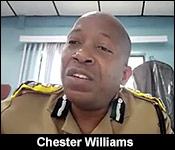
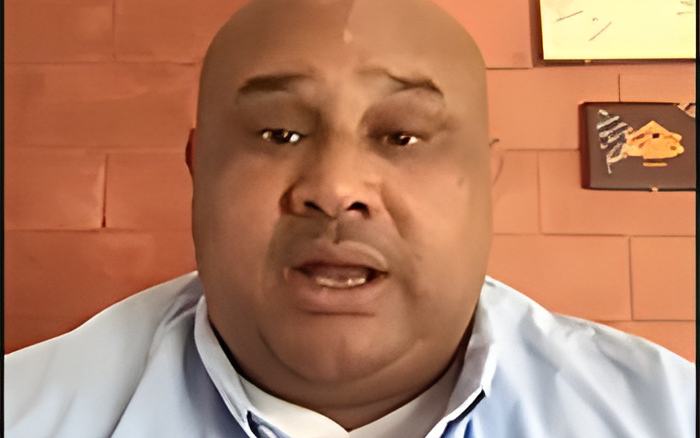
Chester Williams - Commissioner of Police
"PC Trapp is a junior police officer. She's just a constable. She's governed by the Police Act. In the police Act, Section 20 A, subsection one, subsection B, says that no police officer shall engage or give any political opinion with respect to any political party, and shall not partake in parliamentary elections or Village Council Elections. Now, the circular that came out in 2001 would not govern Miss Trapp must trump because she does not fall under the Public Service Regulations. She would be governed by the Police Act, which clearly forbids her from being involved in village council politics."
Orson "OJ" Elrington - Attorney for PC Alicia Trapp
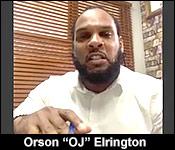
"They are creating their own law. Let me tell you what is the law, Mr. Ortiz. The law is pellucidly clear. The Public Service Regulations do not govern police officers. The Public Service Regulation has a carve-out. Section 3 G says that the Public Service Regulations shall not apply to any category or class of officers to the extent that another enactment provides, specifically for the regulation of that category, or class of public officers, where special regulations are made in respect of that category or class of officers. The police have the Police Act with all of its regulations. Section 138, has an entire chapter, not only regulations that govern the conduct of police officers."
Chester Williams
"To make it clear to Mr. Ellington, in that same section of subsection two, it says a noncommissioned officer or constable who breaches subsection one, commits a major offense against discipline. It never said a senior police officer. It is clear, noncommissioned officer or constable, of which Mr. Arzu is none."
Orson "OJ" Elrington
"The Police Act is again very clear, pellucidly clear, that there is only very minute, a strict set of prohibitions that officers cannot conduct in. And it says, there in 24 A, no officer shall be a scrutineer an election agent, or an assistant election agent under the Representation of the People Act, or a candidate for parliamentary, municipal, or village council elections. So, as you would know, my good friend, all of those roles are official roles - official. It's not talking about supporters. It's not talking about campaigners. It's not talking about anything else. It cannot be that the commissioner or any other person can purport to be saying that a police officer cannot be a supporter, and cannot have their own political opinion. In fact, the Constitution protects this right. It is so paramount that the Constitution protects the right to your own political opinion, freedom of association, and freedom of expression."
We've looked at the Police act, and in a 2018 amendment, it says, "No police officer shall... publish any information or express any opinion on matters of national security interest or with national or international political implications; (b) be a scrutineer, an election agent or an assistant election agent under the Representation of the People Act, or a candidate for parliamentary, municipal or village council elections."
We checked back with the Commissioner a short while ago, and he insists that OJ Elrington is reading part of the law in isolation that refers to the prohibition that police cannot act as a "scrutineer, an election agent or an assistant election agent."
He points out that in his opinion Elrington is disregard the part which says that police can't offer opinions on "matters… with national or international political implications."