
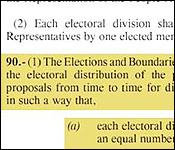
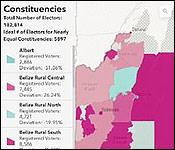
Last night, we brought you part one of our special report on redistricting and how seriously distorted and imbalanced Belize's democracy has become as a result. That's because Belize's population has been steadily growing, but the necessary number of redistricting exercises have not been to keep up.
The best information to 7News suggests that the last exercise was done in 2004, eighteen years ago. Because of that extended delay, the weighting of each vote from a registered elector is not equal, as the constitution calls for. It has created what we're calling "most valuable voters" in the constituencies that are too small and "least valuable voters" in the constituencies that are too big.
Tonight, we take a look at who the biggest winners and losers were in the 2020 General Elections. Daniel Ortiz has that story:
Full Story Video: Some Voters Are More Equal Than Others.
If you believe in democracy and the right to vote, you enter the ballot box on each General Election day with pride to engage in a core democratic duty of electing the leaders of your country.
But what if I suggest to you that our elections haven't been truly democratic for a number of years now?
Ideally, each of the 31 constituencies countrywide should have an equal number of voters. But nobody and nothing is perfect. So, if the expert advice to the Belize Supreme Court is that according to international electoral best practices, constituencies shouldn't be allowed to be more than 10% too big or 10% too small compared to the ideal situation, how far have our elections missed the mark?
In November 2020, the Belizean electorate delivered its verdict that they wanted Prime Minister Briceno and his PUP administration to look after their country's well-being for five years. It was a resounding mandate, and they exited the political wilderness after 13 years of the cold shoulder from the populace.
But, even though the stakes were high, each vote wasn't equally weighted the way the forefathers of Belizean nationhood wisely contemplated.
If you're this far down the "rabbit hole" with me, you may naturally have developed a "Why should I care about this?" itch that will soon need to be scratched. I went looking for possible answers to that question too.
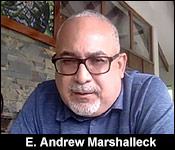
E. Andrew Marshalleck, SC, President, Bar Association of Belize
" We can sit down and argue over that, and everybody can express their views. But, what cannot be denied is that the distribution skews the emphasis placed on localized issues. For instance, we use an example. Belize City is very much concerned about inner-city violence, murders, and crime. And because of the heavy predominance of divisions in the city, those issues translate to the national level and are focused on and given that national priority. Now, I'm not saying that they shouldn't be, even if they weren't skewed the way they were, because those things are important. But, what that has the potential to do, the malapportionment, what it does is it skews localized issues and gives them a level of prominence and importance that they don't..."
Daniel Ortiz
"deserve."
E. Andrew Marshalleck, SC, President, Bar Association of Belize
"Deserve."
Daniel Ortiz
"You have situations where farming communities from out-district areas are ignored."
E. Andrew Marshalleck, SC, President, Bar Association of Belize
"Yes. And also, you have to remember that the budget is voted upon by the House. It has to do with the allocation of resources. And if it is that the majority of votes are centralized in this location, there will be a tendency to direct resources to please those people at the expense of others."
Let's start with the Belizeans, who've been suffering the greatest injustice from the democratic imbalance.
For the 2020 general elections, Stann Creek West had 9,864 registered; the ideal number of electors was just shy of 5,900, so Stann Creek West was 67% too big.
By comparison, the Belizean electors whose vote had the greatest value in those elections came from Fort George in Belize City. In stark contrast, there were only 1,876 registered. Using the striking visuals provided by Total Business Solutions Limited, we see here that their constituency was 68.2% too small. Their vote was worth five times as much as the people of Stann Creek West.
In the animal farm that we love and call Belize, the people of Stann Creek West were treated as the least equal. Despite having the largest number of voters, their influence on the membership of the national assembly was 1/5 of what it should have been.
And the man who they elected was arguably the strongest candidate on the PUP roaster, Rodwell Williams, the politician with the potentially longest list of critics. He said that he had to walk 26 villages to seek assurances of support.
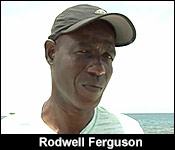
Hon. Rodwell Ferguson, 4-time Winner, Stann Creek West
"I call myself a grassroots politician, and so I keep engaging with the people and experience with them that despite the size, I have a responsibility to serve them. I started my campaign way back in January. I never realized that there was going to be a pandemic. So, when it came, it benefitted me because of what I did; I walked 26 villages two times since this year began. It was hectic, but I knew it was going to be productive."
The segment of the Belizean populace whose vote was unfairly valued the second least was the people of Belmopan. In 2020, their voters' list was 48.5% too big.
Using this comparison of all four general elections: 2008, 2012, 2015, and 2020. We see that they have historically always missed the mark, starting at 19%, widening significantly to 35.5%, then 45.9%, and then finally 48.5% in 2020.
Interestingly, an arguable case can be made that in 2015, John "Big John" Saldivar was the strongest candidate on the Dean Barrow roaster when the UDP made history and became the first party to win three consecutive terms. Remember that he is the politician who the US State Department has designated as "significantly corrupt."
He had a potential list of 9,253 critics who could have voted him out.
Fort George was again the constituency with the highest democratic weight, and at that time, their vote was worth three times that of Belmopan's electorate.
Even though they were the least equal of all Belizeans in that election, 53.9 of the voters who showed up supported Saldivar for his return to the Belmopan parliamentary seat.
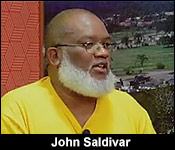
Hon. John Saldivar - Former, Area Rep. Belmopan
"I feel the love of my people. That's all that I can say. My people believe in me and tonight is the result. That's all I can say. Thank you. Look, I am happy to continue to serve my people."
In 2020, however, his popularity decreased massively, and he lost to Oscar Mira, who received 60% of the vote from the electors who showed up on election day.
Two days after the elections, at that time when COVID was this massive public health threat, Mira sent well wishes to his political opponent after reports emerged that he had contracted the deadly virus.
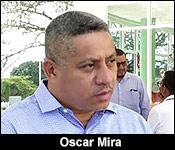
Oscar Mira, Area Rep. Belmopan
"I was told earlier this afternoon that he is hospitalized along with his wife. I wish him a speedy recovery. I really wish him that he recovers safely."
And while the people of those constituencies were the winners and the losers of an imbalanced democracy, we turn now to the ones that did follow the law and the democratic principle of "one man (or woman), one vote."
In 2020, Cayo West, Orange Walk Central, Corozal Southwest, Cayo North East, Dangriga, and Corozal Bay all obeyed the best practice of plus or minus 10% deviation.
Coincidentally, the ones that obeyed the rule the strictest over the course of our last four general elections are Corozal Southwest in 2020, Lake Independence in 2015, Corozal Southwest again in 2012, and Belize Rural Central in 2008.
Put another way, Belizean fans of the Avengers movie franchise would say those constituencies were "Perfectly balanced, as all things should be."
We still have a few more critical matters to share tomorrow, including the link between the Census and redistricting.