
The Portico Definitive Agreement - who knew what and when? Tonight 7News is closer to answering that after the leak of a major document. It's a legal opinion prepared by government's top international al attorney. In April, he advised the government that the Definitive Agreement was unlawful and unenforceable. But, still, one month later the Briceno Government took that same discredited Definitive Agreement to Cabinet - and didn't even mention that adverse legal opinion.
But, up until now - it had been swept under the executive carpet? But why? That's what Jules Vasquez tried to find out:
The Prime Minister tore up the Definitive Agreement two weeks ago - but British King's Counsel Ben Juratowich advised government to do that months before, in April.
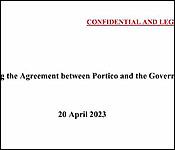
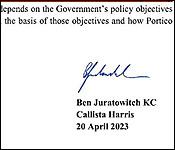
In a legal opinion - labeled privileged and confidential - which has been obtained by 7news from Cabinet level sources - Juratowich makes a compelling case against the definitive agreement.
The 53 page opinion delivered on April 20th, 2023 told the government in no uncertain terms that the Portico Definitive Agreement signed by Erwin Contreras on October 1st, 2020 was bad news.
He says, quote,
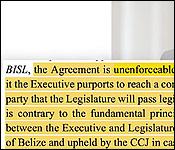
"the Agreement is unenforceable for illegality. This is because in it the Executive purports to reach a contractual agreement with a private party that the Legislature will pass legislation of particular content."
He adds:
"The Executive simply cannot bind the Legislature to pass legislation."
He later says "The result is that the Agreement is unenforceable."
And he advises,
The Government needs to indicate to Portico that the Agreement is invalid and unenforceable, explaining that this is because it was entered into without authority and because its content is illegal as a breach of the Constitutionally enshrined principle of the separation of powers between the Executive and Legislature.
And he then urges the government:
"it is incumbent on the Government to take action to remedy the situation. This is both because the Government should not tolerate a contract it knows to be unlawful and because, if it did, it may ultimately be held to have ratified the contract."
While stressing,
"The illegality of the content of the contract means that the contract is simply unlawful even if the Government were to wish to maintain it."
And re-iterating:
"the Government cannot as a matter of principle lawfully proceed on the basis of a contract the content of which is unlawful."
He could not have been more clear or specific.
But, this crucial legal opinion was not appended to the Cabinet Memorandum number 84 of 2023, in fact it was not even mentioned.
That memorandum expresses no reservations about the Definitive Agreement - which Juratowich so expressly warned about. The memorandum glosses it over, calmly saying, "An agreement was eventually executed on 1st October 2020 between the Government and Portico," as if there is nothing in question about the Contreras signing.
It then urges Cabinet members to treat the definitive agreement as binding, saying, "it is now critical that the tangible support of Government is provided through the introduction of the requisite legislation…which the Government committed to take steps to enact under the Definitive Agreement."
It then urges Cabinet members to, quote, "note the progress of the Project and to approve the tabling of the proposed Bill before the next sitting of the House of Representatives for enactment,"
So, the Cabinet paper - presented by Minister of State for Finance Chris Coye - asked expressly for approval of legislation - as required by the Definitive Agreement - which he clearly felt government was bound by - despite the advice to the opposite by Juratowich.
But Cabinet members - after reading the odious terms of the Definitive Agreement - didn't even need the Juratowich opinion to know they had to reject it.
But, three weeks later - after the whole thing erupted into controversy - oddly, Coye was still talking about a pending legal opinion:
posted (June 9, 2023)
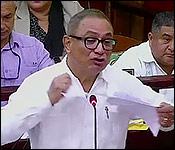
Chris Coye

"I think that all depends on legal advice, the legal advice that is procured on it and it is only based on that advice that the government acts."
But government had already procured top tier legal advice two months earlier - and that left no doubt about what should be done with the Definitive Agreement.
Had Coye not seen the legal opinion from the British King's Counsel? Or had he seen it and dismissed it? And why hadn't other ministers seen it?
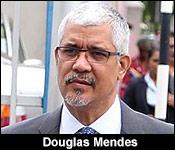
But, Government did turn to another legal opinion - that of Trinidadian King's Counsel Douglas Mendes - which Francis Fonseca extracted from in the House on June 16th.
posted (June 16, 2023)
Francis Fonseca, PUP Freetown Rep
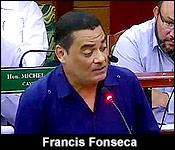
"Mr Mendes has advised that based on his portfolio and having regard to relevant case law, Minister Contreras as he then was, had the implied and ostensible authority to execute the definitive agreement."
"As Mr Mendes advised, whether we like it or not, the agreement represents a potential legal liability to the government of Belize. Until otherwise established by a court of law. So the Ministry of Finance Economic Development and Investment had a duty and obligation to bring the matter before the Cabinet for discussion and review."
Of course, we now know it wasn't taken before Cabinet for discussion and review, but for ratification - which Juratowich had advised would be the worst step government could take.
So, why did certain Cabinet level actors in Government ignore the advice from its most eminent legal advisor - what pushed them to press on as if they were bound by the Definitive Agreement?
Hopefully these questions are answered when the Senate Special Select Committee is convened in the coming weeks
Best estimates from those with knowledge of how much British King's Counsels charge, say that the cost for preparing a legal opinion of that nature and breadth would be close to 100,000 pounds, which is about 125 thousand US dollars. That cost, of course, makes the fact that it was swept under the rug even more conspicuous.