
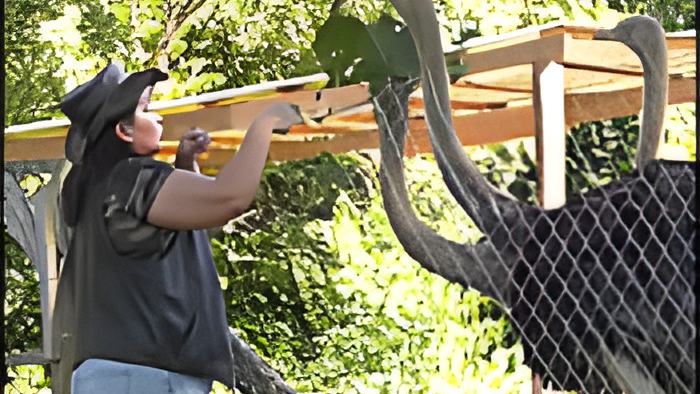
In February, we visited Nancy Marin's farm in Georgeville, Cayo for a fascinating look at the imported exotic birds - that looked very odd in this tropical setting. Marin wanted to open the conversations about starting a new ostrich meat industry - but she was all tangled up in red tape between BAHA and the Forestry Department - which made it seem that her plan was about as grounded as one of her flightless birds.
But, the clouds have cleared and BAHA has now taken the lead in a double edged regulatory process between their office and forestry.
We spoke to the BAHA Chairman this afternoon - who says that - once all the regulatory provisions are met - he's in favor of an ostrich industry for Belize:
Hugh O'Brien, Chairman, BAHA
"My advice as a senior agriculture person in Belize with the background and history that I have and knowledge will be to advise for ostrich farming to be embraced is a new activity for farming in Belize. The decision on whether ostrich can be grown in Belize in terms of a policy is a decision that has to be made primarily by the ministry of agriculture, because its going to be a farmed animal, but because it is an animal enlisted under CITES, because its considered an endangered species, then the forestry department has got to be involved in any decision to grow or not to grow ostrich in Belize. Forestry department is not so concern about the growing of ostrich. Forestry department is concerned about when that whoever is growing ostrich wants to trade the products that are produced, then for those things to be traded the forestry department will have be able to issue CITES certification of origin for those products. So, if you're going to grow ostrich and you're not involved in the forestry department, you are going to have problems when it is time for you to export or even sell your products locally. We had a very clear communication with Miss Nancy Juan Marin who wants to raise ostrich. I explained to her the results of the meeting, I said to her that the first step is that we have to finalize the pest risk analysis and tomorrow they are having their final meeting to finalize the pest risk analysis and once that is finalize, I can give you some inkling. It's not going to be a threat to Belize, based on the initial feedback that I've gotten. Then the next step is to for this ostrich farmer who is Miss Nancy Juan Marin to present to forestry department the origin of the current, I think she has 3-4 ostrich at the farm - the origin of those ostrich. Because you can't start a CITES certification with a blank paper when you have 3-4 on your farm, so essentially we agreed, forestry and BAHA that there are I think 2-3 people with ostriches in Belize. They also have to provide that documentation, if they are going to be interested in expanding their farm operations and forestry is going to provide okay, tell us where you got it, even if you got it illegally from Mexico, let us know which farm it came from and we'll start from there."

"The next step is going to be an inspection of the farm, in this case to make things simple, we're going to do a joing inspection, so BAHA and the forestry department are going to go in together along with the ministry of agriculture and do a joint inspection, make some recommendations, at the same time Miss Nancy Juan already have her management plan fairly well advance in terms of her preparation. So they are going to be sharing ideas on how to improve that managing plan. Once that is complete, there is a one stop process we've put in place now, so somebody does not have to apply to both forestry and BAHA and once she gets the approval which we anticipate to be targeted by the end of June, but some slippages have occurred so we may go into July and our anticipation is that somewhere in July - let us say there is further slippage - late July and maybe early August ostrich farming would be an activity that will be commencing in Belize and government of Belize, the minister of agriculture in particular have already made the decision that ostrich farming will be promoted and there will be efforts to encourage other people to get involve."
Jules Vasquez
"Do you see the Mennonites who are the kings of poultry eventually stepping in to ostrich meat?"
Hugh O'Brien
"Thats an interesting question, but I will say this, we have to be a bit careful. These people are very hard working, they work together, I'm talking about the Mennonites, they work together, they work strategic, they share their resources, they don't have to find cash for all their activities, because of the cooperation system that they have. But I'm saying that in the context that the Mennonites are dominating our food production and processing in Belize and while that is a good thing for food security and so forth, it is not a good thing to some extent. I can go as far as to say my black people, we're not moving ahead. We staying behind and then we now starting to complain that everything that's been done is for the Mennonites and in time it's going to become a bigger problem for us and people are going to say well you know, some of what you have is mine. So, I would advise in a sense the Mennonites maybe, they need to start stepping back from certain things and this might be one of them, like ostrich, leave the sheep farming, leave the vegetable farming, leave the ostrich farming to the non-Mennonite Belizean."
So, that final meeting on the pest risk analysis is being held tomorrow and after that there should be some certainty on the way forward for ostrich meat in Belize. As O'Brien says, he is in favor of forming that industry, once all provisions are met.
But, this isn't your regular chicken, so don't start warming up the grill for an Ostrich barbecue just yet. O'Brien says that Ostrich meat sells for as much as 30 dollars per pound.