When the police send out reports on the destruction of marijuana p plantations, it seems simple enough: "so many thousand plants were uprooted and destroyed." But that one line description tells nothing of the days of very hard work that goes into that effort. This weekend Alfonso Noble found out firsthand how plantations are found and destroyed. After taking a very necessary day to rest after three days deep in the jungles of the Chiquibul Reserve, he found out that "uprooting and destroying" drugs is just about the hardest thing he's ever done.
Alfonso Noble Reporting,
It's six on Saturday morning and a platoon from Echo Company at Camp Belizario makes its final preparations for the task over the next 3 days. The platoon of 11 men, including one police officer from the Special Patrol Unit receive their final briefing from Officer Commanding Echo Company Captain Thomas Cal.
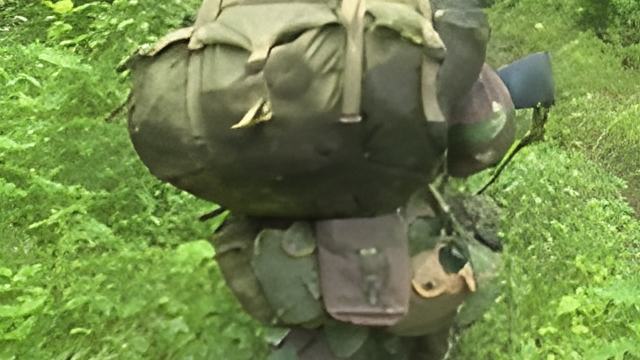
Then they load up into an awaiting Land Rover and a Hilux Pickup truck. We then travek to Arenal and from there on to a track that will lead us to a marijuana plantation. If the road conditions and the first obstacle, a herd of cattle, is any indication, it's going to be a long and weary road. We creep behind the herd of cattle for a few more minutes and then it was up to normal speed which through this track is pretty slow. Soon enough these 4x4 vehicles are put to the test. With this kind of terrain it's not long before the men unloaded and the walking began,
It would seem that time is no factor and the distances are irrelevant, but in the middle of the jungle that is not so. Every so often we pause to take time to ensure that we are on track in Belizean territory checking maps and taking GPS readings. Calling in our progress to command post as we trek along.
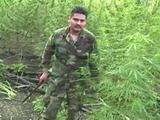
After 5 hours of walking we arrive here at Thermo Camp where Captain Cal has decided to give the guys a break and we'll have a quick lunch. Ramen Soup, fire, and the grill. The men brew their meals, stirring packs of Ramen Soup, or rice or whatever is their preference from their day's ration and we eat. With a meal in the stomach team leader Cal presses on. The rest of the day continues pretty much this way. Until we arrive at our campsite. As night falls we have to prepare sleeping accommodations and that means the soldiers and myself set up our bashas. By this time I am dead beat and all I could think about was sleep.
The following morning, Sunday morning, the team is off again, Cal and a reconnaissance team had already found the marijuana plantation. By 2 in the afternoon the team is moving again up and down countless grueling hills. On the way to the plantation the soldiers discover some lumber ready for extraction through the nearby trails. It's been illegally extracted from the Chiquibul Reserve and it is bound for Guatemala. The soldiers make their way to it, count it and measure them. There are 33 pieces ranging in dimensions and ready to be hauled off.
With that task completed, the men press on in search of the marijuana fields. Soon enough a clearing is visible where we see marijuana trees. Cautiously the soldiers make their way into the field. Sure enough the plants are there and they are mature. Then it is time to move in and Cal gave the men the signal to advance. The target was a hut at the top of a hill, presumably used by those who take care of the field. Slowly the soldiers move in on the hut but find no one inside. With that, an inventory is take, soldiers noting about 50 Xate seedlings and a few other possessions, but not much else. The structure was located just a few meters from the border line and from that vantage we could see acres of corn as well as the marijuana field. The signaler as he is called, Corporal Marroquin, then places a call to command to confirm the find.
Corporal Marroquin,
"We have approximately eight to ten thousand plants marijuana at 2 to 8 feet in height."
That was the preliminary count but it would be off by at least 10, 000 plants. The final count came in at 20,000 plants.
Capt. Thomas Cal, Commanding Officer Echo Company
"We are out here roughly six miles south of Arenal and at our present position we are almost two to three hundred meters east of the international boundary between Belize and Guatemala."
After walking for about a day and a half we finally reach it: the marijuana plantation, and the next objective is to destroy it.
Capt. Thomas Cal,
"The procedure for us when we identify these marijuana fields is to first of all report the position, the exact location so we can get a confirmation from headquarters on whether we should go ahead and destroy ourselves or wait for further instructions. In this case its definitely in Belize, we're destroying it, rooting out and cutting all the marijuana field, we'll bundled them together
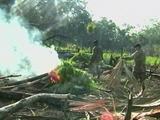
and burn them. It appears that this is the third crop for this region as we've seen that there's more mature plant that have been cultivated and harvested in this region. Also between where I am standing right now, which is the marijuana field, and behind me, is a cornfield also leading up to the border. Just east of the border, about 20 meters, there is a small hut which is used temporarily by three to four individuals that would come here, I would imagine on a weekly basis, to take care of their cornfields and also take care of their marijuana fields."
Those who take care of the fields are not Belizeans, Cal speculates that because of the location of the marijuana field, the cornfield and the hut, all almost on the border line, the people cultivating out here are Guatemalans.
Capt. Thomas Cal,
"In this region between Arenal, going south passing through our location towards Caracol, it's a reservation area and you find out that the entry points are numerous and its not accessible by Belizeans. Its rather more accessible by the Guatemalans and so readily I can say these cultivators are mostly four Guatemalans, as you can recognize right where you are, its right along the border, and you may have noted that we have to come in a long way to get into this position, going through rugged terrain before you can find reasonable tracts or frequently used tracks to get to these marijuana fields."
After this operation though no one would get to these marijuana fields any more, the soldiers made sure of that by first burning down the thatched hut and then cutting down and burning all the marijuana trees some of them oddly resembling Christmas trees. The complete destruction of the plantation took the BDF soldiers until Monday afternoon and from there we trekked out. As for me this was what is was like simply trying to stay alive and catching a desperate breath when I could. And while I fought for dear breath, for the men it was just one more mission accomplished.
Authorities say that there are two larger marijuana plantations in the area but they are unable to destroy them because they fall in Guatemalan territory.