In related news, a decision by the National Forensic Science Service to halt testing on open alcohol containers for minor public drinking charges has raised significant concerns among local law enforcement and the Belize City Council.
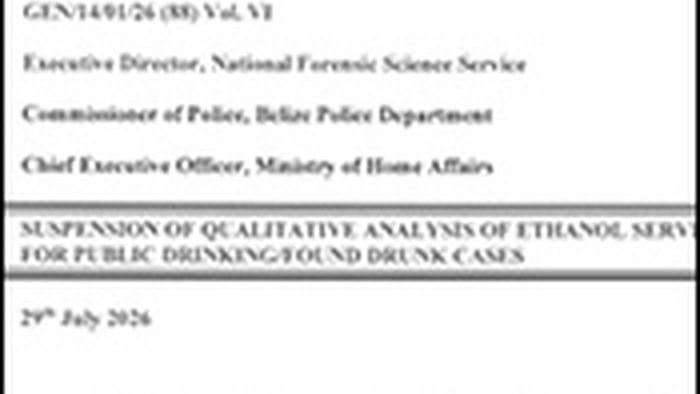
In an official memorandum dated July 29, Executive Director Gian Cho announced that effective October 1, the laboratory will permanently suspend its Qualitative Analysis of Ethanol service. The service—most frequently requested by police and municipal officers pursuing charges for public drinking or being found drunk—involves testing to prove the alcohol content of seized beer or liquor bottles.
While the NFSS views the suspension as a vital move to streamline operations, reduce case backlogs, and pursue international accreditation, local authorities worry the decision creates practical and financial hurdles for municipal enforcement and court convictions.
In the memorandum, Director Cho outlined a clear case for phasing out the testing, citing severe operational bottlenecks. The laboratory's limited team of Forensic Chemists currently processes over 700 drug cases annually, and spending time on minor public drinking offenses threatens to delay major drug cases to the point of dismissal.
Furthermore, running chemical analysis on a $200,000 instrument that relies on costly imported parts to secure a conviction with a maximum fine of just $25.00 offers virtually no return on investment. The NFSS emphasized that the same specialized equipment and analysts are urgently needed for higher-priority cases.
The low cost of a fine is what Jermaine Hyde, the City's Courts Manager, discussed at a town meeting on Tuesday night:
Jermaine Hyde, Court Manager
"And I just want to share I know it has been mentioned several times here, public drinking. I just want to show you in terms of what it costs whenever somebody is found guilty of public drinking at the court, the fine is $25 plus $5 cost of court. Now I will tell you this, when our officers charge somebody for public drinking, the test, because we have to test what we take from them, the sample, the test to get that done at the lab in Ladyville is $150. We are already operating at a loss to get the sample from Belize City to the lab in Ladyville costs for us to transport it to Ladyville. So when we look at these expenses and we look at what the fine is, doesn't balance. So when the legislation came into reality years ago $25 is a lot of money, but now when you look at the cost of actually getting a successful prosecution at the court we are over $200, $250, it is ten times more than what the actual fine is. So we really really need to have legislation that is current, that is modern that will allow for us to have compliance."
As an alternative, Director Cho suggested that police and municipal agencies forward testing requests to the Hummingbird Analytical Laboratory at the University of Belize, proposing that offender fines could help offset third-party testing fees.