
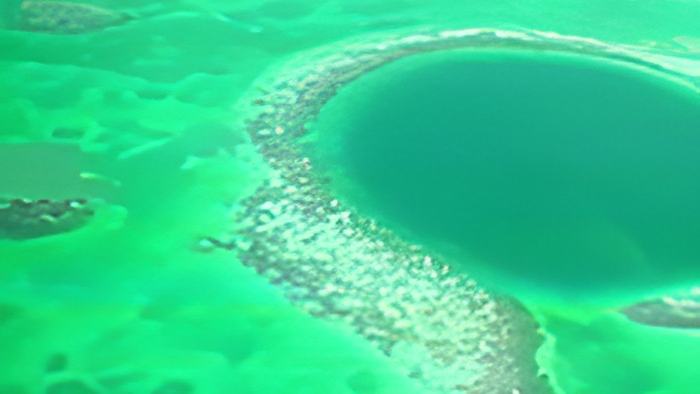
At 400 feet deep and a quarter of a mile across the Blue Hole is one of the most incredible dive sites on earth, sought out by divers throughout the world. Well tonight, we'll take you to the bottom of it. Our colleague at the San Pedro Sun, Ron Sniffin teamed up with a high tech scuba crew from Dive Portal Magazine and tonight he has their story of what it's like at the bottom of the Big Blue.
Ron Sniffin Reporting, The [San Pedro Sun]
The pristine waters offered by the Caribbean Sea and the Great Barrier Reef off our coast has made Belize one of the most popular diving and snorkeling destinations in the world. And topping this destination is the mysterious Blue Hole. While thousands of divers have descended into this unique formation, no one has documented reaching the bottom, until now.
John Chatteron, Diver
"We came to Belize to dive into the Blue Hole. We are deep technical divers so we were interested in visiting the bottom. We're not the first divers to set our sights on the bottom of the Blue Hole. This isn't the deepest dive we're ever made. This isn't the most difficult or dangerous dive we've ever made but when you start approaching four hundred feet of water in a relatively remote location, its going to be a challenging dive and that's really what interested us, the challenge. We got into the water, we went down, got to the bottom expeditiously, we explored the southwest corner of the hole, which was our target area. Our maximum depth in that area was 365 feet. It wasn't as deep as we were expecting, we thought it was going to be more in line with 400 feet but it is what it is."
Ron Sniffin,
What did you see at the bottom?
John Chatteron,
"The bottom has a layer of fine silt
that is very soft and about four to six inches thick. Below that is a gravelly sediment. There is, in the area of the southwest corner, there is a bunch of pieces of dive gear, weight belts and whistles and snorkels, things like that. But it looks very much like sand dunes. Its growing, its not flat, its not desolate, it's a very interesting configuration and it seems to go on for quite some distance but its not uniform. The walls there are overhung. When you get down to about a hundred feet, everything kind of comes out like this. Below a hundred feet it comes out into a big belt so from the bottom when you look straight up, if you've got the wall right along your side, all you're seeing is rock for fifty to a hundred feet out so it is a substantial overhang."
To dive to these depths takes a tremendous amount of experience and skills but it also takes a very specialized type of equipment.
Richie Kohler, Diver
"They are very small and very compact so I'm still diving with tanks of air. The beauty of this system is that these two tanks, one with oxygen and one with, in this case 10 oxygen and 90% helium, we're able to stay under water with this unit approximately five to six hours regardless of depth, this doesn't care whether you're at 30 feet or 30 feet, you can stay under water until it bottoms out in six hours. Show me a tank that can do that."
John Chatterton and Richie Kohler both host the History Channel program, Deep Sea Detectives. While the Blue Hole footage will not likely make this program that focuses more on shipwrecks, the Blue Hole will be featured in their new DVD titled Dive Portal Video Magazine which focuses on extreme diving. From San Pedro for the San Pedro Sun, Ron Sniffin, News Channel 7.
7NEWS produced for broadcast by News Director Jules Vasquez
Edited and Prepared for the internet by Keith Swift