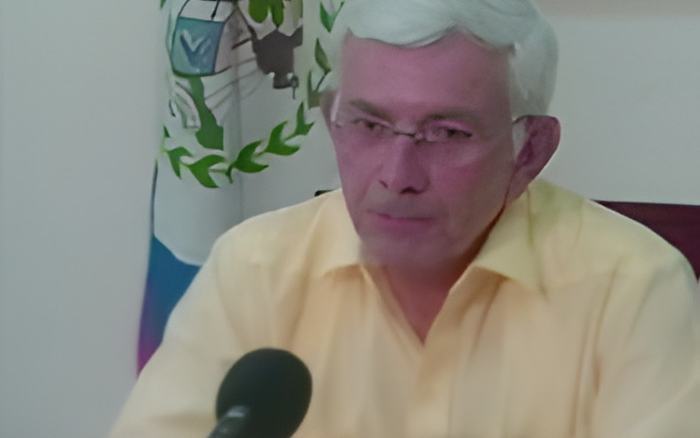
In June, we told you about excavations at Cahal Pech in San Ignacio. For Director the Institute of Archaeology Jaime Awe it was a happy return to his stomping grounds, the place where he did research for his doctorate degree. Along with students from Galen University, he set out to find out about the Maya Middle Class - since so much is already known about the elites. Now in another installment of our series with Dr. Awe called 'Glimpses into the Past,' he explains that while he set out to do one thing he ended up with something completely different.
Alfonso Noble Reporting,
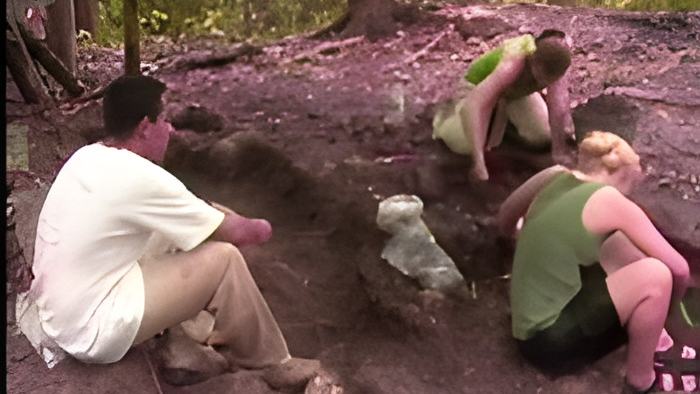
This summer archaeology students from Galen University got their hands dirty in this dig at Cahal Pech.
Dr. Jaime Awe led the excavations. He says it was to have been mostly unremarkable, decidedly unglamorous archaeological work, to look at the lifestyles of those at the lower end of Maya society. And while they set out on a workmanlike mission, they ended up with something completely different - this burial tomb bedecked in treasures of the ancient Maya world. Awe told us how they stumbled upon this trove of riches.
Dr. Jaime Awe,
"We decided to excavate a small section of the site that we had never looked at, where the mounds are no higher than about two feet, and the reason for that is that in the past we've tried to find out about how the rulers and the elite people live. I wanted to see how the common people lived, the lower classes that lived in the downtown area. Gradually we started to expose a lot of these big stones that had been piled up in one corner of the building and it was obvious that these stones had been sort of looted, if you want, from other buildings and this happens especially until the decline of Maya civilization. We cleaned up all the stones and then we removed them and we started to go down but we were going through a lot of dirt and then we started to find the walls of what seemed to be a chamber and then we realized this is not just any burial, this is a tomb that had been filled in."
He explains that usually tombs are only covered with a cap and are left hollow. That was not the case in this burial site.
Dr. Jaime Awe,
"In this situation it was different because the Maya had buried this individual and then put in some nice offerings and artifacts and then they covered it with dirt and put all these big stones on top and so it took us much longer to excavate and when we finally finished exposing it, these are things that we discovered. Down by the feet of the individual we found probably the complete skeleton of a feline, some large cat, I think it might be jaguar. It means that these people sacrificed a jaguar to put in this tomb. Then further up, especially around the head area, there were several ceramic objects, or vessels. We had some bowls, we had some dishes, some plates, and two incense burners."
Along with the incense burners, they found a breast plate made of more than 40 dog teeth, deer bones and jade sewn together. This was along with this well preserved vase which awe compares with to the legendary Buena Vista Vase.
Dr. Jaime Awe,
"It looks a little bit like the Buena Vista Vase but what is different from it in terms of when you compare it to the Buena Vista Vase, is the image that it depicts. On the Cahal Pech one it depicts this weird sort of individual. In fact I refer to it as a 'manimal,' just joking of course, because it looks like part human, part animal. If you compare it to the Buena Vista Vase, which is painted like I said in the same stylistic tradition, but the imagery on the Buena Vista Vase is superb in comparison, it has these two Lords, very likely the hero twins, all their regalia, beautiful fancy dress with their fancy headdress and very likely representing either rulers or the hero twins and then hieroglyphs which say this was the drinking cup of some Lord from the site of the Buena Vista. The Cahal Pech one is a little simpler than that because it is more recent, in other words the Buena Vista one is a little earlier but it shows that this art style still continues on."
And more than just that continues on. Awe says that the recent unearthing of the tomb would suggest that sometime between 850 and 1200 ad the Maya repopulated the site of Cahal Pech albeit at a smaller scale.
Dr. Jaime Awe,
"This is one of the largest tombs every discovered at Cahal Pech. We have several other tombs that we've found at the site but they are not as late, they are much earlier than this one. This one was over about eight feet in length and about four to five feet in width, just a huge tomb, and it dates to about 850 to 950 AD at a time when Cahal Pech had been abandoned, these are people who are moving in and re-colonizing, if you want, coming back to this place that's sacred."
Now Awe is linking this tomb to previous discoveries made a few years ago during the restoration of plaza A. At that time archaeologists found broken pottery and the remains of other items at the base of the stairs. While some speculate that this may just be refuse, Awe disagrees.
Dr. Jaime Awe,
"I don't think so because when we look at the materials that we are finding, we could put most of these pots back together and we are finding things like figurines that had been purposely snapped, nice projectile points or spear points, we also have a spindle holes that they used to use to make cotton around the spindle and these are complete objects. These represent offerings. This is not garbage. No sensible monarch would throw away perfectly good functional objects but they would put them as offerings. We found this burial that they dug into one of the rooms of this child and as we start to go down, we started to see several pots and then at the bottom we found the skeleton of the child with this little whistle. This other picture here shows you some of the whole pots we found with this child. the discovery of the tomb now makes a lot more sense to us."
These most recent discoveries then tell Awe that while he was originally looking for the Maya low-end, what he in fact found was the same Maya elite in a less flamboyant era. Now he says if he=s to ever dig again for the Maya middle class he=ll have to look elsewhere.
Dr. Jaime Awe,
"The next time I go back to excavate at Cahal Pech, I might have to go outside of the city center and look for evidence of more common people to really get a better sense of how the support population really lived."
Eventually, the new finds will be displayed at the Cahal Pech Visitors' Center.
7NEWS produced for broadcast by News Director Jules Vasquez
Edited and Prepared for the internet by Keith Swift