
For over ten years the old fire station that houses the Water Taxi Association has been home to the maritime collection courtesy of the Curry family. But with all the traffic at the terminal it's been overlooked and neglected. Now the Museum of Belize has taken over the natural history collection as well as a collection of boat models that were once housed at the terminal.
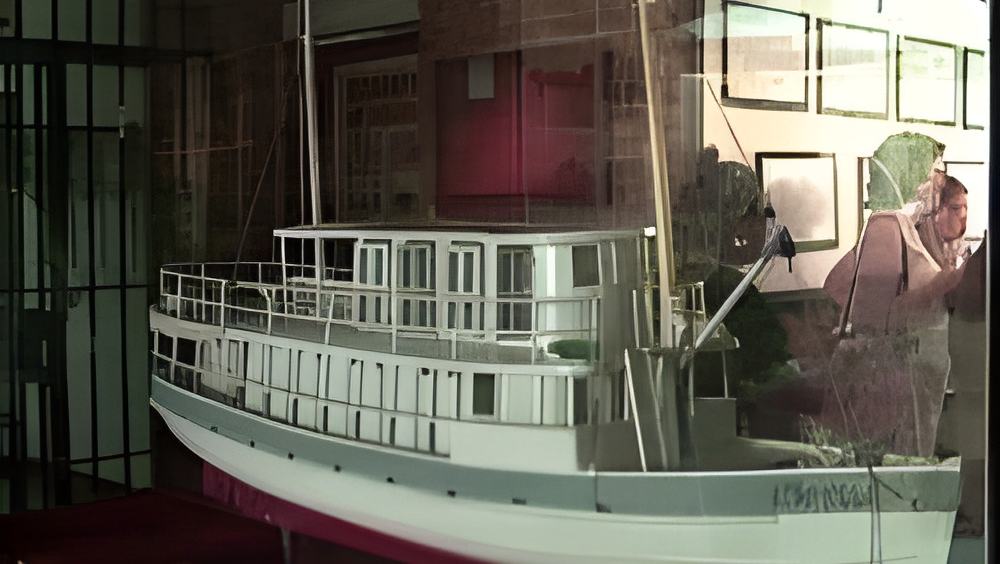
So today it was like a rebirth of the maritime museum. It began with the re-introduction of one of the favorite pieces, a scale model of a well know boat that once moved people and cargo between Belize City and the northern districts. We were at the Museum of Belize this morning for the re-introduction of the Afri-kola. Alfonso Noble tells of its fascinating history.
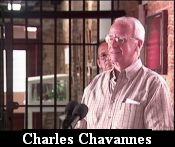
Charles Chavannes,
"It is hard to imagine that at one time in this country the only way you could to get any of the southern cities, or any of the northern cities, was by water, west to Cayo by water, so the boat played a very important role in the history of Belize."
Indeed in the formative years of the then British Honduras colony the only means of transportation was by boat. These were the times of boats like the Heron-Herbert Lord, the Sarawee, and the LGS, but most notable among the cargo and passenger sea-going vessels was the Afri-kola it was the titanic of its time Charles Chavannes the grandson of the owner explains that the Afri-kola was launched in October of 1922 making runs to the southern part of the country at first.
Charles Chavannes,
"The Afri-kola was launched in October 1922 and she made her maiden voyage on the southern run. It started in Belize on Wednesday, traveled down Stann Creek and all the places and ended up in Punta Gorda, crossed over to Puerto Barrios, turned around and came back and was back in Belize on Saturday."
The fortunes of the Afri-kola would change 3 years after its maiden voyage with the unfortunate demise of a smaller cargo and passenger vessel the EML which made runs to and from the northern district. That sank in 1925 killing one Bishop Hopkins and two Pallotine nuns as it did. After that tragedy the government of the day requested that the Afri-kola make runs north.
Charles Chavannes,
"It was at that time that the government then requested my grandfather
to take up the northern run and so he decided he would give up that southern run and he sought the north. At six o'clock on Monday evening the Afri-kola left the wharf. At 5:30 the first vessel went off, at a quarter to six the second vessel went off and by six o'clock when the third vessel was gone, Afri-kola was cast off and leaving the wharf already.
The Afri-kola traveled all night long through the treacherous way on the way up there. She arrived in Corozal on Tuesday morning, off loaded cargo and passengers, left Corozal at about ten o'clock and headed up the New River where she went to ports like Caledonia, Santa Cruz, Pueblo Nuevo, and eventually San Estevan before ending up in Orange Walk. Overnight in Orange Walk while they unloaded and turned around on Wednesday morning and headed back to Belize doing the same thing; people, cargo, at all these stops. The kind of cargo that was transported and brought back skins, alligator skins, corn, chicle from the interior, and sugar - that's how we got the sugar into Belize."
Chavannes who was a boy in the time of the Afri-kola can fundly recollect the experiences travelling up and down the northern coastline, and as he has those recollections he's pleased that he himself can claim a part of Belizean history.
Charles Chavannes,
"I have a detailed recollection of just about everything and every place she stopped and I enjoyed every minute of it. I am happy to know that someone has taken the effort to try and preserve the history of that time of when we could not travel to Corozal or Orange Walk or any of the other places in this country other than by sea. It makes me feel good that I am part of the history of this country."
The man who can claim the revival of a bygone era is 90-year-old Simeon Young.
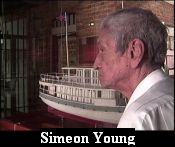
He remembers that he was commissioned to construct this model of the Afri-kola back when George Price went to England, that's in 1993 during the British withdrawal from Belize. He recalls vividly how long it took for him to make this fine scaled model of the boat.
Simeon Young,
"It took me about a week. It was me alone working on it. I made the mother first. It was three of us working. I went to Corozal in this boat because they used to run from Belize to Orange Walk and Corozal, this same boat."
While he may have gone to Corozal in this very boat his craftsmanship can now transport younger generations to that era just by looking at what was the premier means of transportation in the early 20's.
Similar unveilings will take place at the museum staggered over three month periods. The remainder of the maritime collection is now being housed at Old Belize.