
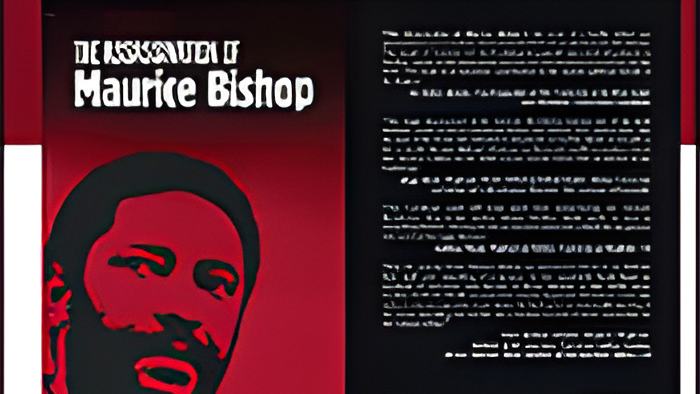
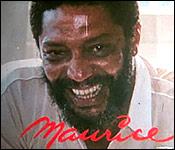
Last night we told you about Godfrey Smith's new book, "The Assassination of Maurice Bishop." It takes the reader to the island nation of Grenada between 1979 and 1983 which witnessed the rise and fall of the English-speaking world's only socialist revolution.
And, after the fall, came the American invasion…. that's where we pick up the story with the author tonight:
… and to destroy the Caribbean's only - English speaking Caribbean's only - successful revolution.
When that revolution fell in executions, bloodshed and explosive civil unrest, the US invaded Grenada two weeks later in what the UN called "a flagrant violation of international law and of the independence, sovereignty and territorial integrity of that State."
But Smith sees it differently:
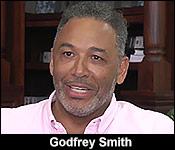
Godfrey Smith, Author
"There is a contrary view to mine held by some of who were involved in the demise of the revolution that this whole thing was because the United States and it is the United States who mashed up the revolution by their invasion which some called an intervention. My own view and readers will form their own view that, those who were opposed to Bishop Bernard and his acolytes served up Grenada on a platter providing the perfect pretext for the United States, who had long been wary of them to invade, take power and to turn back the revolution."
Jules Vasquez
"Your narrative somewhat lets the Americans off the hook."
Godfrey Smith
"No, they are not let off the hook, they we're certainly watching it, I accept that there is a chance they may well have invaded later on down the road. The tragedy for me is that these fellows destroyed it themselves."
And that government fell in the year before George Price's PUP lost its first election - 1984. The two events are linked only by an early 80's timeframe, but what are the similarities between Price and the other transformative Caribbean leaders Smith has written about?
Jules Vasquez
"You have looked at now 3 transformative leaders in the Caribbean and the contrast between them are fascinating, especially when these two Afro-Caribbean leaders island men, are contrasted with our ascetic Mestizo Creole George Price, a mainland man. How would you compare these leaders?"
Godfrey Smith
"They are all three different but the thing that puts Price completely a part is his almost gandhian ascetism. His lifestyle was completely ordinary. He had one bag that he used to travel with, a little shoulder bag. One suit that he used for quite a long time, lived very humbly, one small refrigerator, roach infested kettles, he was basic, he was almost like a Gandhi. Manley certainly wasn't like that and Bishop was somewhere in between both men in my view. In terms of their fixity of purpose, all three had fixity of purpose, all three were committed to an ideology because even anti-colonialism can be characterised as an ideology. A big point of departure is the international scene. Maurice Bishop and Michael Manley were both titans on the international scene, they were hugely charismatic speakers, they could move crowds, tens of thousands. Price astute, he attended to avoid and even appears to be shy with cameras and the media and being international attention, while Manley and Bishop live for those moments."
Jules Vasquez
"If you are a citizen in the mid 1970's, and you have those three names on a ballot to pick as your prime minister. Who do you vote for?"
Godfrey Smith
"I think personally it would be hard not go with Michael Manley, simply because of his immense charisma and his speaking skills, his magnetism, the man really was phenomenal."
Jules Vasquez
"Explain to me if you can the influence and input and prescience of the Cuban wisdom in this entire undertaking of a socialist revolution."
Godfrey Smith
"Cuba always tried to tell these fellows, look what worked for us might not necessarily work for you. You don't have to proclaim socialism from the ills, in fact specifically Bishop told that by a very erudite Cuban now living in Jamaica, warned them, you can't be proclaiming vanguard socialism, you have to try keep the alliances of the churches, you've built the business classes, etc. And he was trying to suggest more of social democracy that is not as frowned upon in Europe and other places as Marxism is."
But, they didn't listen and history now tells a tale of a revolution unravelled and comrades turned executioners.
Smith's book accurately captures this descent into ruin and envelopes the reader in palace intrigues and covert manoeuvres as one sinister turn begets another, until it all turned over. It's real history that moves with the pace and suspense of an espionage novel:
Godfrey Smith
"I am conscious every step of the way of writing the book that it has to be high paced, readable and intense. It also means it has to be short, it can't be 3, 400, 500 pages because even me and I consider myself a fairly disciplined reader have difficulty going through some of those tomes that are 5, 600 pages. So, it's at a very modest 220 pages, it's easy to handle, easy to read and that is deliberate."
The book is available for $50.00 at Smith's Marine Parade Law Chambers.