
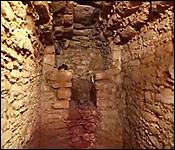
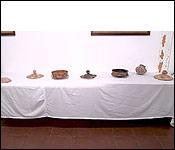
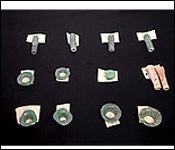
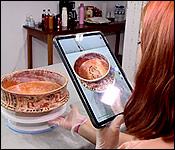
It may appear as just a few pieces of bone and jade jewelry, and old clay dishes with designs, but these ancient artifacts actually belonged to a Maya King, and were found in his tomb. The Institute of Archeology under NICH gave the media a brief tour today to showcase some of the items that were recently excavated from the Caracol temple. Jomarie Lanza has this story.
These are just a handful of the estimated 50 pieces of artifacts that were recently excavated from the tomb of the Caracol king Te Kab Chaak. Archaeologist Rumari Ku told us that they managed to quite literally piece together some of these items which led them to confirm who's resting place they had uncovered.
Rumari Ku. Archaeologist, Institute of Archeology
"What we have here today is only specific to the tomb and that is quite a lot considering who was in there and the materials that were being pulled out are very important so it is quite a number. Here we only have a couple just so that you guys can see the variety that kept coming out so you have pottery you have jade you have bone. All of these things kind of give an idea of who was in there and add on to all of the aspects of who he was."
"The person who was actually found in there was of course one of the dynastic rulers, when it comes to that he was not buried with common household items he was buried with very elite, high end material so when it comes to ceramics you usually find a lot of ceramics everywhere, when it comes to sites. These ceramics are very important because not only are they painted and polychrome meaning they have different designs on them but they are also formed in a way that they represent something so if you see the top of the lids for all of these pieces they all represent an animal on them so that itself goes to show that they took time to make these types of potteries the designs and engravement on the bone was really important because it meant that they took time to really bury this man with the finest things that they could find. Jade is an important thing here in Belize and of course that being within the tomb gave a representation of elite, of status and that adds on more of who was in that tomb so he wasn't just buried with household items he was buried with the finest things that they could find and give him."
Part of their process as archeologists also involves analysing these items by way of 3D photogrammetry. By taking pictures of these items from a number of different angles it enables them to not only share their discovery but also better manipulate the artifacts without having to tamper with them, especially for those most delicate.
Katherine Coye, Research & Enforcement, institute of Archeology
"So in the research unit of the institute we are in charge of documenting and preserving any way possible any artefact that comes out of Belize that is what we refer to as the national collection. And one way that we do this is by creating 3D photogrammetry models of the artefacts that are best suitable for that so you might see that we are only using the more complete vessels that are not reconstructed temporarily but the reason we do this is because sometimes things happen and we live in a region that is kind of prone to natural disasters and because we dont have sometimes the best facilities that will properly protect these things from floods or hurricanes one way we can perfectly preserve an artefact as it's been found is through digital photogrammetry. So the process of that is taking several pictures from every possible angle of the object and the programme basically stitches those together and creates a nice little module in 3D space."
Coye says it is a useful programme, especially for students and those with a curiosity who are unable to see the objects in person.
Katherine Coye, Research & Enforcement, institute of Archeology
"The 3D modules are a more immersive experience. For example many people dont know what the back of the jade head looks like they don't know what the underside looks like and another great part about the 3D scans is that they also capture how we catalogue artefacts so people know that we are keeping track of these things and we know where these things are and we know exactly where they were found, what they might have been used for things like that."
"We have collaborated with the ministry of education and they have this wonderful website called access 501 and each of our archaeological reserves will have a tab the terrestrial ones that is. The terrestrial archaeological reserves have a tab and they have various artefacts from them that have been scanned and im sure we will be expanding that collection in the future."