
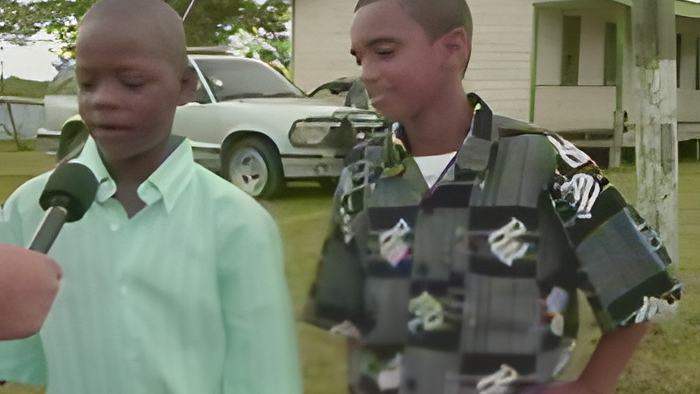
It's Youth Hostel Awareness Week and those who run the institution are trying to improve the public perception of the facility. It's awareness and fund raising, which we've seen before, but as we found out today, difference making is what the Youth Hostel is really doing in the lives of 25 young men and women.
Jules Vasquez Reporting,
The Youth Hostel - the commonly held belief is that it a prison for wayward children. And true enough, the 10 girls and 15 boys, all under 17, who are here are troubled cases and they are kept in by thicked grilled windows, if not prison bars. They are here for offenses such as theft, drug trafficking, burglary, and that ominous catch all term: uncontrollable behavior.
And when Belize's children become uncontrollable, this is where they are sent to be reformed or simply kept away. But for those who run the hostel, it is not just a place to discard wayward children, it is an opportunity to turn their lives around.
Glendamae Martinez,
"We try our best here to try to see how we can break that cycle. We will not get a 100% but we will try to see how we could get as much as we can to start to see themselves as being special and that they play a important role in society today."
And that lesson of personal value and values has not been lost on 12 year old Tyrone Smith, who will be here for six years, and 13 year old Luis Moreno, who will be here, he says, for a few years. They are here for.
Alfonso Noble,
Why are you here?
Luis Moreno,
"Uncontrollable behavior."
Alfonso Noble,
And you?
Tyrone Smith,
"Uncontrollable behavior."
But this morning they were ever under control when they gave us a tour of the chicken and pig rearing program. And they seemed as decent and knowledgeable as two gentlemen farmers. Their job is to wash the pigs, in fact they do such a good job that these pigs are denied of a properly swarthy sty. They also rear these chickens, and Tyrone has his eye on this one.
Tyrone Smith,
"This one here we will kill and eat. Sir sometimes when we don't get donations and so this will be big and this is what we will eat. Hard time will stop because we got food right in here. We have 127 or 128 chickens but this is the one we will kill though."
And while you might think these are country boys, judging from how skilled and conversant they are with their animals. In fact they are not, this is learned behavior. Tyrone is from the city, and Luis is from Orange Walk and these very young men- brought here for uncontrollable behavior - have bought into the Youth Hostel vision of personal rehabilitation.
Tyrone Smith,
"I tend to animals and practice reading and writing and I learnt a little
bit. I practice arts and craft, life skills, and other stuff. I chop and on weekend I do general clean-up of the house. I go to the pig pen and take care of the chicken, tend to the pigs, and go around. I have been here and here is better than being out there because you could be giving trouble out there and you can die or you can be in here and spend six years like fun because they won't rough you up or take you top boot camp and stuff like that or beat you and fight with you."
Luis Moreno,
"I go to school from Mondays to Fridays and I do my homework in the night. I go to St. George's Anglican and I am in standard two."
Director of the Hostel, Glendamae Martinez says that cases like these show that there is help.
Glendamae Martinez,
"Children at these institutions are great kids, its just that they have not gotten the proper guidance and also because of the environment that they find themselves into this institution. But here we try to take them through the rehabilitation process."
And that rehab process means living here in rooms like this, not luxurious, but clean and dignified quarters. And those who live here are made to adhere to the strict rules of the Hostel, meaning they have to learn from programs that will help them later in life.
Glendamae Martinez,
"We have a literacy program. We have a life skills program that teaches them coping skills so that when they go back into society, they will be able to make better choices. We have arts and craft programs. We also have thirteen of our students who are attending different high schools in Belize City. So on a daily basis we have programs in place to enhance their lives."
And now the hostel is trying to raise awareness of its vision and the role it plays in saving at risk children from a dangerous future. But while it does important work, it seems the Hostel isn't at the top of anyone's list of priorities, and Chairman of the Advisory Board Dean Fuller says they do have needs.
Dean Fuller,
"The major improvements that are needed are the infrastructure for the facility. We need to fence this facility and make it a little safer from people who are walking in off the streets. We also need to improve the living conditions, the living accommodations, for the residents here at the Youth Hostel."
And while they need physical improvement, they couldn't improve much on the spirit of these two model inmates, Tyrone Smith and Luis Moreno.
Alfonso Noble,
You seem like nice young men, how can you be in here for uncontrollable behavior? What did you used to do at home?
Tyrone Smith,
"I used to walk 'bout and come in late at night."
Luis Moreno,
"I does do the same thing too when I was younger. When I was going on to age 9, I used to like to go out and come in late and didn't listen to my mother."
Alfonso Noble,
But now you can't do that?
Luis Moreno,
"I cannot do that no more because I am getting older, I am becoming a teenager right now."
Tyrone Smith,
"I say the same thing because I will just grow up and grow up right here until I am 18 and come out and find my job and have a family and done."
Sounds like a storybook ending but for most children who pass through here it certainly is not. These two and others will continue to return to troubled homes and social settings where the perils of young adulthood will continue to plague them and in the business of rehabilitation and reform there are no sure things.
Glendamae Martinez,
"We have success and we have failures."
Dean Fuller,
"The kids are not forgotten. Currently they are leading very productive lives. They are currently enrolled in schools and a lot of them are getting out of the institutions, they don't remain here for long periods of time. Some get adopted, some move in back with family. The youth system provides for counseling for parents to provide a better environment outside of the Youth Hostel."
That's the hope and when there are no easy solutions, hope is about as good as it gets. And it doesn't get much more hopeful than these future farm owners.
Youth Hostel week ends on December third.
7NEWS produced for broadcast by News Director Jules Vasquez
Edited and Prepared for the internet by Keith Swift