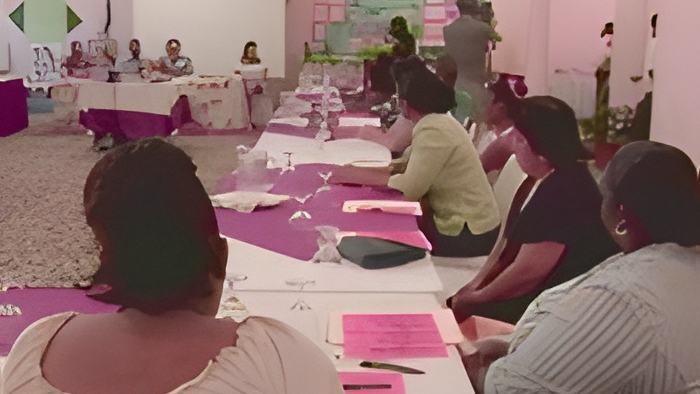
The Caribbean Center of Excellence for Teacher Training, CCETT, this morning held a professional development conference. 30 primary school teachers that are participating attended and they took time to look at the program, where it is going and how it can be improved. Alfonso Noble reports.
Alfonso Noble Reporting,
With various instructional displays illustrating new methods for teaching, reading and comprehension in primary schools, teachers from 6 schools participating in Caribbean Center of Excellence for Teacher Training pilot project showcased what students are now encountering in the classroom. CCETT's Director Rosalind Bradley says this gathering is a means of self-evaluation.
Rosalind Bradley,
"Today is really about sharing and it's the teachers taking the lead, they are on the forefront, they are sharing ideas in terms of what they're learning and things they've been doing in their classrooms and what's working and what's not working and how they're going to go from there."
And while that will be determined, based on findings so far by both the program itself and the Ministry of Education, the program is making great strides at improving the way students learn.
Maud Hyde,
"The most important progress we've seen is the enthusiasm towards reading itself. Its something that I think largely we noticed that our children were losing unless they came from an environment where books were second nature to them. It was somewhat a challenge for our teachers to get them to be interested in reading on their own and I think this program, one of the biggest success really shows that the children once more can walk into a room with lots of books, love to read, pickup a book, and try to read on their own."
Rosalind Bradley,
"We're finding out that in terms of the average results on our tests went from the range of 44% to 70%. We have some schools where the students now are averaging in reading about 70%. That has been a tremendous increase in terms of performance. We have some areas where the students are doing excellent like the areas of phonics, listening comprehension, and the areas of picture word recognition. In those areas children are doing an excellent job. We still where we are working with language, the use of language where they have to write, and also in the area of comprehension, but its improving."
Maud Hyde,
"The first group of students who have been engaged in the program will be sitting BJAT next year and I think we'll be looking at the results to see how the reading has really indicated progress in that particular test and from there we want to be able to engage other schools to be able to help schools to develop their own reading capacity to build their reading centers so that they can also use the project to stimulate other students to be able to read well and improve the whole literacy within the school."
For the University of Belize that is implementing the CCETT Project these efforts are paramount.
Dr. Corinth Morter-Lewis,
"Although reading is a part of what would be considered language arts, it affects their science, their math, their social studies, and we've found that that carries over into high school and even at the university level literacy for a lot of our students is still not what it should be and so for this is issue of reading and getting it early, if it doesn't happen by standard one, students are continually happen difficulties keeping up, catching up, and even like I said they get to the university level and we have seriously problems sometimes with their ability to perform at the level they should. If we can get our students at the level of literacy that this program is in many ways going to help in fostering, then it does a lot at our level, it makes it possible for us to take those [programs out, we don't have to put students through a summer period of improving their language and their writing skills."
The expectation now is that with students going through the CCETT program, literacy will see a marked improvement in the pilot schools. And though the project comes to a close this year, at the end, by then the best teaching methods would have been extracted for sustained implementation in primary schools.
The CCETT program has taken 6 primary school from Belize District where select classes from infants 1 and 2 and standards 1 and two are instructed using a new model of teaching developed by CCETT.