
On Friday we took you to Toledo’s annual food fair where it was a grow what you eat menu. The fair was held as a harvest of sorts for the ’GATE’ program – the Garden Based Agriculture of Toledo’s environment. It is in 6th year and since 2002 it has introduced subsistence farming to students in 30 of Toledo’s 53 schools. So along with math and English, students in Toledo are now learning and getting practical hands on training in the 123’s of farming. It’s a novel program spearheaded by Plenty Belize and when our team was in Toledo on Friday, we got a closer look at how Toledo’s primary schoolers are growing what they are eating. Keith Swift reports.
Keith Swift Reporting,
On Friday Ryan Salam took us inside his garden. For the past six months the 9-year-old has been a subsistence farmer - he has planted and been reaping fruits and vegetables - right from the back yard of his home in Punta Gorda. Daily you’ll find Ryan dutifully watering and tending to his garden.
Ryan Salam, Subsistent Farmer
“I water it in the morning evenings.”
Keith Swift,
What all is in your garden?
Ryan Salam,
“Cho cho cho, cucumber, cabbage, tomato, and beans.”
Macario Salam, Ryan’s Farmer
“Every morning he waters it. I don’t have to tell him, he knows his job in the evening.”
Ryan works under the close supervision of his father Macario Salam.
Macario Salam,
“I think it is from the roots, it is from my parents and I show him, and he shows me that interest and what is being in taught in school – he is putting in practice here. So this is the practical phase for him.”
That school is the St. Benedict’s Roman Catholic School in PG where Ryan is in standard 2. This is the school's garden – and rule number one is that whatever is grown here – is what they eat. Principal Olive Woodeye has laid down the hard line - junk foods are off limit – so instead of going to the store – her students go to the garden.
Olive Woodeye, Principal
“As soon as the plants are ready to harvest, they are the recipients of the plants. So they have a deep interest in the garden project. For us at school we do not entertain snacks that are not nutritious so we when we reap from the garden – everybody gets something from the garden and they eat it. We eat only fruits at school, they get only fruits.”
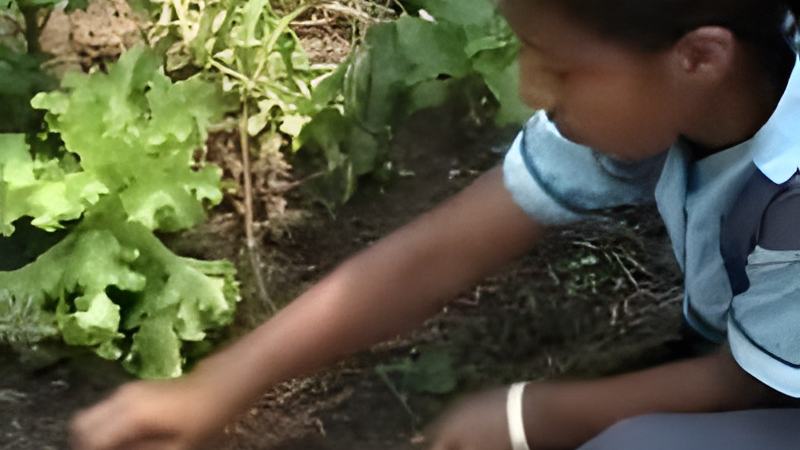
5 miles away in Forest Home Village – 13-year-old Teresita Rash is doing some farming of her own. She works alongside her father in her family’s garden - and on any given day - after school or before – this is what you’d find the standard four 4 student doing.
Teresita Rash,
“I spend like about 23 hours only because sometimes I have chores to do home.”
Keith Swift,
And when you are done with your chores?
Teresita Rash,
“Then I come in the garden and plug out some grass so they don’t grow in the garden. We clean the garden, we water garden.”
Teresita says the best part for her is the reaping – the convenience of going to her backyard for fresh fruits and veggies - as opposed to the market.
Teresita Rash,
“The best thing about having your own garden is the more you can have – you don’t have to go and buy to the shop or to the market. Sometimes some vegetables have chemicals and our garden doesn’t have chemicals.”
Keith Swift,
So if your mom is making caldo, I know they’ll need cabbage
Teresita Rash,
“You could just come to your garden and get the cabbage. They don’t need to go to shop, if they make their own garden. When the plantain ready they can take it and eat it.”
Abib Palma, Technical Officer – Plenty Belize
“We find out that at harvest time is when they decide that they like
it. When they plant cucumbers or cabbage and they are harvest – then they decide that want to plant more and so they get to like it.”
Teresita and Ryan are a part of GATE – Garden Based Agriculture for Toledo’s Environment. Plenty Belize’s Director – Mark Miller says the idea is to introduce the lost practice of subsistence farming to primary school students.
Mark Miller,
“There is a premise, a thought a lot of people have that they go to school so they don’t have to work hard. And I have gone through so many years of schools, got Master’s degree in this and that and I love getting my hands dirty. I have a garden, I have kids, I do what I can to raise my own food and going to school doesn’t mean you don’t work hard. It means you work hard but you work smart at the same time. As students get their hands dirty and they start seeing things grow and seeing success then that feeling tends to go.”
And that success was on display on Friday at Toledo’s Food Fair. These fruits and vegetables were grown by standard 3 and 4 students at Santa Teresa RC School. Abib Palma says that’s part of the plan.
Abib Palma,
“They will learn to grow up doing the practices that will become natural for them. So by just doing natural organic stuff, composting, mulching or some of the basic things that they need to learn and once they learn that, we know that growing up it will be like a habit to them and just like going and playing football it becomes a habit and you decide if you like to do it or you want to do it and eventually you get something to eat.”
Or something to sell.
Abib Palma
“For Toledo I think in the coming years we will have Toledo exporting more crops instead of importing vegetables – that will be the benefit to Toledo.”
Mark Miller,
“It allows us to eat better, it allows us to be healthier and it allows us to be ready for changes that are bound to come as this world continues to change with powers beyond our control.”
And if that is the case – then one thing is for sure – these students are planting the seeds for Toledo’s future. Reporting for 7NEWS, Keith Swift.
The program hopes to eventually expand to all schools in Toledo. The program is similar to the “REAP program – which was introduced in the 1970’s and 80s. It was similarly aimed at introducing integrating agriculture into the curriculum. For more on Plenty Belize clickhttp://www.plenty.org.